
Non-FictionHealth & WellnessExercise
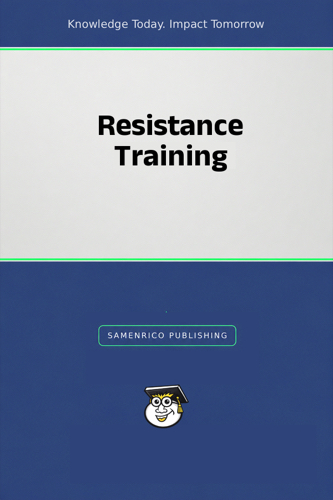
Resistance Training eBook
Teaches strength exercises for older adults.
Teaches strength exercises for older adults.
Formats
Free sample
Chapter 1: The Unfinished Ending--–- The obituary read like hundreds of others in the Sunday paper: "Passed away peacefully after a brief illness. Survived by three children and six grandchildren. Enjoyed gardening and Sunday dinners." What the obituary did not say was that the deceased had spent her last eight years in a wheelchair not because of a disease, but because she could no longer stand up from a seated position. She had not fallen. She had not suffered a stroke.
She had simply, gradually, lost the ability to rise. Her leg muscles, unused and unopposed, had atrophied to the point where they could no longer lift her own body weight against gravity. She did not die of old age. She died of sitting.That story is not hypothetical. It is a composite drawn from hundreds of geriatric case studies, nursing home records, and the private confessions of family caregivers who watched a parent or grandparent shrink from a person into a passenger.
The medical term for this phenomenon is sarcopenia, derived from the Greek words for "poverty of flesh." But poverty of flesh is not a disease in the conventional sense. You cannot catch it from a virus. You cannot inherit it like Huntington's. You cannot blame it on bad luck or bad genes. Sarcopenia is a disuse phenomenon.
It is what happens when the human body executes its ancient biological programming to shed tissue that it believes is no longer needed. And the body believes muscle is not needed when you do not use it.This chapter is not about exercise. Not yet. Before we talk about reps, sets, or the proper way to hold a dumbbell, we must first dismantle a lie that has been sold to you so thoroughly, so relentlessly, and for so many decades that you likely believe it the way you believe the sun rises in the east. The lie is this: that slowing down, weakening, shrinking, and eventually becoming dependent is a normal and inevitable part of growing older.
That frailty is just what happens after sixty-five or seventy or seventy-five. That you should expect to lose your balance, fear the bathtub, stop carrying your own groceries, and eventually need help getting out of a chair.The lie is seductive because it offers permission. Permission to stop trying. Permission to accept the rocking chair. Permission to tell yourself, "I'm just not as young as I used to be," and leave it at that.
But permission is not the same as truth. And the truth, supported by decades of peer-reviewed research, thousands of clinical trials, and the lived experience of centenarians who still squat to weed their gardens, is this: the vast majority of what we call "aging" is actually deconditioning. And deconditioning is reversible.The Hundred-Year Discovery In the 1960s, a pair of physiologists at the University of Texas Medical Branch named Dr. Robert De Busk and later Dr. Rikli (whose work would evolve into the Senior Fitness Test) began noticing something strange.
Elderly patients admitted to the hospital for minor procedures were losing muscle mass at an alarming rate—up to five percent per week of bed rest. But when those same patients were put on simple leg-strengthening protocols, they regained that muscle just as quickly. The loss, it turned out, was not a function of their age but of their inactivity. The hospital bed was the culprit, not the calendar.This discovery launched a half-century of research that has fundamentally overturned how we understand the aging body. Consider the landmark 1994 study published in the Journal of the American Medical Association, in which researchers placed nursing home residents aged seventy-two to ninety-eight on a high-intensity resistance training program.
These were not healthy, active seniors. These were frail individuals, many of whom used walkers or wheelchairs. After just eight weeks, their muscle strength had increased by an average of 174 percent. Walking speed improved by nearly fifty percent. Spontaneous physical activity—the kind of casual movement like getting up to change the television channel or walking to the bathroom without assistance—increased by thirty percent.
The researchers concluded, in characteristically understated academic prose, that "resistance training is a feasible and effective means of counteracting muscle weakness and physical frailty in very old people."What they meant, translated from scientific caution into plain English, was this: these people got better. They got stronger. They got faster. They got more independent. Not younger, no—the clock does not run backward.
But better than they were. And better than they had any right to expect based on the conventional wisdom of the time.Since that study, the evidence has accumulated into a mountain. A 2009 meta-analysis in The Cochrane Database of Systematic Reviews examined 121 trials involving more than 6,700 older adults and found that resistance training consistently improved muscle strength, functional performance (standing from a chair, climbing stairs, walking speed), and quality of life. A 2018 study in The Journal of Gerontology followed 1,600 seniors over six years and found that those who did any resistance training at least twice per week had a forty-six percent lower risk of becoming disabled in basic activities of daily living—bathing, dressing, transferring from bed to chair. Forty-six percent.
That is not a marginal improvement. That is a transformation.The Biology of the Unfinished Ending To understand why this works, you need to understand something about your muscles that your doctor may never have told you. Muscle is not passive tissue. It is not like the insulation in your attic, sitting there unchanged until it crumbles. Muscle is metabolically active, hormonally responsive, and astonishingly plastic.
Every time you contract a muscle against resistance—whether that resistance comes from a dumbbell, a resistance band, or simply your own body weight—you trigger a cascade of biological events that researchers call "mechanotransduction."Here is what happens, stripped of jargon: When a muscle fiber experiences tension, it sends a signal to the cell nucleus. That signal says, in effect, "We are being asked to work. We need to prepare for more work in the future." The nucleus responds by activating genes that produce new contractile proteins—actin and myosin, the molecular motors that make muscle shorten. These proteins are woven into the existing muscle fibers, making them thicker and stronger. At the same time, satellite cells—a type of stem cell that lives on the surface of muscle fibers—are activated.
These cells fuse with existing fibers, donating their nuclei to support even more protein synthesis. This process, called hypertrophy, is the reason a previously sedentary seventy-five-year-old can double their leg strength in three months.But the benefits go far beyond bigger muscles. Resistance training also improves what physiologists call "neural adaptation." Your brain communicates with your muscles through nerves that branch out from your spinal cord. In an untrained older adult, that communication is often slow and inefficient. The signal to "contract" travels along frayed or demyelinated pathways, arriving late and weakly.
Resistance training rebuilds that neural highway. It increases the firing rate of motor neurons, recruits more muscle fibers simultaneously, and improves the coordination between opposing muscle groups (like the quadriceps and hamstrings, which must alternately contract and relax to produce smooth movement). This…
This is the end of the free sample. Get the eBook to keep going. Buy now
About this book
Details
- Author
- Ricketts Aliza
- Publisher
- SamEnrico
- Language
- English
- Genre
- Non-Fiction, Health & Wellness, Exercise
- Released
- 2026-06-07
- Pages (approx.)
- 127
- Available as
- eBook, Audiobook

Read better in the ZLOADR app
Your eBooks on your phone or tablet. Sign in with your SamEnrico account and start reading.
More by Ricketts Aliza
 Zumba Glute Activation GuideRicketts Aliza$11.99
 Anki For Fashion DesignRicketts Aliza$11.99
 The Financial Stress and UtilitiesRicketts Aliza$11.99
 The Sober Living GuideRicketts Aliza$11.99
 Idea Implementation for BusinessRicketts Aliza$11.99
 White Sands Desert CrossingRicketts Aliza$11.99
 Managing Distractions for PhotographersRicketts Aliza$11.99
 The Quantum Cosmos: Galileo’s Telescope and the Birth of Modern AstronomyRicketts Aliza$11.99
 Shadows of the Black Prince: The Phantom Brigade of 1396Ricketts Aliza$11.99
 Velvet Bent: Agrostis GrassRicketts Aliza$11.99
 The Essential Guide to KaraokeRicketts Aliza$11.99
 How to Start a Filtration Equipment and Apparatus (wholesale) Business (Beginners Guide)Ricketts Aliza$11.99
You may also like
 Hong Kong Handover 1997Dunn Johnnie$11.99
 Zumba For Postnatal Recovery CourseNeal Christian$11.99
 Zumba for BeginnersLadner Nikia$11.99
 YouTube Comment Mining GuideHumes Pandora$12.99
 Worry Box MeditationCarlin Rudy$11.99
 Workplace Stress MeditationNguyen Lynn$11.99
 Workplace Stress and Sleep RepairHawley Ivory$11.99
 Workplace Perfectionism CureDelaney Jeffry$11.99
 Workplace Injustice Anger GuideWallen Isabelle$11.99
 Work Addiction and Burnout LinkGreenwood Ester$11.99
 Women in Yoga and WellnessBeattie Galina$11.99
 Women in Stand Up ComedyChun Evangeline$11.99