
Non-FictionSelf-HelpEngineering
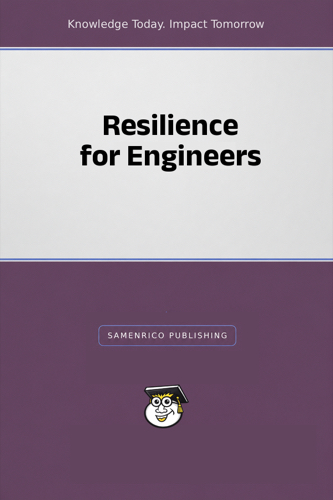
Resilience for Engineers eBook
Bounces back from design failures.
Bounces back from design failures.
Formats
Free sample
Chapter 1: The Parable of the Unbroken Bridge--–- Every engineer carries a secret. It is not a secret of fraud or malice. It is a secret of omission. You have stood on a completed structure—a bridge you designed, a control system you coded, a chemical reactor you sized—and felt the quiet terror that no one else can see. The thing works.
The calculations passed. The inspectors signed off. But you know where the weld is slightly off. You know which bolt was substituted because the specified one was backordered. You know the assumption you made about wind load because the client was rushing.
And you smile for the photograph while your stomach knots because you understand something that non-engineers cannot: the absence of failure is not evidence of resilience.This chapter opens with a confession that most engineering textbooks avoid: the most dangerous engineer in any organization is not the one who has failed often. It is the one who has never failed at all. That engineer has never pushed a design to its breaking point. Has never seen a prototype shatter on a test stand. Has never received the midnight phone call that something went wrong.
And because they have never failed, they have never learned where their assumptions are brittle. They are walking through a minefield of unknown unknowns, convinced the path is safe because they have not stepped on a mine yet.This is the Paradox of Perfection. And until you understand it, you cannot begin to build resilience.The Lie of Zero Engineering culture worships a dangerous idol: the perfect record. We celebrate projects that launched without incident. We promote engineers who have never had a recall.
We give awards for "zero lost time due to accidents." On the surface, this makes sense. Of course we want things to work. Of course we want to prevent harm. But the worship of zero creates a perverse incentive: hide your near-misses, obscure your small failures, and never, ever admit that you cut a corner.The result is what safety researchers call the "iceberg of ignorance." For every major catastrophe that makes the news, there are hundreds of minor failures that were caught in time, thousands of near-misses that were quietly fixed, and tens of thousands of small errors that were never documented at all. The engineer who reports every near-miss looks worse than the engineer who stays silent.
So silence becomes rational. And catastrophe becomes inevitable.Consider the data from high-reliability industries. Commercial aviation, which has learned more from failure than any other field, tracks every incident—not just crashes, but hard landings, runway incursions, altitude deviations. The Federal Aviation Administration receives over 100,000 incident reports per year. The vast majority involve no injuries.
But each report is a data point that prevents a future death. Contrast this with typical engineering firms, where post-project reviews are rare, failure is punished, and the only incidents that get discussed are the ones that cannot be hidden.The lie of zero is comforting but fatal. A perfect safety record is not evidence of resilience. It is often evidence of under-reporting.The Unifying Definition: What This Book Means by Resilience Before we go further, we need a shared language. The word "resilience" has been stretched to mean everything from "toughness" to "optimism" to "bouncing back quickly." In this book, we will use a single, precise definition established at the outset and maintained through every chapter:Resilience is the capacity of an engineer, a design, or an organization to absorb unexpected shocks, recover essential function, and capture learning that makes the next iteration stronger.Notice what this definition includes and excludes.
First, it requires unexpected shocks. Planning for known risks is risk management, not resilience. Resilience begins where risk registers end. Second, it requires recovery of function, not just survival. A bridge that collapses but kills no one has not demonstrated resilience; it has failed less badly than it could have.
Resilience means the bridge still carries traffic after the earthquake. Third, and most critically, resilience requires learning that makes the next iteration stronger. If you survive a failure but learn nothing, you are not resilient. You are lucky. And luck runs out.This definition ties together the psychological, technical, and organizational dimensions of the book.
Chapter 3 will explore how engineers learn to reframe failure as data. Chapters 4 through 6 will explore how technical systems can be designed to absorb shocks. Chapters 7 through 9 will explore how teams can create the psychological safety required for honest reporting. And Chapters 10 through 12 will explore how organizations can build cultures that fund intelligent failure and learn from every collapse.But the definition stands alone, right here, as the spine of the book. Every tool, every case study, every protocol that follows is an answer to the question: How do we increase our capacity to absorb, recover, and learn?Henry Petroski's Central Insight: Engineering Advances by Failure No single thinker has done more to reframe engineering failure than Henry Petroski.
In his seminal work To Engineer Is Human, Petroski made an argument that seems radical only because we have been taught the opposite. He argued that engineering does not advance by getting things right. It advances by getting things wrong and then correcting the errors.Consider the history of bridge design. The earliest stone arch bridges were massively overbuilt because engineers did not understand the forces acting on them. They succeeded through brute force, not elegant calculation.
Over centuries, engineers refined their understanding by studying bridges that collapsed. The Tay Bridge disaster of 1879, which killed 75 people when a train plunged into a Scottish river, led to new standards for wind loading. The Tacoma Narrows Bridge collapse of 1940, captured on film as "Galloping Gertie" twisted herself apart, revolutionized our understanding of aerodynamic resonance. Every standing bridge today contains the lessons of bridges that fell.Petroski's insight is humbling but liberating. The engineer who never fails has never pushed the boundaries of what is possible.
The engineer who never fails has never designed anything truly new. The engineer who never fails is, in Petroski's words, not an engineer at all—because engineering is fundamentally about operating at the edge of knowledge, where failure is always a possibility.This is not an argument for recklessness. It is an argument for intelligent risk-taking followed by rigorous learning. The difference between a catastrophic failure and an intelligent one is not whether the failure occurs. It is whether the failure is contained, whether the cost is acceptable, and whether the learning is captured.Science vs.
Engineering: Proving You Are Right vs. Admitting You Are Wrong Safely The Paradox of Perfection is reinforced by a confusion between science and engineering. Scientists seek to prove hypotheses correct. A successful experiment confirms the scientist's theory. An unsuccessful experiment is often a disappointment, a waste of grant money, a setback to publication.
The scientific method, in its popular telling, rewards confirmation.Engineering is different. An engineer's design does not need to be "proven correct" in any absolute sense. It needs to be safe enough and functional enough for a specific context. The engineer's job is not to demonstrate that failure is impossible—that would be a claim of omniscience. The…
This is the end of the free sample. Get the eBook to keep going. Buy now
About this book
Details
- Author
- Francisco Felica
- Publisher
- SamEnrico
- Language
- English
- Genre
- Non-Fiction, Self-Help, Engineering
- Released
- 2026-06-05
- Pages (approx.)
- 139
- Available as
- eBook, Audiobook

Read better in the ZLOADR app
Your eBooks on your phone or tablet. Sign in with your SamEnrico account and start reading.
More by Francisco Felica
 Living Trust for ParentsFrancisco Felica$11.99
 SAD In Men GuideFrancisco Felica$11.99
 London Insurance GuideFrancisco Felica$11.99
 Body Anchoring during PanicFrancisco Felica$11.99
 Job Change Transition GuideFrancisco Felica$11.99
 Distraction Technique GuideFrancisco Felica$11.99
 Building on Bad IdeasFrancisco Felica$11.99
 The Leviathan's Forge: How the Iron Serpent Built the First Sky-Piercing SpireFrancisco Felica$11.99
 Tina Turner: The Comeback Queen of PopFrancisco Felica$11.99
 Service Providers Guide to Export AgentsFrancisco Felica$11.99
 A Collector's Handbook to the Mathis MyFrancisco Felica$11.99
 Solicitation DisclosuresFrancisco Felica$12.99
You may also like
 Hong Kong Handover 1997Dunn Johnnie$11.99
 Zumba For Postnatal Recovery CourseNeal Christian$11.99
 Zumba for BeginnersLadner Nikia$11.99
 YouTube Comment Mining GuideHumes Pandora$12.99
 Worry Box MeditationCarlin Rudy$11.99
 Workplace Stress MeditationNguyen Lynn$11.99
 Workplace Stress and Sleep RepairHawley Ivory$11.99
 Workplace Perfectionism CureDelaney Jeffry$11.99
 Workplace Injustice Anger GuideWallen Isabelle$11.99
 Work Addiction and Burnout LinkGreenwood Ester$11.99
 Women in Yoga and WellnessBeattie Galina$11.99
 Women in Stand Up ComedyChun Evangeline$11.99