
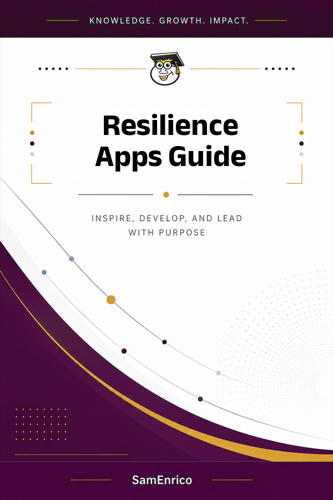
Free sample
Chapter 1: The App Audit--–- Before you download a single new tool, before you learn a single breathing technique or reframing strategy, you must first answer a deceptively simple question: What is already running on your mental device? Most people live their entire lives never once looking at the default programs installed in childhood, never questioning the background processes that drain their battery, never noticing the malware that corrupts their perception of reality. They wake up, run the same loops, feel the same frustrations, and wonder why resilience always seems to belong to someone else.This chapter is not about adding anything new. It is about subtraction. It is about opening the settings menu of your mind and taking an honest, compassionate inventory of what is there.
You cannot fix what you refuse to see. And you cannot build resilience on a foundation of unconscious habits that actively work against you.Welcome to the App Audit.The Hidden Cost of Default Programs Every mind runs on default programs. These are automatic thought patterns, emotional responses, and behavioral scripts that activate without your explicit permission. They were installed through a combination of genetics, childhood experiences, cultural messaging, and repeated life events. Some of these programs serve you well—they keep you safe, help you navigate social situations, and automate routine decisions.
But many of them are outdated, inefficient, or actively harmful.Think of your mind as a smartphone that has been running for years without a single software update. You have downloaded dozens of apps, opened thousands of tabs, and accumulated years of cached data. The phone still works, but it is slow. It crashes at the worst moments. The battery drains by noon.
And you have long forgotten which apps are essential and which are just taking up space.The first step toward genuine resilience is not learning to be tougher. It is learning to be more honest about what is already there.Consider a common default program: catastrophizing. Your boss sends an email that says, "Can we talk briefly tomorrow morning?" Within three seconds, your mind has constructed an elaborate narrative in which you are being fired, your career is over, your spouse will leave you, and you will die alone under a bridge. This entire sequence happens automatically, without your consent, and it triggers a full stress response—cortisol flooding your system, heart rate increasing, muscles tensing—all for a meeting that might simply be about a new project.That is a default program. And it is draining your battery right now.Other common default programs include rumination (replaying past mistakes on an endless loop), emotional reasoning (believing that because you feel something, it must be true), mind-reading (assuming you know what others think of you), and personalization (interpreting neutral events as targeted attacks on your worth).
Each of these programs runs in the background, consuming mental energy, distorting reality, and leaving you less capable of handling actual challenges when they arise.The tragedy is that most people never notice these programs running. They assume that their anxious thoughts are simply "how life is." They mistake the map for the territory, the program for reality. And so they live their entire lives inside a simulation built by default settings they never chose.The Unified Resilience Log: Your One Tool for Everything Before we go any further, we need to introduce the single most practical tool in this entire book. In previous versions of resilience training, readers were asked to keep multiple separate logs—a trigger log, a thought record, a boundary audit, a social network map, a control inventory. This approach is overwhelming and inefficient.
It creates paperwork fatigue long before any real change occurs.We are going to do something different.You will keep exactly one log. It is called the Unified Resilience Log (URL for short, a small joke for those who appreciate digital metaphors). This is a single document—physical notebook or digital file, your choice—that will accompany you through every chapter of this book. Each chapter will add a new column or section to the same log. By the end, you will have a complete map of your mental landscape, not a scattered collection of disconnected exercises.Here is what the Unified Resilience Log looks like in its initial form.
You will create seven columns:Date Trigger Automatic Thought Distortion Type Pause Used?Reframed Thought Action Taken Do not fill this out yet. First, you need to understand what each column means. That is what this chapter and the next three chapters will teach you.For now, just create the log. A physical notebook works beautifully—something about the act of writing slows down thinking and engages deeper processing. But a spreadsheet or document works fine as well.
The key is consistency. You will make one entry per day for the next thirty days. Each entry takes approximately two minutes. That is a tiny investment for what could be a life-changing return.The Cognitive Load Inventory: Measuring Your Mental Battery Drain Before you can audit your apps, you need to know which ones are using the most energy. This is where the Cognitive Load Inventory comes in.
Unlike the Unified Resilience Log (which you will update daily), the Cognitive Load Inventory is a one-time self-assessment that establishes your baseline.Rate each of the following statements on a scale from 1 (almost never) to 5 (almost always). Be honest. No one is grading you.I often imagine worst-case scenarios when facing uncertainty.I replay past conversations in my head, wishing I had said something different.I assume people are judging me negatively unless proven otherwise.I have difficulty saying no to requests, even when I am already overwhelmed.I re-read emails or texts multiple times before sending, worried about how they will be received.I feel responsible for other people's emotions.I have a hard time letting go of mistakes, even small ones.I compare myself unfavorably to others on social media or in real life.I need things to be "just right" before I can feel okay.I often feel exhausted even after a full night's sleep.Now add your score. If you scored above 30, your cognitive load is significantly elevated. If you scored above 40, you are running multiple energy-draining default programs simultaneously.
This is not a diagnosis or a judgment. It is simply data. You cannot change what you do not measure.The Cognitive Load Inventory is not meant to shame you. It is meant to show you that your current level of mental fatigue is not a personal failing—it is the predictable result of running inefficient software. When you upgrade your mental operating system, your energy will increase.
Not because you tried harder, but because you stopped wasting energy on programs that do not serve you.The Three Categories: Bloatware, Malware, and Essential Apps Not all default programs are created equal. To conduct a proper app audit, you need to sort your mental habits into three categories.Bloatware refers to habits that are inefficient but not actively harmful. They take up space and drain energy, but they do not fundamentally distort reality or cause significant suffering. Examples include mild procrastination, excessive list-making, re-reading emails…
This is the end of the free sample. Get the eBook to keep going. Buy now
About this book
Details
- Author
- Ferris Carmelina
- Publisher
- SamEnrico
- Language
- English
- Genre
- Non-Fiction, Self-Help / Technology
- Released
- 2026-06-07
- Pages (approx.)
- 140
- Available as
- eBook, Audiobook

Read better in the ZLOADR app
Your eBooks on your phone or tablet. Sign in with your SamEnrico account and start reading.
More by Ferris Carmelina
 Teen Social Comparison GuideFerris Carmelina$11.99
 The Stepfamily Rejection WoundFerris Carmelina$11.99
 Food Comparison on Social MediaFerris Carmelina$11.99
 Mobile Game Spending TrackerFerris Carmelina$11.99
 After Dream Processing JournalFerris Carmelina$11.99
 The Polio Vaccine HistoryFerris Carmelina$11.99
 Remote Work Imposter SyndromeFerris Carmelina$11.99
 Returning to Work After LossFerris Carmelina$11.99
 The Comeback Kid: How a High School Dropout Built a Billion-Dollar EmpireFerris Carmelina$11.99
 The Sunken Secrets of the Mary Celeste: Unraveling the Mystery of the Abandoned ShipFerris Carmelina$11.99
 The Kingmaker and the Cavalier: Oliver Cromwell's Rise in Blood and IronFerris Carmelina$11.99
 The Dancer's Guide to Rebetiko DancesFerris Carmelina$11.99
You may also like
 Parent Time Apps GuideWoodruff Shiela$11.99
 Chunking Apps GuideSingleton Ada$11.99
 Notification Management GuideYamamoto Mui$11.99
 Scripting AppsDias Codi$11.99
 Loneliness and TechnologyEdmiston Isreal$11.99
 Caregiver Technology SolutionsCone Dorcas$11.99
 Habit Apps GuideTejada Dina$11.99
 Remote Work Tool StackHolland Kathy$11.99
 Pain Meditation AppsCroteau Elin$11.99
 Gratitude for TechnologyArreola Brenna$11.99
 Virtual Memory PalacesBillingsley Fe$11.99
 Senior Technology ConfidenceGallant Tonie$11.99