
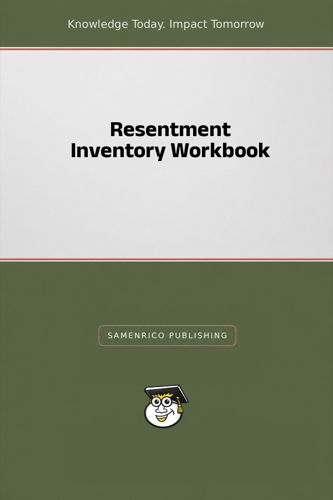
Non-FictionSelf-HelpSelf-Assessment
Resentment Inventory Workbook eBook
A systematic audit of hidden bitterness across all
A systematic audit of hidden bitterness across all life areas.
Formats
Free sample
Chapter 1: The Loop You Didn’t Choose--–- You are not angry. At least, not in the way you think. Anger is a forest fire—hot, fast, and eventually it burns out. Resentment is a landfill. It smolders underground for decades, releasing toxic gas into every relationship, every decision, every quiet moment before sleep.
You cannot see it from the surface, but you can smell it. You can feel it in your jaw when you hang up the phone. You can taste it in the back of your throat when someone says their name.This chapter is not about making you feel bad for being resentful. You have been fed a cultural lie that resentment is a moral failure—a sign that you are small, unforgiving, or weak. That lie is why you have never done anything about it.
You have been shamed into silence, and that silence has allowed the resentment to grow roots into every corner of your life.Here is the truth: resentment is not a character flaw. It is a biological process. It is your brain’s desperate attempt to protect you from future pain by keeping you vigilant against past harm. The problem is not that you resent. The problem is that you have never been taught how to audit what you resent, why you resent it, and what to do with the information once you have it.This book is that audit.
This chapter is where you stop being the victim of your own memory and become the accountant of your own emotional ledger.The Three-Layer Model Before we go any further, you need to understand how this entire book works. Resentment is not one thing. It is three things happening at once, and if you try to fix only one layer, the others will pull you back down.Layer One: The Cognitive Story. This is the narrative you replay in your mind. “They knew what they were doing.” “I would never have done that to them.” “They got away with it.” This layer lives in your prefrontal cortex—the thinking part of your brain.
Most self-help books stop here. They tell you to “reframe the story” or “choose a different interpretation.” That works for about three days. Then the story comes back.Layer Two: The Physical Posture. This is where the story lives in your body. The clenched jaw when you think about your ex.
The tight shoulders when your parent calls. The shallow breathing when a colleague gets the promotion you deserved. You cannot think your way out of a resentment stored in your muscles. This layer is the subject of Chapter 11, but you need to know it exists right now because it explains why “just letting go” has never worked for you.Layer Three: The Relational Debt. This is the unspoken expectation you believe the other person owes you.
“They owe me an apology.” “They owe me recognition.” “They owe me the life I could have had if they hadn’t done what they did.” This layer is the most practical because it gives you something to measure. A debt can be canceled. A story is harder to erase. A physical posture is harder to release. But a debt?
You can decide, right now, to stop charging interest.This book moves through these layers in order: first the mind (Chapters 1-4), then the relationships where the debt lives (Chapters 5-10), then the body (Chapter 11), and finally a daily practice that ties all three together (Chapter 12). You cannot skip a layer and expect to heal. If you only change your story, your body will betray you. If you only change your body, the unpaid debt will return. If you only cancel the debt, the story will rewrite itself.You need all three.
This chapter gives you the first tool for Layer One.What Resentment Actually Is (And What It Is Not)Let us clear the ground of false definitions. Most people use the words anger, resentment, jealousy, and envy as if they are interchangeable. They are not. And confusing them is why you have been trying to solve the wrong problem.Anger is a chemical surge. It lasts between 90 seconds and 30 minutes, depending on the trigger.
Anger has a purpose: it signals that a boundary has been crossed and mobilizes energy to restore that boundary. Anger is useful. Anger is clean. Anger ends.Resentment is what happens when anger does not end. Resentment is anger that has been reheated so many times it no longer resembles the original meal.
It is the slow, low-grade, chronic reliving of an offense. Unlike anger, which is a feeling, resentment is a story—a narrative you replay because your brain believes that rehearsing the injury will prevent it from happening again.Jealousy is the fear of losing something you have to a rival. “I am jealous that my partner is spending time with them.” Envy is the pain of not having something someone else has. “I envy their success.” Resentment is different from both. Resentment says: “They owe me something they have not paid.”You can be jealous without being resentful.
You can be envious without being resentful. But resentment always contains a claim of unpaid debt. That is its fingerprint. That is how you will learn to identify it before it becomes decades old.The Rumination Loop Here is the neuroscience that changes everything. When you experience a social injury—a betrayal, a rejection, an unfairness—your brain activates the same regions that process physical pain.
The anterior cingulate cortex and the insula light up. Being left out of a lunch invitation activates the same neural networks as being lightly burned.This is not a metaphor. Your brain literally cannot distinguish between a broken arm and a broken promise in the first milliseconds of processing.Here is where it gets interesting. After the initial injury, you have a choice. Not a conscious choice, but a neural choice.
Your brain can either let the event fade into background memory (which it does for most daily disappointments) or it can flag the event as “high priority, may happen again, must rehearse for safety.”Resentment is the second option. Your brain flags the injury and then, every time you replay it, strengthens the neural pathway. This is called rumination. Rumination is not overthinking. Overthinking is trying to solve a problem.
Rumination is playing the same tape on repeat because your brain believes that familiarity is safer than uncertainty.Think about that. Your brain would rather feel the familiar pain of an old resentment than risk the terrifying unknown of forgiveness, confrontation, or letting go. The devil you know. That is not weakness. That is evolution.
Your brain is optimized for survival, not happiness. And survival says: “That person hurt you once. If you stay angry at them, you will remember to avoid them. If you forgive them, you might get hurt again.”Your resentment is not a flaw. It is a failed protection strategy.
It is a bodyguard who has been standing at the same door for ten years, long after the threat has left the building.The Complaint Versus The Resentment Before we move to the inventory prompts…
This is the end of the free sample. Get the eBook to keep going. Buy now
About this book
Details
- Author
- Camarillo Marx
- Publisher
- SamEnrico
- Language
- English
- Genre
- Non-Fiction, Self-Help, Self-Assessment
- Released
- 2026-06-08
- Pages (approx.)
- 144
- Available as
- eBook, Audiobook

Read better in the ZLOADR app
Your eBooks on your phone or tablet. Sign in with your SamEnrico account and start reading.
More by Camarillo Marx
 TM Scientist ClarityCamarillo Marx$11.99
 Ramirez Acetone Shoe PrintCamarillo Marx$11.99
 Hip Opener RoutineCamarillo Marx$11.99
 Imposter Syndrome and AgingCamarillo Marx$11.99
 The Unseen Symphony: How a Blind Composer Changed Classical Music ForeverCamarillo Marx$11.99
 The Forgotten Flight: The Mystery of the Lost Airship ItaliaCamarillo Marx$11.99
 Operational Acceptance SpecialistCamarillo Marx$11.99
 PCT National Phase DeadlinesCamarillo Marx$12.99
 UN Human Rights CareersCamarillo Marx$12.99
 How to Start a Press (mechanical) (metal Forming) Business (Beginners Guide)Camarillo Marx$11.99
 Understanding Craniosynostosis Warman TypeCamarillo Marx$17.99
You may also like
 Hong Kong Handover 1997Dunn Johnnie$11.99
 Zumba For Postnatal Recovery CourseNeal Christian$11.99
 Zumba for BeginnersLadner Nikia$11.99
 YouTube Comment Mining GuideHumes Pandora$12.99
 Worry Box MeditationCarlin Rudy$11.99
 Workplace Stress MeditationNguyen Lynn$11.99
 Workplace Stress and Sleep RepairHawley Ivory$11.99
 Workplace Perfectionism CureDelaney Jeffry$11.99
 Workplace Injustice Anger GuideWallen Isabelle$11.99
 Work Addiction and Burnout LinkGreenwood Ester$11.99
 Women in Yoga and WellnessBeattie Galina$11.99
 Women in Stand Up ComedyChun Evangeline$11.99