
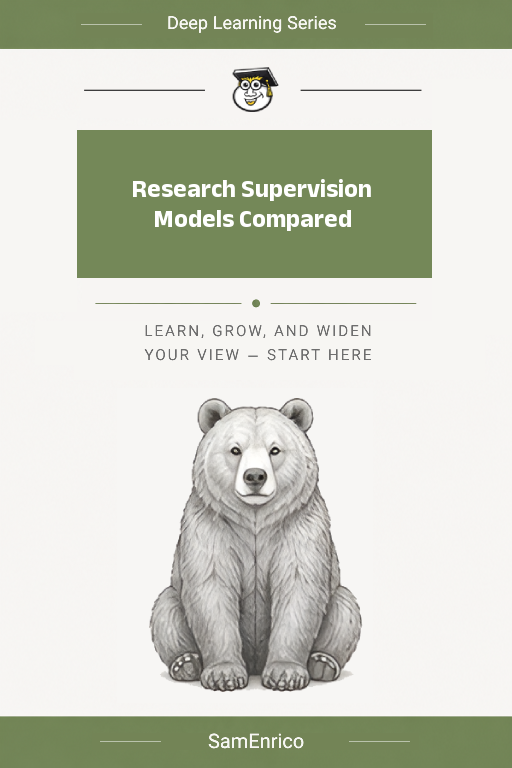
Research Supervision Models Compared eBook
Compare UK single supervisor, US committee model,
by Ponder Peg
Compare UK single supervisor, US committee model, and Australian co-supervisor systems for graduate students across all three countries.
Formats
Free sample
Chapter 1: The Hidden Curriculum--–- Every doctoral student remembers the moment the illusion shattered. For Maria, a first-generation Ph D student in biomedical engineering at a Russell Group university, it came during her sixth month. Her supervisor, a distinguished professor with thirty-two years of experience, had not responded to her last four emails. The monthly supervision meeting had been canceled three times consecutively. When she finally knocked on his door, he looked at her with genuine confusion and asked, “Remind me, what is your project about again?” Maria smiled, apologized for interrupting, walked to the nearest stairwell, and sat on the concrete floor for forty-five minutes, unsure whether to cry or withdraw from the program entirely.For James, a political science doctoral candidate at a large public university in the Midwest, the moment arrived during his dissertation committee meeting.
He had spent fourteen months collecting survey data from three countries. His chair nodded approvingly. But the outside member from sociology leaned forward and said, “Your methodological framework is twenty years out of date. You need to redo this entire analysis using Bayesian hierarchical modeling.” The second internal member added, “And your theoretical grounding in rational choice is fundamentally incompatible with the critical realist position you claim in chapter two.” James looked at his chair, who shrugged apologetically. No one had told him that his committee members had not spoken to each other in six years.For Priya, an international student in environmental science at an Australian Group of Eight university, the moment came when her principal supervisor announced a two-year secondment to a government agency.
“But don’t worry,” he said cheerfully, “you have a co-supervisor.” Priya had met her co-supervisor once, for fifteen minutes, during orientation. The co-supervisor was a specialist in hydrology; Priya’s project was on atmospheric chemistry. She spent the next three months sending emails into a void before discovering, through a fellow student, that her university’s candidature agreement contained a clause she had never read: the “ten-day rule” required formal substitute supervision within ten business days of any principal supervisor absence. No one had told her. No one had enforced it.
The rule existed only on paper.Three students. Three countries. Three supervisory models. One common experience: the hidden curriculum had swallowed them whole.The Great Misdiagnosis of Doctoral Failure For decades, universities and funding bodies have explained doctoral attrition—consistently estimated at 40-50 percent across OECD countries—through a familiar set of narratives. Students fail because they lack intellectual ability.
They fail because their research design was flawed. They fail because they could not manage their time. They fail because they were not sufficiently resilient. In other words, universities have systematically pathologized the student while exonerating the system.This chapter argues the opposite: most doctoral students do not fail because of who they are or what they lack. They fail because of a fundamental misalignment between their expectations and the actual operational logic of the supervisory model they have entered.
They fail because no one taught them the hidden curriculum—the unwritten rules about power, communication, feedback, and conflict that determine success or failure in any doctoral program. And most critically, they fail because the structural design of the supervisory model itself—whether UK single supervisor, US committee, or Australian co-supervisory panel—systematically shapes the likelihood of completion, the quality of the experience, and the mental health of the candidate.This book is built on a deceptively simple premise: the question “which supervisory model is best” is fundamentally the wrong question. The right question is “which supervisory model best fits this student’s needs, this discipline’s conventions, and this institution’s culture?” Effectiveness is not determined by any model’s inherent superiority but by the alignment—or misalignment—between structural design and individual circumstance.Before we can answer that question, however, we must first understand the terrain. We must understand what doctoral supervision actually is (as opposed to what universities claim it is). We must understand how the hidden curriculum operates across different national systems.
And we must establish the empirical baseline against which any comparative judgment must be made.Defining the Doctoral Supervision Relationship At its most basic level, doctoral supervision is the process by which an experienced researcher guides a novice through the creation of original knowledge. But this definition, while accurate, is as useful as defining marriage as a legal contract between two people. It captures nothing of the lived experience.Doctoral supervision is, in practice, a relationship of radical asymmetry. The supervisor holds formal authority over milestone approvals, funding recommendations, letters of recommendation, and—ultimately—the decision to permit submission. The student holds virtually no formal authority at all.
This asymmetry is structural and intentional; it reflects the apprenticeship model that has dominated doctoral education since its medieval origins in European universities. But asymmetry without explicit governance becomes vulnerability.Drawing on decades of higher education research, this book proposes a fundamental distinction that will recur throughout these chapters: the difference between the Supervisory Alliance and the Supervisory Contract.The Supervisory Alliance is a collaborative, trust-based relationship characterized by mutual respect, transparent communication, shared goals, and emotional attunement. In an alliance model, the supervisor views the student as a junior colleague in training, not as an assistant or subordinate. Meetings are characterized by genuine dialogue. Feedback is constructive and developmental.
Conflict, when it arises, is addressed directly and resolved collaboratively. The alliance model produces the best outcomes—higher completion rates, shorter time-to-degree, more publications, better post-Ph D employment, and stronger mental health—but it is fragile. It depends almost entirely on the interpersonal skills and goodwill of the supervisor. It cannot be mandated by policy.The Supervisory Contract, by contrast, is a transactional, compliance-driven arrangement centered on milestone completion. In a contract model, the supervisor views the student as a trainee who must meet specified requirements by specified deadlines.
Meetings focus on progress checking rather than intellectual development. Feedback is evaluative rather than developmental (“this section is insufficient” rather than “here is how you might strengthen this argument”). The contract model is reliable in the sense that it produces predictable outcomes for average students, but it systematically fails to support struggling students or to challenge excellent students. It is also the default model in most universities, because it requires minimal emotional labor from supervisors and provides clear documentation for audit purposes.Here is the uncomfortable truth that no university handbook will tell you: most doctoral supervision relationships begin as aspirational alliances and degenerate into contractual minimalism within eighteen months. The reasons are structural.
Supervisors are overworked, under-recognized, and rarely trained in mentorship. Students are anxious, financially precarious, and terrified of appearing incompetent. The result is a slow erosion of trust, replaced by bureaucratic compliance.The three national models examined in this book—UK single supervisor, US committee, and Australian co-supervisory panel—each attempt to solve this problem through structural design. The UK model bets on intensity: a single deep relationship that, when functional, produces transformative mentorship. The US model bets on distribution: multiple perspectives that, when aligned, produce rigorous quality control.
The Australian model bets on redundancy: structural backups that, when activated, produce continuity and resilience. Each model embodies a theory…
This is the end of the free sample. Get the eBook to keep going. Buy now
About this book
Details
- Author
- Ponder Peg
- Publisher
- SamEnrico
- Language
- English
- Genre
- research, Student's Shortcut
- Released
- 2026-06-01
- Pages (approx.)
- 156
- Available as
- eBook, Audiobook

Read better in the ZLOADR app
Your eBooks on your phone or tablet. Sign in with your SamEnrico account and start reading.
More by Ponder Peg
 Community Service PurposePonder Peg$11.99
 Team Charter CreationPonder Peg$11.99
 Design Thinking for EvaluationPonder Peg$11.99
 Teresas Laughter at the DevilPonder Peg$11.99
 NVC Cheat Sheet GuidePonder Peg$11.99
 Security Guard Shift SleepPonder Peg$11.99
 Parent Evening Wind DownPonder Peg$11.99
 COPD and Smoking Cessation HandbookPonder Peg$11.99
 The Rune Carver's Curse: Secrets of the Viking KingsPonder Peg$11.99
 The Kabaddi Kings of the 19th Century: How a Village Game Became a Global PhenomenonPonder Peg$11.99
 Service Providers Guide to Intensive CarePonder Peg$11.99
 How to Produce Toy FootballsPonder Peg$11.99
You may also like
 Harvard Extension School Research OpportunitiesSykes Olimpia$11.99
 Translational Research Potential Without PubsGibbs Wm$12.99
 Research Replication Projects Without PubsMilam Susanna$12.99
 Research Proposal That Hides No PublicationsPatel Maisha$12.99
 Research Proposal Scoring RubricOsullivan Mammie$12.99
 Research Proposal Sample AnalysisJasper Faustino$12.99
 Research Proposal Revision Strategies ManualWhiting Mavis$12.99
 Research Proposal Revision ProcessWhalen Dayna$12.99
 Research Proposal Problem Statement ManualRunyon Aja$12.99
 Research Proposal Peer Review Process GuideTurnbull Almeda$12.99
 Research Proposal Peer Review GuideCullen Danyel$12.99
 Research Proposal Participatory Design GuidePlace Cathi$12.99