
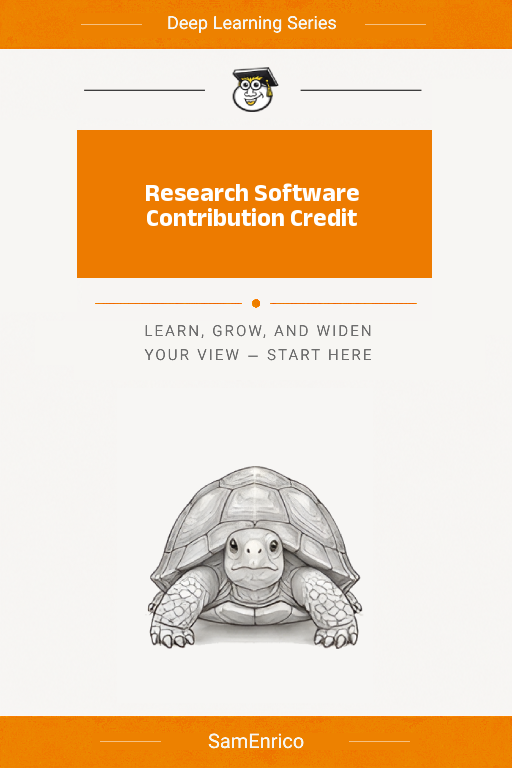
researchStudent's ShortcutOpen Source
Research Software Contribution Credit eBook
Contribute to open source research software to dem
Contribute to open source research software to demonstrate technical research skills.
Formats
Free sample
Chapter 1: The Invisible Labor--–- The first time Elena presented her simulation framework at a computational biology conference, she was proud. For eighteen months, she had designed, debugged, documented, and maintained a Python library that modeled protein folding dynamics. The library had been downloaded over two thousand times. Three labs had emailed her saying they could not have completed their research without it. When the senior professor from a prestigious university approached her after her talk, Elena expected a question about her methods.
Instead, the professor shook her hand and said, "Wonderful work. Who wrote your code?"The question landed like a slap. Elena had written the code. Every line. But in the professor's mental model, the person who designs the research (the professor) and the person who executes the research by writing software (the technician) were separate species.
Elena was a Ph D candidate, third year, first author on two papers that used her software, but not a single citation had ever pointed to her code repository. Her name appeared in acknowledgements sections—"we thank Elena for technical assistance"—while the graduate student who ran the pre-existing software package received co-authorship.Elena's story is not exceptional. It is the rule. This chapter diagnoses the systemic problem that the rest of this book exists to solve: research software contributors are the invisible workforce of modern science, and unless you actively, strategically, and persistently seek credit, your technical research skills will remain uncounted, uncited, and unrewarded.The Structural Invisibility of Software in Academia The academic reward system was designed for a world before code. Tenure, promotion, grant funding, and reputation have historically been tied to three artifacts: peer-reviewed papers, invited talks, and teaching evaluations.
Software—even software that enables entire fields of research—fits none of these categories neatly. A paper sits in a journal with a DOI, a volume number, and a page range. A code repository sits on Git Hub with a README, a license, and perhaps a Zenodo badge. The former is legible to hiring committees. The latter is often treated as "supplementary material" at best.Consider the data.
A 2016 study in Peer J Computer Science surveyed over 1,000 researchers and found that while 95% of them used software in their research, fewer than 20% had ever received formal credit (authorship or citation) for software they wrote. A 2019 report from the UK's Software Sustainability Institute estimated that research software engineers (RSEs)—people whose primary contribution is code—contribute to over 90% of research projects but appear as authors on less than 30% of resulting papers. This gap between contribution and credit is not accidental. It is structural.The structure operates through several mechanisms. First, authorship norms in most disciplines still privilege the person who writes the paper over the person who writes the code.
The "intellectual driver" is assumed to be the person who conceived the question, not the person who built the tool to answer it. Second, citation practices for software are underdeveloped. Most researchers do not know how to cite code, and even when they do, journals often strip software citations from reference lists because they are not indexed in traditional databases. Third, evaluation criteria for hiring and promotion rarely ask for evidence of software contribution. A candidate can list "maintained X package with Y contributors and Z citations," but a search committee trained to count first-author papers may not know what to do with that information.The Underground Contributor: A Portrait of Exploitation The "underground contributor" is a recurring character in every research lab that builds software.
She is the postdoc who spends six months debugging a simulation framework only to be relegated to the acknowledgements. He is the research software engineer hired on a soft-money contract who builds the entire data pipeline for a longitudinal study and watches the PI give co-authorship to a collaborator who contributed two paragraphs of discussion. They are the Ph D students who write the code that becomes the method section of a Nature paper but whose names appear seventh in a list of twelve, preceded by lab managers and undergraduate volunteers.This pattern is so common that it has acquired a name in the RSE community: the invisible contributor syndrome. It has three predictable stages.Stage One: Enthusiasm. The early-career researcher is excited to apply their coding skills to a meaningful scientific problem.
They volunteer to build a tool, design a workflow, or refactor legacy code. The PI expresses gratitude and promises authorship on "the paper that comes out of this."Stage Two: Ambiguity. Months pass. The tool works. Papers are written.
The PI begins to write the author list without consulting the contributor. The contributor assumes their role will be recognized. The PI assumes that "technical assistance" belongs in the acknowledgements. No explicit conversation occurs. This ambiguity is the breeding ground of exploitation.Stage Three: Resignation.
The paper is published. The contributor reads the acknowledgements section and finds their name under "We thank..." They feel angry, then tired, then cynical. They decide that "this is just how academia works." They stop investing in software quality because why invest in something that does not count? The research ecosystem loses a skilled contributor, and the cycle repeats with the next enthusiastic student.This book exists to break that cycle. The first step is recognizing that the cycle is not inevitable.
It is maintained by silence, by vague norms, and by the mistaken belief that credit for software is a "nice to have" rather than a fundamental requirement for a functional research system.AI as a Catalyst: Why the Problem Is Getting Worse Before It Gets Better If the credit problem were merely a matter of academic tradition, it might slowly improve as younger, more computationally literate generations rise through the ranks. But a new factor has entered the equation, and it is accelerating the crisis: generative AI.Large language models (LLMs) can now generate working code from natural language prompts. A researcher who cannot write Python can ask Chat GPT to produce a data visualization script. A lab with no dedicated RSE can generate boilerplate for a simulation framework. On its face, this seems like democratization.
But it also creates a dangerous new justification for denying credit: "Why should we add you as an author? An AI could have written that code."The threat is real, but the correct response is not panic. It is clarity about what actually constitutes human value in research software. An LLM can generate a function that sorts a list or fits a linear regression. An LLM cannot:Identify which research question is worth answering in the first place Design an architecture that balances computational efficiency with maintainability over a five-year horizon Make trade-offs between speed, memory, and readability based on the specific needs of a scientific community Write documentation that anticipates the misunderstandings of a novice user Respond to a bug report at 10 PM on a Sunday because a collaborator's grant deadline is Monday morning Decide when to refactor legacy code versus when to leave it working but ugly Navigate the social dynamics of an open-source community, mediating between feature requests from competing labs Preserve the reproducibility of a ten-year-old analysis when dependencies have changed across three major versions…
This is the end of the free sample. Get the eBook to keep going. Buy now
About this book
Details
- Author
- Eastman Jennette
- Publisher
- SamEnrico
- Language
- English
- Genre
- research, Student's Shortcut, Open Source
- Released
- 2026-05-30
- Pages (approx.)
- 129
- Available as
- eBook, Audiobook

Read better in the ZLOADR app
Your eBooks on your phone or tablet. Sign in with your SamEnrico account and start reading.
More by Eastman Jennette
 Drug Dependency and Abscess CareEastman Jennette$11.99
 Nobel Economics Laureates GuideEastman Jennette$11.99
 The Nobel Chemistry PolymersEastman Jennette$11.99
 Affirmations for Chronic IllnessEastman Jennette$11.99
 Ankle Locking and TensionEastman Jennette$11.99
 Rocky Mountain VanishedEastman Jennette$11.99
 Meditation For Busy PeopleEastman Jennette$11.99
 Finance Master GuideEastman Jennette$11.99
 The Twitter Files: Inside the Secrets of Elon Musk's TakeoverEastman Jennette$11.99
 The Master Craftsmen: How Stradivarius Violins Defied Time and ScienceEastman Jennette$11.99
 Anansi Weaves the World: The Spider’s Infinite SchemesEastman Jennette$11.99
 Foundations of Data Science and Machine LearningEastman Jennette$11.99
You may also like
 Scientific Research On TM GuideMartens Nathanial$11.99
 Research Proposal Methodology Section MasteryPauley Debroah$11.99
 Research Proposal Appendix CompilationRaines Tyisha$11.99
 Academic Researcher Distraction GuideFord Virgil$11.99
 TM Research and ScienceCovert Nicki$11.99
 Social Anxiety Research ReviewRoberge Cole$11.99
 Research Proposal Significance Section GuideBock Tory$12.99
 Research Proposal Reviewer PsychologyLugo Tawanda$11.99
 Research Proposal Research Questions DesignLara Robbi$11.99
 Research Proposal References and CitationsPatten Shanice$11.99
 Research Proposal Mixed Methods DesignCameron Omega$11.99
 Research Proposal Data Management PlanAnderson Roberto$12.99