
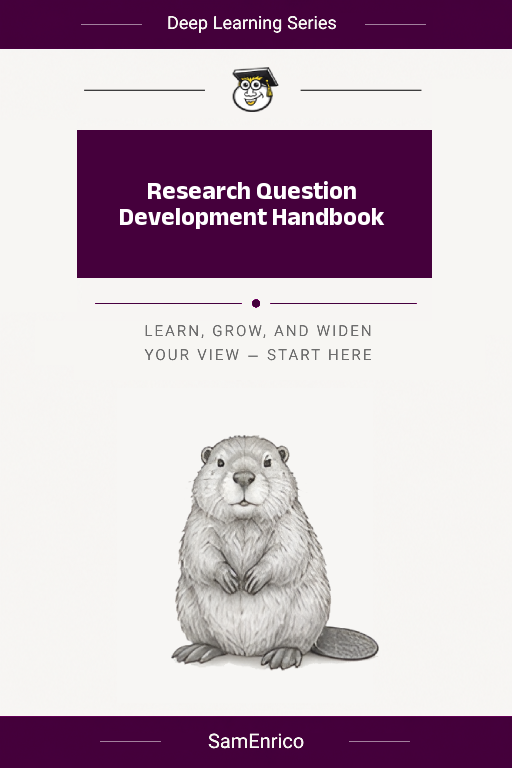
Research Question Development Handbook eBook
Craft focused answerable research questions that d
Craft focused answerable research questions that drive your entire proposal narrative forward.
Formats
Free sample
Chapter 1: The Question Wreck--Every thesis advisor has a graveyard. It is not a physical place, but a mental archive of proposals that never should have been written. In this archive live the students who spent months polishing title pages, formatting margins, and compiling bibliographies—but who could not answer the simplest, most devastating question in all of research: “So what?”If you are reading this book, you are likely standing at the edge of that graveyard yourself. You have a topic. Maybe several topics.
You have a vague sense that you should be studying something. You have a deadline approaching. And somewhere in the back of your mind, a quiet voice is whispering: “What if my question isn’t actually a question at all?”That voice is correct to be worried.This chapter exists to save you from the most common, most painful, and most preventable disaster in academic research: spending weeks or months developing a proposal around a topic that was never actually a problem worth solving. We call this disaster The Question Wreck—and by the end of this chapter, you will know exactly how to identify whether you are headed for one, and exactly how to steer yourself back to safety.The Graveyard of Vague Interests Let us begin with a truth that most research methods books are too polite to say aloud: Most failed proposals do not fail because of bad grammar, weak statistics, or poor writing. They fail because the question at their center was never a real question at all.What do we mean by this?
Consider the following statements, each of which a real student has submitted as a “research question” in a proposal draft:“What are the effects of social media on mental health?”“How does remote work affect employee productivity?”“Why do some students succeed in college while others struggle?”“What is the relationship between leadership style and organizational culture?”On the surface, these look like questions. They end with question marks. They contain subjects and verbs. They seem to inquire about something unknown. But watch what happens when we apply the simplest test in all of research—the test that separates a genuine research question from a vague interest.Ask: “So what?”Student: “What are the effects of social media on mental health?”Advisor: “So what?”Student: “Well, we need to know.”Advisor: “So what?”Student: “Because social media is everywhere.”Advisor: “So what?”Student: “……”The conversation dies.
The question has no spine. It has no cost attached to it. It names a phenomenon but no consequence. It is, in the technical language of this book, a topic masquerading as a problem.Here is the distinction that will save your research career: a topic is a subject area. A problem is a consequence that matters.
Topics are nouns. Problems are predicaments. Topics say “I am interested in X.” Problems say “If we do not understand X, then Y will continue to cost Z.”Let us be concrete. The student who asked about social media and mental health had a topic. The student who asks *“How does exposure to algorithmically curated video content on Tik Tok between the hours of 9 PM and midnight affect self-reported sleep quality and next-day academic concentration among first-year college students at residential universities?”* has a problem.
The difference is not just length or specificity. The difference is that the second question names a specific cost (poor sleep, reduced concentration) attached to a specific population (first-year college students) in a specific context (nighttime Tik Tok use). If that question goes unanswered, something bad continues to happen. That is a problem.The first question names nothing. It floats in a void of vague concern.
It is the research equivalent of saying “I wonder about things.”The So What? Cascade: Your First Diagnostic Tool If the distinction between topic and problem is the most important conceptual move in this book, the So What? Cascade is the most important practical tool. It is simple, brutal, and effective.Here is how it works. Write down your proposed research question.
Then ask yourself “So what?” Write down the answer. Then ask “So what?” again. Repeat. By the third or fourth iteration, one of two things will happen: you will hit a genuine cost—something financial, human, environmental, or theoretical that will continue to worsen if your question goes unanswered—or you will realize that your question is fundamentally trivial and you need to start over.Let us see the Cascade in action with a weak question and a strong question.Weak Question: “What are the effects of remote work on employee productivity?”So what? “We need to understand remote work because it is common now.”So what?
“If we understand it, companies might manage it better.”So what? “Better management might improve productivity.”So what? “Improved productivity might increase profits or reduce burnout.” (Finally, a cost! But it took four iterations to get there—and notice how vague the cost still is. “Might” is doing a lot of work.)Strong Question: “How does the shift to remote work affect the frequency and quality of informal mentoring interactions among junior and senior software engineers at mid-sized technology firms, and what strategies do senior engineers report using to maintain these relationships?”So what?
“If informal mentoring declines, junior engineers may receive less tacit knowledge about codebases and team norms.”So what? “Without that tacit knowledge, junior engineers take longer to reach full productivity, increasing onboarding costs and decreasing team cohesion.”So what? “Increased onboarding costs and decreased cohesion could reduce the firm’s ability to scale effectively, potentially affecting retention and innovation.”Notice the difference. The strong question names a specific population (junior and senior software engineers), a specific context (mid-sized tech firms), a specific mechanism (informal mentoring), and a specific set of costs (longer onboarding, lower cohesion, reduced retention). The Cascade hits a genuine, articulable cost by the second iteration.
The weak question is still swimming in vague possibility at the fourth.The rule is simple: If you cannot articulate a real-world or scholarly cost to leaving your question unanswered by the third “So what?,” you do not have a research question. You have a topic. Return to the drawing board.The Three Levels of Inquiry: Topic, Problem, Question To help you diagnose where your current thinking lives on the spectrum from vague to precise, this chapter introduces a framework that will recur throughout the book: the Three Levels of Inquiry.Level 1: The Topic. A subject area. A noun.
An arena of interest. Examples: social media, remote work, climate change, adolescent anxiety, organizational culture. Topics are where researchers start, but they are never where researchers stay. A topic alone cannot drive a proposal because a topic has no direction. It is a field, not a path.Level 2: The Problem.
A consequence that matters. A cost that is currently being paid and will continue to be paid unless something changes. Problems answer the question “So what?” with a specific, verifiable outcome. Examples: “Remote work is increasing burnout among mid-level managers,” “Current anxiety screenings miss forty percent of adolescent cases,” “Informal mentoring relationships are declining in remote settings.” Problems are the engine of research. Without…
This is the end of the free sample. Get the eBook to keep going. Buy now
About this book
Details
- Author
- Bourque Jolyn
- Publisher
- SamEnrico
- Language
- English
- Genre
- research, Student's Shortcut
- Released
- 2026-05-30
- Pages (approx.)
- 152
- Available as
- eBook, Audiobook

Read better in the ZLOADR app
Your eBooks on your phone or tablet. Sign in with your SamEnrico account and start reading.
More by Bourque Jolyn
 The 48 Hour JumpstartBourque Jolyn$11.99
 Pain Meditation MistakesBourque Jolyn$11.99
 Boundary Setting For ExecutivesBourque Jolyn$11.99
 Napping for Night OwlsBourque Jolyn$11.99
 Small Talk for Book ClubsBourque Jolyn$11.99
 Zumba for KidsBourque Jolyn$11.99
 Alibaba Counterfeit DetectionBourque Jolyn$11.99
 Lithium Treatment GuideBourque Jolyn$11.99
 The Silk Road Heist: How a Textile Artist Smuggled Forbidden Fabrics to FreedomBourque Jolyn$11.99
 Child Loss And Social WithdrawalBourque Jolyn$11.99
 The Timbuktu Tally Masters: Counting the Stars and Gold of MaliBourque Jolyn$11.99
 The Collapse of Wirecard: How a Fintech Empire Evaporated OvernightBourque Jolyn$11.99
You may also like
 Harvard Extension School Research OpportunitiesSykes Olimpia$11.99
 Translational Research Potential Without PubsGibbs Wm$12.99
 Research Supervision Models ComparedPonder Peg$12.99
 Research Replication Projects Without PubsMilam Susanna$12.99
 Research Proposal That Hides No PublicationsPatel Maisha$12.99
 Research Proposal Scoring RubricOsullivan Mammie$12.99
 Research Proposal Sample AnalysisJasper Faustino$12.99
 Research Proposal Revision Strategies ManualWhiting Mavis$12.99
 Research Proposal Revision ProcessWhalen Dayna$12.99
 Research Proposal Problem Statement ManualRunyon Aja$12.99
 Research Proposal Peer Review Process GuideTurnbull Almeda$12.99
 Research Proposal Peer Review GuideCullen Danyel$12.99