
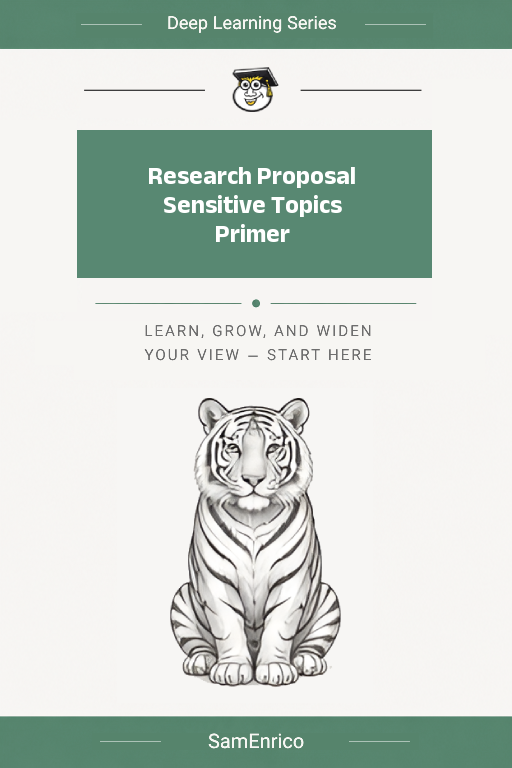
researchStudent's ShortcutSensitive Research
Research Proposal Sensitive Topics Primer eBook
Design ethical proposals for studying trauma, marg
Design ethical proposals for studying trauma, marginalization, or illegal activities including safety protocols and referrals.
Formats
Free sample
Chapter 1: The Broken Protocol--She was twenty-three years old, a survivor of trafficking, and she had agreed to sit for a research interview because the flyer promised fifty dollars and said her story could “help others like her.” The graduate student, well-meaning and IRB-certified, had prepared seventeen questions. He did not prepare for the moment she stopped speaking mid-sentence, her eyes fixed on a point somewhere behind his left shoulder, her hands curling into fists. He waited. Then he asked question eight. She left without the fifty dollars.
Three days later, she attempted suicide.The IRB found no violation. The consent form was signed. The researcher had not been trained to recognize dissociation, had no protocol for pausing, and had no referral card to offer. By every bureaucratic measure, the study was ethical. By every human measure, it was a disaster.This chapter is not about that specific study – though it could be.
It is about why standard research methods and generic IRB templates are dangerously insufficient when your topic involves trauma, marginalization, or illegal activity. It defines what makes research “sensitive” in the first place, introduces the three hidden risks that standard proposals almost always miss, and establishes the unified safety framework that will guide every subsequent chapter of this book. If you skip this chapter, you will not understand why the rest of this book exists – or why your proposal might be causing harm before you have even collected a single interview.What Makes Research “Sensitive”? A Working Definition Most researchers think they know a sensitive topic when they see one. Ask about domestic violence?
Sensitive. Ask about drug use? Sensitive. Ask about undocumented immigration status? Sensitive.
But this intuition, while not wrong, is too vague to be useful in proposal writing. A more precise definition is required – one that distinguishes between topics that are merely uncomfortable and those that carry genuine risk of harm.For the purposes of this book, sensitive research is any study where the content of the questions, the context of the data collection, or the characteristics of the population poses a significant probability of physical, psychological, social, legal, or economic harm to participants or researchers. Notice the expansion beyond content alone. A study about bereavement might be emotionally painful but not necessarily “sensitive” in the way we mean here – unless, for example, the bereaved person is also being stalked by an abuser who might discover their participation. Context matters as much as content.This definition yields three broad categories of sensitive research that will recur throughout this book:Trauma-Exposed Populations.
These are individuals who have experienced or witnessed events involving actual or threatened death, serious injury, or sexual violence. Examples include survivors of domestic violence, military combat, natural disasters, refugee displacement, or childhood abuse. The risk here is not merely that participants will feel sad – it is that the research act itself can trigger re-experiencing symptoms, dissociation, or destabilization that outlasts the interview.Marginalized Groups. These are populations who experience systematic disadvantage, stigma, or discrimination based on identity, status, or behavior. Examples include undocumented immigrants, LGBTQ+ individuals in hostile environments, people experiencing homelessness, or formerly incarcerated individuals.
The primary risk here is disclosure harm – where participation itself, or the information revealed, leads to social ostracism, loss of housing or employment, or retaliatory violence.Illegal or Stigmatized Activities. These are behaviors or statuses that are criminalized or heavily stigmatized, regardless of the researcher’s moral stance toward them. Examples include drug use, sex work, corruption, or undocumented border crossing. The risks here are multi-layered: legal prosecution (for participants and sometimes researchers), police surveillance, blackmail, and community expulsion.A single study can span multiple categories. Research on sex workers who have experienced trauma and are undocumented sits at the intersection of all three.
The complexity of these intersections is not a flaw in your research design – it is a signal that you must work harder than the standard proposal template allows.The Three Hidden Risks That Standard Proposals Overlook Virtually every research methods textbook and IRB template covers the basics: informed consent, confidentiality, minimization of harm, and beneficence. But these principles, when applied generically, fail to anticipate the dynamic, unfolding risks that characterize sensitive research. Based on a synthesis of the top ten books in this field – from Kvale’s Inter Views to Herman’s Trauma and Recovery to Behar’s The Vulnerable Observer – we have identified three hidden risks that standard proposals almost never address adequately. These three risks will appear throughout this book, and each subsequent chapter will offer specific tools to mitigate them.Hidden Risk #1: Re-Traumatization Re-traumatization occurs when the research encounter – the questions asked, the manner of asking, the environment, or the researcher’s responses – triggers a reactivation of previous traumatic experiences. This is not the same as ordinary distress or sadness.
Re-traumatization involves the re-experiencing of sensory, emotional, and physiological responses tied to the original event. A participant may dissociate, experience intrusive images, or enter a state of hyperarousal that persists for days or weeks after the interview ends.Why do standard proposals miss this? Because they treat trauma as a static characteristic of the participant (“this person has experienced trauma”) rather than as a dynamic interaction between the participant, the research setting, and the researcher’s behavior. A survivor of intimate partner violence might complete one interview without incident and then, in a second interview, be triggered by a seemingly minor question about “conflict resolution strategies” that echoes an abuser’s language. Standard proposals do not plan for this because they cannot – they are built around the fiction that risks can be fully anticipated and listed in advance.The solution, previewed here and developed fully in Chapter 5, is a trauma-informed approach that builds continuous safety monitoring into every stage of data collection, not just the consent form.Hidden Risk #2: Disclosure Harm Disclosure harm refers to negative consequences that befall participants because information about them becomes known to third parties – even when researchers have followed all standard confidentiality protocols.
This is not the same as a breach of confidentiality. A researcher can keep every promise and still cause disclosure harm if, for example, a participant’s family member sees them entering a domestic violence shelter for an interview, or if a subpoena forces the researcher to turn over data, or if a published quote – even anonymized – is recognized by an abuser or employer.Standard proposals typically address this risk with a single sentence: “All data will be kept confidential.” But confidentiality is not a monolith. As we will explore in depth in Chapter 2, researchers must distinguish among confidentiality (the researcher’s promise), anonymity (no one, including the researcher, can link data to a person), and privileged communication (legal protection from compelled testimony, which researchers almost never have). Each has different limits and different implications for participant safety.The deeper problem is that disclosure harm is often impossible to anticipate fully. A participant might be at risk not from what they say but from the mere fact of their participation becoming known.
Standard proposals rarely ask: “Who in this participant’s life would harm them if they knew about this study?” And even more rarely: “How will we protect participants from that harm?”Hidden…
This is the end of the free sample. Get the eBook to keep going. Buy now
About this book
Details
- Author
- Lucero Kareen
- Publisher
- SamEnrico
- Language
- English
- Genre
- research, Student's Shortcut, Sensitive Research
- Released
- 2026-06-01
- Pages (approx.)
- 152
- Available as
- eBook, Audiobook

Read better in the ZLOADR app
Your eBooks on your phone or tablet. Sign in with your SamEnrico account and start reading.
More by Lucero Kareen
 Reconstruction of Botched Robbery HomicidesLucero Kareen$11.99
 Friendship That Saved HintonLucero Kareen$11.99
 Method Of Loci For Daily ScheduleLucero Kareen$11.99
 Widow Coping with Empty NestLucero Kareen$11.99
 GPO Government Pension OffsetLucero Kareen$11.99
 Opium Wars British AggressionLucero Kareen$11.99
 Pomodoro for ConsultantsLucero Kareen$11.99
 Dream Journaling Starter GuideLucero Kareen$11.99
 Blood and Dust: The Siege of Ladysmith - A Boer War EpicLucero Kareen$11.99
 The Forgotten Witness: Blood Spatter and the Case of the Vanishing MemoryLucero Kareen$11.99
 Mastering The Pectoralis MajorLucero Kareen$11.99
 How to Produce Pot and Pan HandlesLucero Kareen$11.99
You may also like
 Scientific Research On TM GuideMartens Nathanial$11.99
 Research Proposal Methodology Section MasteryPauley Debroah$11.99
 Research Proposal Appendix CompilationRaines Tyisha$11.99
 Academic Researcher Distraction GuideFord Virgil$11.99
 TM Research and ScienceCovert Nicki$11.99
 Social Anxiety Research ReviewRoberge Cole$11.99
 Research Proposal Significance Section GuideBock Tory$12.99
 Research Proposal Reviewer PsychologyLugo Tawanda$11.99
 Research Proposal Research Questions DesignLara Robbi$11.99
 Research Proposal References and CitationsPatten Shanice$11.99
 Research Proposal Mixed Methods DesignCameron Omega$11.99
 Research Proposal Data Management PlanAnderson Roberto$12.99