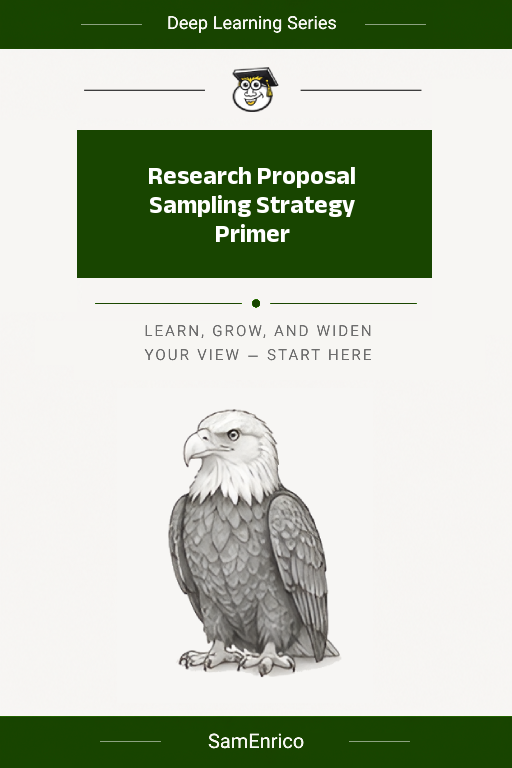
Research Proposal Sampling Strategy Primer Audiobook
Justify participant selection, sample sizes, and r
Justify participant selection, sample sizes, and recruitment methods that align with your research questions and resources.
Formats
Free sample
Chapter 1: The Alignment Principle--When you sit down to write the sampling section of your research proposal, your brain will do something predictable and unhelpful. It will reach for the easiest possible sentence: “I will recruit 30 participants.” Or 50. Or 100. It does not matter which number – what matters is where that number came from. In ninety percent of the proposals I have reviewed as a dissertation advisor and methodologist, the sample size was chosen for one of three reasons: a previous study used that number, a professor once mentioned it in passing, or the student simply ran out of patience and picked a round figure.
None of these are justifications. They are confessions.The problem is not that you are lazy or careless. The problem is that most research methods textbooks teach sampling as a technical appendix to the “real” work of designing surveys or conducting interviews. They give you formulas for power analysis and tables of random numbers, but they never explain that sampling is not a calculation to be performed after you have already written your research questions. Sampling is the skeleton of your entire proposal.
If the skeleton is misaligned, nothing else can stand up straight.This chapter exists to fix that problem at its root. You will learn why sampling is not about “how many” but about “why those” and “why that many given what I am trying to learn.” You will encounter the single most important concept in this book – the Alignment Principle – which will guide every decision you make in the chapters that follow. And you will leave with a practical tool to diagnose whether your current sampling logic (or your lack of one) is setting you up for success or for a painful round of reviewer comments.But first, let me tell you about a conversation I had with a doctoral student named Maria. She was studying how community health workers navigate language barriers with patients. Her research question was beautifully qualitative: “How do bilingual community health workers negotiate meaning when medical terminology lacks direct translation?” She had completed her literature review, chosen her methodology (interpretive phenomenology), and written a compelling proposal – except for the sampling section.
There, she had written: “I will interview 30 health workers.”Thirty. Not because saturation in phenomenology typically occurs between 5 and 25 interviews. Not because a power analysis suggested 30. Just thirty. When I asked why, she said, “My…
This is the end of the free sample. Get the Audiobook to keep going. Buy now
About this book
Details
- Author
- Taggart Lilia
- Publisher
- SamEnrico
- Language
- English
- Genre
- research, Student's Shortcut, Sampling Methods
- Released
- 2026-05-30
- Pages (approx.)
- 158
- Available as
- eBook, Audiobook

Listen in the VoxFlicks app
Audiobooks and audio dramas wherever you go. Sign in with your SamEnrico account and press play.
More by Taggart Lilia
 Inaccessible Airline Luggage FightTaggart Lilia$11.99
 Pedestrian Crash ReconstructionTaggart Lilia$11.99
 Imposter And Depression LinkTaggart Lilia$11.99
 Peg System For Language VocabularyTaggart Lilia$11.99
 The Startup Succession PlanTaggart Lilia$11.99
 Pomodoro for Remote WorkersTaggart Lilia$11.99
 Pets and Hypnosis ListeningTaggart Lilia$11.99
 Hannah Montana to Miley CyrusTaggart Lilia$11.99
 The Slave Who Turned the Tide: The Defection of Samuel Ajayi CrowtherTaggart Lilia$11.99
 The Silent Visionary: Thomas Gainsborough and the Birth of British PortraitureTaggart Lilia$11.99
 How to Become a Coupon ClerkTaggart Lilia$11.99
 How to Produce Drain RodsTaggart Lilia$11.99