
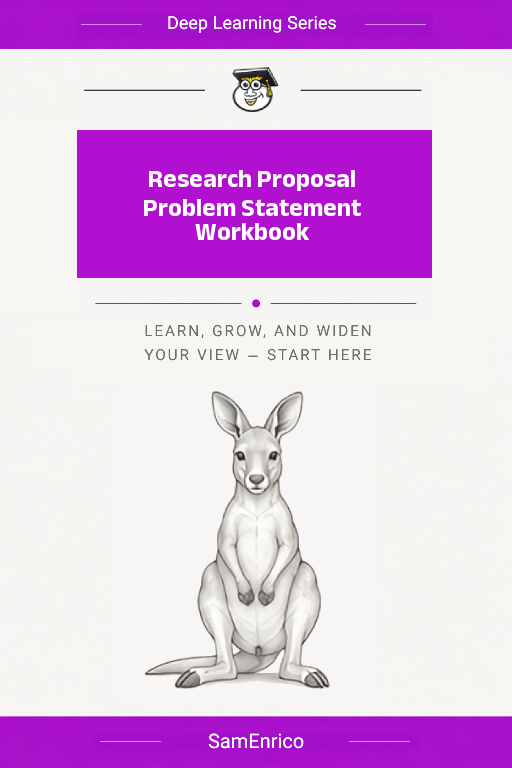
Research Proposal Problem Statement Workbook
Craft compelling problem statements that establish
Craft compelling problem statements that establish research gaps and justify your proposed investigation to graduate faculty.
Formats
About this book
Free sample
Chapter 1: The Gap Trap--–- Every year, thousands of doctoral students sit before their dissertation committees, palms sweating, and hear the same six words: “I don’t see the research gap.” Not “your methods are flawed.” Not “your sample is too small.” The problem, almost always, is that the student has confused a topic with a gap, a curiosity with a contribution, or a missing population with a missing argument. This chapter dismantles the single most common misconception in graduate research—that a research gap simply means a topic no one has examined—and replaces it with a precise, actionable typology that will save you months of revision.–- Let us begin with a confession that appears in nearly every dissertation writing group, every faculty office hour, and every panicked email sent at 2:00 a.m.: “I thought my gap was fine. My advisor said it wasn’t a gap at all.” The student who says this is not lazy, not unintelligent, and not unprepared. They have fallen into what this book calls the Gap Trap—the seductive but fatal belief that identifying something “no one has studied” is sufficient justification for a doctoral dissertation.–- The Gap Trap has many disguises. Sometimes it looks like a student saying, “No one has looked at teacher burnout in rural Montana high schools.” Sometimes it sounds like, “There are no studies on how nurses in small hospitals experience moral distress.” And sometimes it appears as, “Researchers disagree about whether leadership training works, so I will study leadership training.” These statements feel like gaps.
They sound specific. They even cite a population or a disagreement. But they are not, by themselves, research gaps—and committees reject them every single day.–- Why? Because a genuine research gap is not the absence of a study. It is the presence of an unresolved intellectual problem within the existing literature.
The difference is subtle but profound. Absence says, “No one has done this.” Unresolved problem says, “The literature itself points to a contradiction, a blind spot, an insufficiency, or an unexplained phenomenon that demands attention.” The first…
This is the end of the free sample. Get the eBook to keep going. Buy now
Contents
- Chapter 1
- Chapter 2
- Chapter 3
- Chapter 4
- Chapter 5
- Chapter 6
- Chapter 7
- Chapter 8
- Chapter 9
- Chapter 10
- Chapter 11
- Chapter 12
Details
- Author
- Forman Jesusita
- Publisher
- SamEnrico
- Language
- English
- Genre
- research, Student's Shortcut, Thesis Writing
- Released
- 2026-06-01
- Pages (approx.)
- 148
- Available as
- eBook, Audiobook

Read better in the ZLOADR app
Your eBooks on your phone or tablet. Sign in with your SamEnrico account and start reading.
More by Forman Jesusita
 Imposter For Students GuideForman Jesusita$11.99
 Body Position Reconstruction GuideForman Jesusita$11.99
 Parent Time Blocking GuideForman Jesusita$11.99
 Public Sector Talent RetentionForman Jesusita$11.99
 Flexible Time BlockingForman Jesusita$11.99
 The Startup Burn Rate GuideForman Jesusita$11.99
 Deep Work For EducatorsForman Jesusita$11.99
 Car Hypnosis Listening SafetyForman Jesusita$11.99
 The Lost Codex of the Silk Road: A Merchant's Secret LegacyForman Jesusita$11.99
 The Alchemists of Timbuktu: Unveiling Africa's Forgotten Scientific PioneersForman Jesusita$11.99
 How to Produce Pool Sweeps and VacuumsForman Jesusita$11.99
 How to Produce Downhill SkisForman Jesusita$11.99