
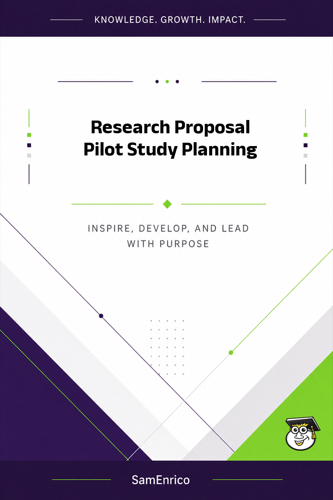
researchStudent's ShortcutPilot Testing
Research Proposal Pilot Study Planning eBook
Design small scale tests to refine methods before
by Downs Gianna
Design small scale tests to refine methods before full study.
Formats
Free sample
Chapter 1: The Million-Dollar Mistake--–- Every year, millions of dollars vanish into research studies that never should have been launched. Not because the science was bad. Not because the researchers were incompetent. But because they skipped a single, deceptively simple step: testing their methods on a small scale before betting everything on a large one.The scene plays out in universities, hospitals, corporations, and government agencies with depressing regularity. A team spends six months writing a grant proposal.
They secure $500,000 in funding. They hire staff, recruit participants, collect data across twelve sites over two years. And then – nothing. The findings are null. The intervention didn't work.
Or worse, the data is so messy that no one can tell what happened. The post-mortem reveals the truth: the survey was too long, participants didn't understand the instructions, the intervention was delivered inconsistently across sites, and the primary outcome measure showed no variation because everyone scored at the ceiling. These were not scientific failures. They were logistical failures. And every single one of them could have been caught with a two-month, $5,000 pilot study.This book exists because that tragedy is entirely preventable.The Hidden Epidemic of Preventable Failure Let me tell you about a study that should have worked.
A team of health psychologists wanted to test whether a text-message intervention could help diabetes patients manage their blood sugar. The science was solid – behavioral economics suggested that daily reminders and feedback would improve adherence. The team was experienced – they had run similar studies in other populations. The funding was generous – enough to recruit 800 patients across eight clinics. They did everything right.Except one thing.
They didn't pilot their recruitment script.On paper, the script was perfect. It explained the study's purpose, the randomization process, the data collection schedule, and the compensation structure. It was approved by three ethics boards. It was translated into two languages. But when the research assistants started making phone calls, something strange happened.
Only 12 percent of eligible patients agreed to participate. The team was baffled. They ran focus groups. They surveyed non-participants. Finally, someone suggested recording the recruitment calls.What they heard changed everything.
The script was so dense with information that patients tuned out after thirty seconds. The word "randomization" made people nervous – they thought it meant they might get a placebo and lose access to their regular care. The phrase "research study" signaled "experiment" to many patients, who imagined being poked and prodded like laboratory animals. One patient hung up and called her doctor to ask if she was being scammed.The team rewrote the script. They led with the benefit to the patient: "We're offering a free blood sugar monitoring kit and a $25 gift card to anyone willing to share their experiences." They moved the ethics language to the end.
They replaced "randomization" with "a computer will assign you to one of two equally good programs." They removed the word "study" and replaced it with "program."Enrollment jumped from 12 percent to 78 percent.That simple tweak – which took two hours to implement and cost nothing – transformed a failing project into a successful one. But here's the thing: the team discovered the problem during their pilot. They had built a pilot phase into their proposal. They tested their methods on a small scale – fifty patients across two clinics – before committing to the full eight-hundred-patient trial. If they had launched the full study without that pilot, they would have burned through their entire recruitment budget in the first three months, enrolled fewer than a hundred patients, and concluded that text-message interventions don't work.
The science would have been blamed for a logistics failure.That story is not unusual. It is the norm.The Two Types of Failure That No One Talks About When research fails, we tend to blame the hypothesis. "Our intervention didn't work." "The effect wasn't there." "The theory was wrong." But in reality, most failures fall into two categories that have nothing to do with the underlying science.The first is logistical failure. Your recruitment method didn't reach enough people. Your survey was too long, causing massive dropouts.
Your intervention was delivered inconsistently across sites. Your data collection system lost files. Your participant ID system failed, so you couldn't match pre-test to post-test. These are not scientific problems. They are operational problems.
And they are almost always detectable in a small-scale pilot.The second is measurement failure. Your outcome measure showed no variation because everyone scored at the ceiling (or floor). Your measure was not sensitive enough to detect change within your timeline. Your measure was reliable in theory but not in practice – perhaps because research assistants administered it differently, or because participants didn't understand the questions. Again, not a science problem.
A measurement problem. Also detectable in a pilot.Here is the uncomfortable truth: most researchers never discover these failures until it is too late. Why? Because they treat the pilot as an afterthought – a box to check on a grant application, a "feasibility study" conducted on a completely different population, or worse, no pilot at all. They assume that if the methods look good on paper, they will work in the real world.
This is the equivalent of designing a bridge on a computer and then building it without ever testing the materials.What This Book Will Do For You This book is not about research design in the abstract. You will not find chapters on epistemology, philosophy of science, or the history of the randomized controlled trial. You will find a practical, step-by-step system for stress-testing your methods before you commit real time and real money.By the end of this book, you will be able to:Distinguish between a genuine feasibility study (can this type of research be done?) and a pilot study (does our specific protocol work?) – and know which one you actually need.Choose between the two major pilot models: the Standalone Pilot (you have time to pause, fix, and restart) and the Internal Pilot (you cannot pause, so you build adaptations into the main study).Design a Phase 1 "Tweak" pilot that tests your basic logistics with as few as five to ten participants per subgroup – and know exactly what to look for.Identify your Golden Indicator – the one outcome that is meaningful, shows variation, and responds within weeks – so you know whether your measurement strategy is working.Estimate variance (not effect size) from your pilot data, avoiding the dangerous "winner's curse" that leads to underpowered main studies.Set Traffic Light go/no-go criteria before you start, so you never have to argue about whether the pilot "worked."Write a "Pilot Results" section for your grant proposal that demonstrates rigor and earns reviewer confidence – not one that reads like an excuse for why you didn't know what you were doing.And we will do all of this with a single unifying metaphor: the pilot as a methodological stress test. You are not trying to see if your study works. You are trying to break it – to find the weak points, the failure modes, the places where the system crashes – so you can fix them before the real test begins.The Internal Pilot vs.
The Standalone Pilot: A Critical Distinction Before we go any further, we need to address a source of massive confusion…
This is the end of the free sample. Get the eBook to keep going. Buy now
About this book
Details
- Author
- Downs Gianna
- Publisher
- SamEnrico
- Language
- English
- Genre
- research, Student's Shortcut, Pilot Testing
- Released
- 2026-06-09
- Pages (approx.)
- 154
- Available as
- eBook, Audiobook

Read better in the ZLOADR app
Your eBooks on your phone or tablet. Sign in with your SamEnrico account and start reading.
More by Downs Gianna
 Procrastination Overcoming WorkbookDowns Gianna$11.99
 Myanmar Rohingya Family ReunitedDowns Gianna$11.99
 Self Esteem for Aging LGBTQ+ SeniorsDowns Gianna$11.99
 Luxury Goods EconomicsDowns Gianna$11.99
 Gymnastics Routine Lock InDowns Gianna$11.99
 Digital Nomad Visa TrendsDowns Gianna$11.99Digital Nomad Visa TrendsDowns Gianna$11.99
 Everglades Swamp SinkingsDowns Gianna$11.99
 The Great Cookie Heist: How a 1980s Baking Empire Collapsed OvernightDowns Gianna$11.99
 The Magnificent Merchants of the Sahara: The Gold Caravans of the WangaraDowns Gianna$11.99
 Growing DiphylleiaDowns Gianna$11.99
 US Business Credit For StartupsDowns Gianna$12.99
You may also like
 Scientific Research On TM GuideMartens Nathanial$11.99
 Research Proposal Methodology Section MasteryPauley Debroah$11.99
 Research Proposal Appendix CompilationRaines Tyisha$11.99
 Academic Researcher Distraction GuideFord Virgil$11.99
 TM Research and ScienceCovert Nicki$11.99
 Social Anxiety Research ReviewRoberge Cole$11.99
 Research Proposal Significance Section GuideBock Tory$12.99
 Research Proposal Reviewer PsychologyLugo Tawanda$11.99
 Research Proposal Research Questions DesignLara Robbi$11.99
 Research Proposal References and CitationsPatten Shanice$11.99
 Research Proposal Mixed Methods DesignCameron Omega$11.99
 Research Proposal Data Management PlanAnderson Roberto$12.99