
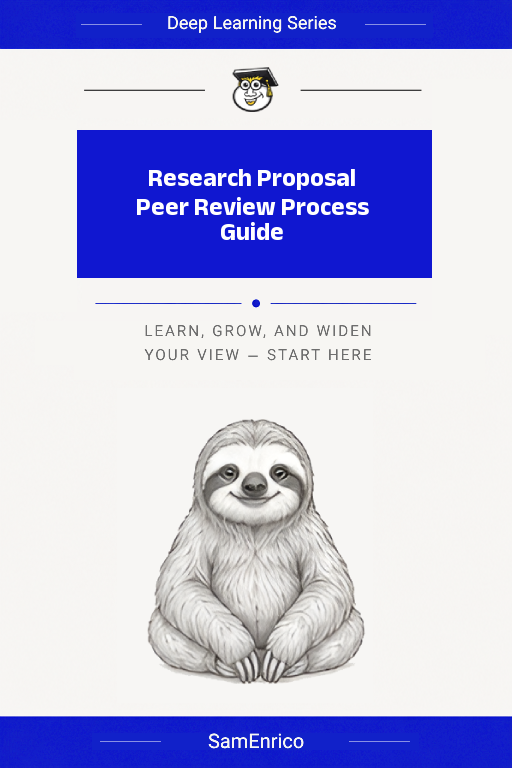
Research Proposal Peer Review Process Guide eBook
Get constructive feedback from advisors and peers
Get constructive feedback from advisors and peers before submitting to graduate admissions committees.
Formats
Free sample
Chapter 1: The Silent Killer...--–- Every year, thousands of brilliant research proposals die not because the science was flawed, not because the writing was poor, but because the feedback arrived too late, from the wrong people, in the wrong form. This is the silent killer of academic dreams. You cannot see it coming. No one warns you about it in orientation. Your advisor may never mention it.
Yet it determines, more than any other factor, whether your proposal ends up in the acceptance pile or the rejection pile. This chapter names the enemy, reveals why most peer review fails, and introduces a radical new approach that will transform how you seek, receive, and use feedback.The Anatomy of a Preventable Death Let me tell you about a student I will call Maria. Maria was brilliant. She had a 3.9 GPA, two conference presentations, and the full support of her thesis advisor. She spent six months developing a research proposal on the effects of community-based interventions on food insecurity among immigrant families.
It was timely, theoretically grounded, and methodologically sound. She submitted it to a competitive graduate fellowship. She was rejected.The feedback came back three months later. The reviewers said her research question was “insufficiently focused.” Her literature review was “too broad.” Her methods section was “vague regarding recruitment strategy.” Maria was devastated. Not because the feedback was wrong—it was not—but because every single one of those problems could have been fixed if she had received the right feedback at the right time.Here is what actually happened.
Maria showed her draft to her advisor, who said, “Looks good, send it.” She showed it to two peers in her cohort, who said, “This is really interesting!” She read it aloud to herself, caught a few typos, and hit submit. She thought she had done everything right. She had not. She had merely gone through the motions of peer review without understanding its architecture.Maria’s proposal did not die from neglect. It died from the silent killer: feedback that was too vague, too late, and too uniformly positive to be useful.This book exists because Maria’s story is not an exception.
It is the rule. And it is entirely preventable.Why Most Peer Review Fails Before we can fix peer review, we must understand why it so often fails. Drawing on research from doctoral education, writing studies, and organizational psychology, I have identified four patterns of failure that appear again and again. Learn to recognize them, because you have likely experienced every single one.Failure Pattern One: The Praise Spiral The Praise Spiral occurs when reviewers focus exclusively on what is working and avoid mentioning what is broken. This is especially common among peers who are also friends.
No one wants to be the bearer of bad news. No one wants to hurt anyone’s feelings. So everyone says nice things, and the author walks away feeling validated but fundamentally unchanged.The Praise Spiral feels good in the moment. That is its danger. You finish a feedback session thinking, I am doing great!
Then you submit and discover that you were not doing great at all. Your friends were just being polite.Failure Pattern Two: The Vague Gesture The Vague Gesture is the comment that signals a problem but provides no path to a solution. You have heard these a hundred times: “This needs more work.” “The methods section could be stronger.” “I’m not sure about the literature review.” These comments are technically correct but practically useless. They tell you that something is wrong without telling you what or how to fix it.The Vague Gesture is often the result of a reviewer who senses a problem but lacks the vocabulary or confidence to name it. They know the proposal is not working.
They cannot say why. So they offer a placeholder comment and move on.Failure Pattern Three: The Unaligned Reviewer The Unaligned Reviewer is the wrong person for the job. Asking your statistician friend to comment on your theoretical framework. Asking your qualitative methods expert to evaluate your regression analysis. Asking your advisor to copy-edit.
These are not failures of effort. They are failures of architecture. The reviewer is trying their best, but they are operating outside their zone of competence.The result is feedback that is either irrelevant or actively misleading. Your statistician friend tells you your theory section is fine (they would not know). Your qualitative expert tells you your quantitative methods need work (they are probably right, but for the wrong reasons).
Your advisor spends forty minutes fixing your commas and never notices that your research question does not match your methods.Failure Pattern Four: The Terminal Draft The Terminal Draft is the proposal that is reviewed only once, at the very end of the writing process, when there is no time left for meaningful revision. This is the most lethal pattern of all. A student writes in isolation for months, produces what they believe is a final draft, and then—at the last possible moment—asks for feedback. The feedback arrives, it is devastating, and there is no time to act on it.The Terminal Draft is a tragedy of timing. The feedback is not wrong.
It is just too late. The student either submits a flawed proposal or misses the deadline entirely. Either way, months of work are wasted.The Orchestrator Mindset If these four patterns represent the disease, this book offers the cure. The cure begins with a single mental shift that I call the Orchestrator Mindset.Most students approach peer review as passive recipients. They write a draft.
They send it out. They wait for feedback to arrive like rain falling from the sky. They take what they get—whether it is useful or not—and try to make the best of it.The Orchestrator does something完全不同. The Orchestrator designs the feedback process before a single word is written. They decide who will review what, when, and in what order.
They choose reviewers based on specific strengths and assign them specific tasks. They build in multiple rounds of review so that feedback arrives early enough to matter. They treat peer review not as an afterthought but as a core component of the writing process.Here is the Orchestrator’s creed, which I encourage you to memorize:I will not ask anyone to review a draft until I have prepared it for their eyes.I will not ask a reviewer for everything. I will ask them for something specific.I will not wait until the end to seek feedback. I will build review cycles into my timeline from the beginning.I will not treat all feedback as equal.
I will weigh it, categorize it, and respond to it systematically.I will not defend my draft. I will listen, paraphrase, and decide later what to change.This mindset is the foundation upon which everything else in this book is built. Without it, the techniques and templates we will cover are just busywork. With it, you become the captain of your own review process rather than a passenger on someone else’s.The Three Reviewers You Need The Orchestrator Mindset immediately raises a practical…
This is the end of the free sample. Get the eBook to keep going. Buy now
About this book
Details
- Author
- Turnbull Almeda
- Publisher
- SamEnrico
- Language
- English
- Genre
- research, Student's Shortcut
- Released
- 2026-06-01
- Pages (approx.)
- 130
- Available as
- eBook, Audiobook

Read better in the ZLOADR app
Your eBooks on your phone or tablet. Sign in with your SamEnrico account and start reading.
More by Turnbull Almeda
 Postpartum Low Milk Supply GuideTurnbull Almeda$11.99
 Triggers and Substance UseTurnbull Almeda$11.99
 Skin Needling At Home Safety ManualTurnbull Almeda$11.99
 Client Centered Scripting ApproachTurnbull Almeda$11.99
 Autonomous Vehicle PlanTurnbull Almeda$11.99
 MBSR for Corporate WorkplacesTurnbull Almeda$11.99
 Chronic Migraine PreventionTurnbull Almeda$11.99
 Gaslighting And AngerTurnbull Almeda$11.99
 Time Blocking For EntrepreneursTurnbull Almeda$11.99
 The Tsar's Maestro: Glinka and the Birth of Russian Classical MusicTurnbull Almeda$11.99
 Silicon Bloodlines: The Untold Legacy of Steve Jobs and the Next Tech DynastyTurnbull Almeda$11.99
 Silk & Shadows: The Forbidden Fashion Empire of the Silk RoadTurnbull Almeda$11.99
You may also like
 Scientific Research On TM GuideMartens Nathanial$11.99
 Research Proposal Methodology Section MasteryPauley Debroah$11.99
 Research Proposal Appendix CompilationRaines Tyisha$11.99
 Academic Researcher Distraction GuideFord Virgil$11.99
 TM Research and ScienceCovert Nicki$11.99
 Social Anxiety Research ReviewRoberge Cole$11.99
 Research Proposal Significance Section GuideBock Tory$12.99
 Research Proposal Reviewer PsychologyLugo Tawanda$11.99
 Research Proposal Research Questions DesignLara Robbi$11.99
 Research Proposal References and CitationsPatten Shanice$11.99
 Research Proposal Mixed Methods DesignCameron Omega$11.99
 Research Proposal Data Management PlanAnderson Roberto$12.99