
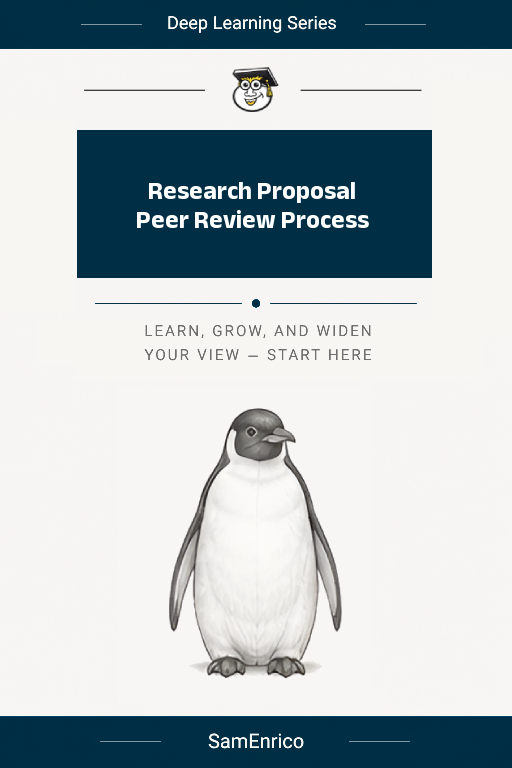
researchStudent's ShortcutProposal Feedback
Research Proposal Peer Review Process eBook
Get informal peer feedback on your research propos
Get informal peer feedback on your research proposal to strengthen PhD applications.
Formats
Free sample
Chapter 1: The Calibration Gap--–- Every year, thousands of brilliant Ph D applicants submit proposals that are logically flawless, methodologically sound, and entirely unconvincing. They cite the right authors, identify genuine gaps, propose feasible methods, and follow every template their advisors provided. And then they receive the rejection letter that says nothing specific, just a polite “not a good fit” or “the committee was impressed but…” They spend months wondering what went wrong. The answer is almost never their topic, their qualifications, or their writing ability. The answer is something no one told them about: the calibration gap.The calibration gap is the distance between what you mean to say and what your reader actually hears.
It exists because you have spent hundreds of hours thinking about your research question, while your reader is encountering it for the first time. You know which assumptions you are making; they do not. You know which transitions are implied; they stumble over missing connections. You know why the fourth paragraph matters; they have already forgotten the first. This gap is not a measure of your intelligence or your ideas.
It is a measure of how many times your proposal has been read by someone who is not you.Here is the painful truth that the top ten best-selling books on academic writing all agree upon but rarely state directly: most rejected proposals are rejected not because they are wrong, but because they are uncalibrated. The admissions committee cannot see the brilliance in your head. They can only see what you put on the page. And if you have never tested that page against the raw, unfiltered reaction of someone who does not already believe in you, you are submitting blind.The Hidden Curriculum of Ph D Proposals Before we can fix the calibration gap, we need to understand what admissions committees are actually looking for. The best-selling books on Ph D success converge on three core criteria, though they use different language to describe them.
Let us name them plainly.Feasibility is the first criterion. Can you actually do this research within the resources, timeline, and skills available to you? A proposal that promises to interview fifty CEOs in three weeks is not ambitious; it is delusional. A proposal that requires fluency in three languages you do not speak is not impressive; it is doomed. Committees have seen too many applicants describe research that would take five years in a three-year funding window.
Feasibility is not about playing small. It is about demonstrating that you understand the gap between an idea and its execution.Originality is the second criterion. Is this a meaningful gap in knowledge, or just a tiny tweak on existing work? Committees receive hundreds of proposals that say “no one has studied X in population Y” when the truth is that no one has studied it because it is not interesting. Originality does not mean being the first.
It means being the first in a way that matters. It means showing that the gap you have identified is not an oversight but an opportunity—a place where existing theories fail, where current methods cannot reach, where the field has been stuck. Originality without significance is just novelty.Alignment is the third criterion. Does your proposal fit the department’s stated strengths and the potential supervisor’s documented interests? This is where many brilliant applicants fail.
They write a proposal that would be perfect for a different department, a different advisor, a different country. They do not realize that admissions committees are not selecting the best proposal in the abstract. They are selecting the best proposal for them. Alignment means reading the department’s website, the supervisor’s recent publications, the program’s stated values, and then writing a proposal that speaks directly to those specifics. It means showing not just that you want to be there, but that you belong there.These three criteria—feasibility, originality, alignment—are the official curriculum.
Every proposal guide mentions them. But the hidden curriculum is something else entirely. The hidden curriculum is that many applicants fail not from a lack of knowledge about their topic, but from a lack of peer calibration. They have never seen how others interpret their writing. They do not know which sentences confuse, which claims seem obvious, which transitions feel like leaps.
They are writing in a vacuum, and the vacuum is lying to them.Why Supervisors Cannot Close the Gap Alone You might be thinking: but I have a supervisor. I have a committee. I have experts who read my work. Surely they can tell me where the gaps are.They can. But they rarely do, not in the way you need.Supervisors are too close to your work.
They have been part of your thinking process for months or years. They know what you mean because you have told them in conversation. When they read your draft, they unconsciously fill in the missing pieces. They hear your voice behind the words. They cannot be naive readers even when they try.Supervisors are too busy.
This is not a criticism; it is a reality. The average Ph D supervisor has multiple advisees, their own research, teaching responsibilities, and administrative duties. When they finally sit down with your draft, they have twenty minutes and a red pen. They focus on the big structural issues—the ones that are easiest to name. They do not have time to mark every confusing sentence or every missing transition.
They assume you will catch those in copyediting.Supervisors are too steeped in disciplinary assumptions. They know the literature so deeply that they cannot see where you have failed to explain it. They know which authors are canon and which are fringe. When you cite only secondary sources, they notice. When you misrepresent a theorist, they flinch.
But they cannot tell you that your opening paragraph is boring because they have read a hundred opening paragraphs just like it. They have developed a professional tolerance for boredom that admissions committees have not.This is not a failure of supervision. It is a feature of expertise. The more expert you become, the less you can see what a beginner sees. The psychologists call this the curse of knowledge.
Once you know something, you cannot unknow it. You cannot remember what it was like to not know it. Your supervisor suffers from the curse of knowledge about your entire field. You suffer from the curse of knowledge about your own proposal.The only cure for the curse of knowledge is a naive reader. Someone who does not know your field, your advisor, your previous work, or your brilliant ideas.
Someone who reads your proposal the way an exhausted admissions committee member reads it on a Friday afternoon: cold, skeptical, and ready to be bored. That person will not fill in your missing transitions. They will not assume you meant something else. They will tell you exactly where they stopped reading and exactly why.The Three Types of Feedback You Actually Need Not all feedback is created equal. The best-selling books on peer review converge on three distinct types of feedback, each targeting a different layer of your…
This is the end of the free sample. Get the eBook to keep going. Buy now
About this book
Details
- Author
- Stanley Shannon
- Publisher
- SamEnrico
- Language
- English
- Genre
- research, Student's Shortcut, Proposal Feedback
- Released
- 2026-05-29
- Pages (approx.)
- 125
- Available as
- eBook, Audiobook

Read better in the ZLOADR app
Your eBooks on your phone or tablet. Sign in with your SamEnrico account and start reading.
More by Stanley Shannon
 The Grocery Store Impulse TrapStanley Shannon$11.99
 Louis Bacon MooreStanley Shannon$11.99
 The Nobel Medicine ImmunologyStanley Shannon$11.99
 Physics Nobel Genius Stories GuideStanley Shannon$11.99
 Self Talk for CreativesStanley Shannon$11.99
 Mouth Covering Gesture GuideStanley Shannon$11.99
 Anapanasati After WakingStanley Shannon$11.99
 Mindfulness For OverthinkingStanley Shannon$11.99
 The Maid of the Dardanelles: A Heroine’s Stand in the War of Austrian SuccessionStanley Shannon$11.99
 The Falklands: Blood and Ice in the South AtlanticStanley Shannon$11.99
 The Unseen Hand: How Frida Kahlo Painted Her PainStanley Shannon$11.99
 Growing ConandronStanley Shannon$11.99
You may also like
 Scientific Research On TM GuideMartens Nathanial$11.99
 Research Proposal Methodology Section MasteryPauley Debroah$11.99
 Research Proposal Appendix CompilationRaines Tyisha$11.99
 Academic Researcher Distraction GuideFord Virgil$11.99
 TM Research and ScienceCovert Nicki$11.99
 Social Anxiety Research ReviewRoberge Cole$11.99
 Research Proposal Significance Section GuideBock Tory$12.99
 Research Proposal Reviewer PsychologyLugo Tawanda$11.99
 Research Proposal Research Questions DesignLara Robbi$11.99
 Research Proposal References and CitationsPatten Shanice$11.99
 Research Proposal Mixed Methods DesignCameron Omega$11.99
 Research Proposal Data Management PlanAnderson Roberto$12.99