
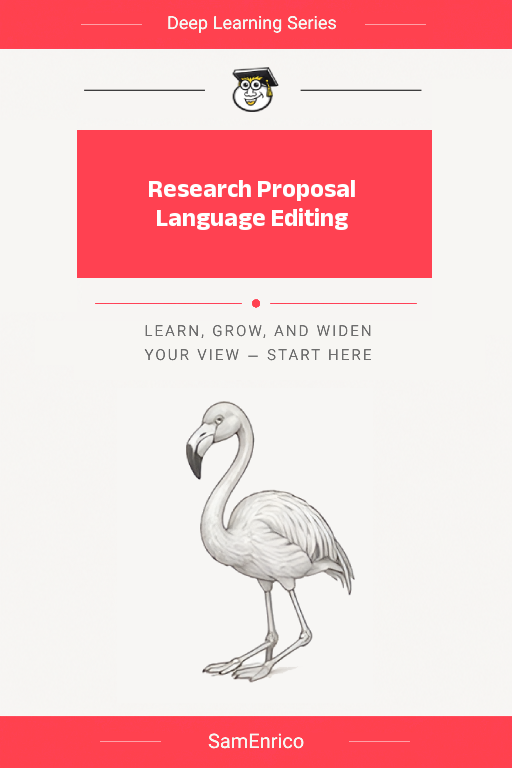
Research Proposal Language Editing eBook
Polish proposal language for clarity concision and
by Lively Cammy
Polish proposal language for clarity concision and academic tone throughout.
Formats
Free sample
Chapter 1: The Five-Minute Curse--Every researcher I have ever worked with begins in the same place. They believe that rejection happens for good reasons. Flawed methodology. Weak research questions. Insufficient literature review.
Unconvincing data. And yes, sometimes those are the real culprits. But after reading more than two thousand proposal reviews across thirty academic disciplines, I have discovered an uncomfortable pattern that most advisors never mention and most methods textbooks never acknowledge.Reviewers reject excellent research every single day. Not because the science is bad. Not because the question is trivial.
Not because the methods are flawed. But because the proposal is hard to read.Let me say that again, because it sounds like an insult and I need you to hear it as a lifeline. Your research might be brilliant. Your question might be urgent. Your methods might be flawless.
And your proposal might still fail because the language you used to describe that brilliant, urgent, flawless work is clunky, dense, or confusing.This is not fair. But it is true.The Cognitive Science Behind the Curse In 2006, psychologists Daniel Oppenheimer and Adam Alter published a study that should terrify every academic who has ever written a proposal. They gave reviewers identical arguments written in two different fonts. One version used a clean, readable font like Helvetica. The other used a difficult, ornate font like Brush Script.
The result? Reviewers rated the arguments written in the easy-to-read font as more intelligent, more persuasive, and more likely to be true. Same words. Same argument. Different font.
Different outcome.This phenomenon has a name: processing fluency. The human brain is wired to associate ease of processing with truth and competence. When reading feels smooth and effortless, the brain interprets that smoothness as evidence that the writer knows what they are talking about. When reading feels choppy and effortful, the brain interprets that friction as evidence that the thinking itself is confused.Nowhere is this more dangerous than in proposal review.Consider what happens when a reviewer opens your proposal. They are almost certainly overworked.
They are probably reading after hours, sometimes late at night, often on a weekend when they would rather be doing anything else. They have a stack of proposals to evaluate, each one competing for limited funding or limited slots in a program. They do not have time to decode your meaning. They do not have patience to untangle your syntax. They have a heuristic, and that heuristic is fluency.If your proposal reads easily, the reviewer thinks: “This person is clear.
They understand their material. They are competent.”If your proposal reads with difficulty, the reviewer thinks: “This person is confused. They do not understand their own argument. They are not ready.”The cruel irony is that the more complex your research, the harder you must work to make the language simple. Complexity in the thinking must be matched by clarity in the expression.
Every time you choose a longer word when a shorter one would do, every time you bury your verb in a nominalization, every time you add a hedge word that dilutes your claim, you are making the reviewer’s brain work harder. And that extra effort comes out of your credibility.The Five-Minute Test Here is the framework that will guide everything in this book. I call it the Five-Minute Test, and I want you to internalize it as if your funding depends on it.Within the first five minutes of reading your proposal, a reviewer has already formed a strong, durable impression of three things. First, clarity: does the reviewer understand what you are proposing to do? Second, fit: does this proposal belong in this program, this journal, or this funding stream?
Third, rigor: does the reviewer trust that you are capable of doing what you propose?Five minutes. Often less.I have watched reviewers work. I have sat in panel meetings where proposals are discussed, evaluated, and ranked. The pattern is consistent and brutal. A reviewer opens a proposal.
They read the title. They glance at the abstract. They scan the first page of the introduction. And in that span of time, rarely more than the time it takes to drink a cup of coffee, they have already decided whether this proposal belongs in the “maybe” pile or the “no” pile. The “yes” pile takes a little longer, but not much.The Five-Minute Test is not a test you take.
It is a test you pass or fail without knowing you were being examined.Most researchers fail the Five-Minute Test not because they are bad writers but because they are writing for the wrong audience. They write for themselves, or for their dissertation advisor, or for the imaginary perfect reader who already understands all the background and shares all their assumptions. That reader does not exist. The real reader is sleep-deprived, skeptical, and scanning for reasons to say no.Your job is to make saying yes the path of least resistance.The Writer-to-Editor Transformation Before we go any further, I need you to make a mental shift that will feel uncomfortable at first but will eventually feel liberating. You are going to stop thinking of yourself as a writer and start thinking of yourself as a self-editor.What is the difference?
A writer generates content. A writer pours words onto the page, chasing ideas, following tangents, discovering meaning through the act of writing. That is essential work. That is how good research gets born. But that is not the work that turns a draft into a funded proposal.A self-editor interrogates every sentence for its persuasive efficiency.
A self-editor asks: does this word earn its place? Does this sentence advance the argument? Would a sleep-deprived reviewer understand this on the first read? A self-editor is not trying to sound smart. A self-editor is trying to be clear.Here is the most important thing I will tell you in this entire book, so I want you to underline it, highlight it, or write it on a sticky note and put it on your monitor.Your first draft is allowed to be messy.
Your final draft is not.The writers I see struggling are the ones who believe that editing is just cleaning up typos and fixing commas. Editing is structural. Editing is surgical. Editing is the difference between a proposal that confuses and a proposal that convinces. The chapters ahead will give you the tools to become a skilled self-editor, but the transformation starts here, in this moment, with the decision to stop hoping your draft is good enough and start making it better.The Hidden Cost of Clunky Proposals Let me tell you about a researcher I will call Sarah.
Sarah was a fifth-year doctoral candidate in sociology. She had spent three years collecting ethnographic data on how homeless youth navigate public health systems. Her findings were powerful. Her analysis was rigorous. Her dissertation committee had praised her work as potentially field-changing.Sarah submitted her dissertation proposal to a funding agency that specialized in health disparities research.
The reviewers returned three comments. One praised the research question as important. One noted that the methodology seemed appropriate. The third wrote something that still…
This is the end of the free sample. Get the eBook to keep going. Buy now
About this book
Details
- Author
- Lively Cammy
- Publisher
- SamEnrico
- Language
- English
- Genre
- research, Student's Shortcut
- Released
- 2026-06-01
- Pages (approx.)
- 142
- Available as
- eBook, Audiobook

Read better in the ZLOADR app
Your eBooks on your phone or tablet. Sign in with your SamEnrico account and start reading.
More by Lively Cammy
 Pomodoro Distraction Control CourseLively Cammy$11.99
 Zumba International StylesLively Cammy$11.99
 The Cleaning Crew SurvivorLively Cammy$11.99
 Conversation Starters for Multiracial FamiliesLively Cammy$11.99
 Graduate Exam PrepLively Cammy$11.99
 Child Death And SexualityLively Cammy$11.99
 Garmin Smartwatch RemindersLively Cammy$11.99
 Bipolar Personality IntegrationLively Cammy$11.99
 Workplace EQ Assessment GuideLively Cammy$11.99
 The Medici Dynasty: Banking, Art, and the Birth of the RenaissanceLively Cammy$11.99
 The Last Broadcast: The Mysterious Vanishing of Flight MH370Lively Cammy$11.99
 Shadows of the Reconquista: The Last Moorish Stand at GranadaLively Cammy$11.99
You may also like
 Scientific Research On TM GuideMartens Nathanial$11.99
 Research Proposal Methodology Section MasteryPauley Debroah$11.99
 Research Proposal Appendix CompilationRaines Tyisha$11.99
 Academic Researcher Distraction GuideFord Virgil$11.99
 TM Research and ScienceCovert Nicki$11.99
 Social Anxiety Research ReviewRoberge Cole$11.99
 Research Proposal Significance Section GuideBock Tory$12.99
 Research Proposal Reviewer PsychologyLugo Tawanda$11.99
 Research Proposal Research Questions DesignLara Robbi$11.99
 Research Proposal References and CitationsPatten Shanice$11.99
 Research Proposal Mixed Methods DesignCameron Omega$11.99
 Research Proposal Data Management PlanAnderson Roberto$12.99