
researchStudent's ShortcutMeasurement
Research Proposal Instrumentation Workbook
Describe and justify surveys, tests, or equipment
by Vera Birdie
Describe and justify surveys, tests, or equipment including validity, reliability, and access considerations.
Formats
About this book
Free sample
Chapter 1: Beyond The Checklist--–- Every research proposal faces a single, defining moment of vulnerability. You may have a brilliant research question, a sophisticated sampling strategy, and a flawless analytical plan. But if you cannot show your committee how you will move from the abstract world of concepts to the concrete world of data, your proposal will collapse. That movement—from idea to measurement—is the job of instrumentation, and it is where most proposals either find their footing or fall apart. This chapter establishes instrumentation as the critical bridge between your research questions and the observable, measurable data you will collect.
It reframes instrumentation not as a technical afterthought buried in your methodology section but as a core credibility argument that proposal committees scrutinize more heavily than almost any other component. By the end of this chapter, you will understand what instrumentation truly means across quantitative, qualitative, and mixed methods designs. You will know why committees focus on this section with laser intensity. Most importantly, you will begin writing the opening paragraph of your own instrumentation section using the first of many templates provided throughout this workbook.Why Instrumentation Deserves Its Own Chapter Let me be direct with you. Many doctoral students and early-career researchers treat instrumentation as a box to check.
They assume that if they name a survey, mention that it has been "validated," and include a brief note about reliability, they have satisfied the requirement. This approach is a serious mistake. Experienced committee members read instrumentation sections not to see if you can name an instrument but to answer three underlying questions: First, do you understand what you are actually trying to measure? Second, can you defend why your chosen measurement approach is trustworthy? Third, have you thought through the practical realities of obtaining and using your instrument?These questions matter because instrumentation determines everything that follows.
If your instrument does not measure what you claim it measures, your results are meaningless. If your instrument produces inconsistent scores, your statistical analyses will lack power and your conclusions will be suspect. If you cannot actually obtain permission…
This is the end of the free sample. Get the eBook to keep going. Buy now
Contents
- Chapter 1
- Chapter 2
- Chapter 3
- Chapter 4
- Chapter 5
- Chapter 6
- Chapter 7
- Chapter 8
- Chapter 9
- Chapter 10
- Chapter 11
- Chapter 12
Details
- Author
- Vera Birdie
- Publisher
- SamEnrico
- Language
- English
- Genre
- research, Student's Shortcut, Measurement
- Released
- 2026-06-01
- Pages (approx.)
- 144
- Available as
- eBook, Audiobook

Read better in the ZLOADR app
Your eBooks on your phone or tablet. Sign in with your SamEnrico account and start reading.
More by Vera Birdie
 Britney Spears Toxic ChildhoodVera Birdie$11.99
 Imposter Perfectionist CycleVera Birdie$11.99
 Reconstruction of Poisoning CasesVera Birdie$11.99
 The Startup Hope GuideVera Birdie$11.99
 Pomodoro for ProcrastinatorsVera Birdie$11.99
 Closed Captioning PioneerVera Birdie$11.99
 Cicero Technique For SpeechesVera Birdie$11.99
 Children and Hypnosis ListeningVera Birdie$11.99
 The Codebreakers of Timbuktu: Africa's Secret Linguistic WarriorsVera Birdie$11.99
 The Ghost Checks of Buenos Aires: Argentina's First White-Collar Crime Wave (1930s)Vera Birdie$11.99
 How to Produce DrainsVera Birdie$11.99
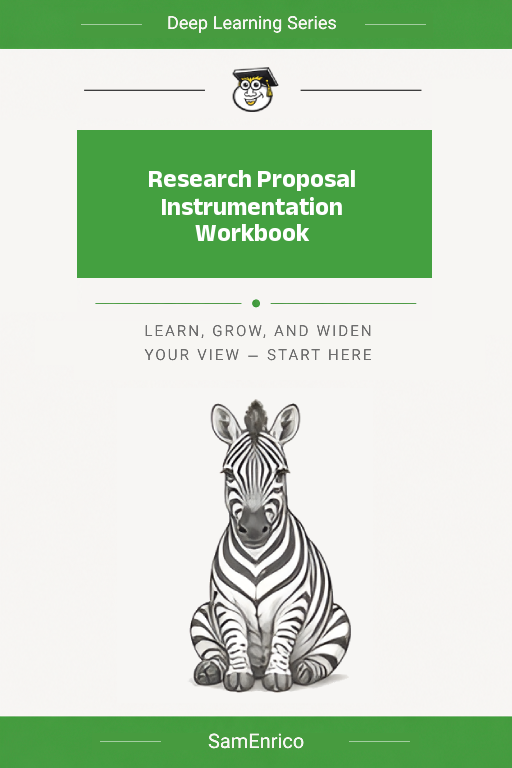 Research Proposal Instrumentation WorkbookVera Birdie$12.99
You may also like
 Scientific Research On TM GuideMartens Nathanial$11.99
 Research Proposal Methodology Section MasteryPauley Debroah$11.99
 Research Proposal Appendix CompilationRaines Tyisha$11.99
 Academic Researcher Distraction GuideFord Virgil$11.99
 TM Research and ScienceCovert Nicki$11.99
 Social Anxiety Research ReviewRoberge Cole$11.99
 Research Proposal Significance Section GuideBock Tory$12.99
 Research Proposal Reviewer PsychologyLugo Tawanda$11.99
 Research Proposal Research Questions DesignLara Robbi$11.99
 Research Proposal References and CitationsPatten Shanice$11.99
 Research Proposal Mixed Methods DesignCameron Omega$11.99
 Research Proposal Data Management PlanAnderson Roberto$12.99