
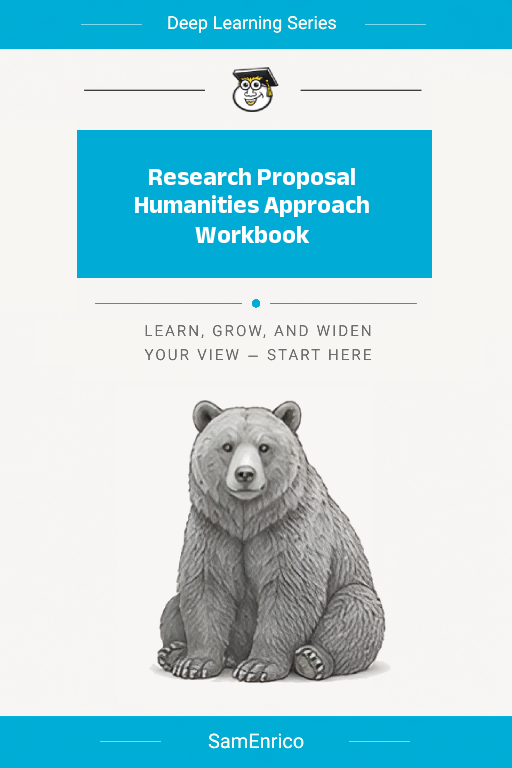
researchStudent's ShortcutHumanities Research
Research Proposal Humanities Approach Workbook
Tailor proposals for humanities disciplines emphas
Tailor proposals for humanities disciplines emphasizing interpretive methods, archival research, and theoretical contribution.
Formats
About this book
Free sample
Chapter 1: Beyond the Blueprint--–- Most academics never learn to write a proposal. They learn to write research reports—dissertations, journal articles, conference papers—and then they assume that a proposal is simply a shorter, future-tense version of the same thing. This is a catastrophic mistake. A research report tells the reader what you discovered. A research proposal tells the reader what you intend to discover, why that discovery matters, and why they should trust you to make it.
These are fundamentally different genres, requiring fundamentally different rhetorical strategies. Yet graduate curricula rarely teach proposal writing explicitly. Students are handed dissertation handbooks with formatting guidelines and vague encouragements to "demonstrate significance," then left to reverse-engineer successful proposals from senior colleagues. The result is widespread anxiety, endless revision cycles, and proposals that read like lab reports—complete with hypotheses that the writer secretly knows cannot be tested in the humanities, data collection plans that mistake archives for laboratories, and significance statements that claim practical applications no humanist actually believes.This chapter dismantles that anxiety by reframing the proposal entirely. The proposal is not a blueprint.
You are not predicting your conclusion. You are not promising to "prove" something in the scientific sense. Instead, you are building a rhetorical argument—a persuasive case that a particular interpretive problem is worth solving and that you have a credible way to solve it. Once you understand this distinction, the entire proposal writing process transforms from a terrifying exercise in prediction into an intellectually satisfying act of persuasion. Let us begin.The Blueprint Fallacy: Why Students Freeze Close your eyes and imagine a blueprint.
You see precise measurements, labeled components, and unambiguous instructions. A blueprint for a house tells the builder exactly where every wall, window, and electrical outlet will go before a single nail is hammered. If the final house deviates from the blueprint, someone has made an error. Now imagine writing a research proposal as if it were a blueprint. You would need to specify exactly what you will find in the archives, exactly what argument you will make about those findings, and…
This is the end of the free sample. Get the eBook to keep going. Buy now
Contents
- Chapter 1
- Chapter 2
- Chapter 3
- Chapter 4
- Chapter 5
- Chapter 6
- Chapter 7
- Chapter 8
- Chapter 9
- Chapter 10
- Chapter 11
- Chapter 12
Details
- Author
- Thames Delmar
- Publisher
- SamEnrico
- Language
- English
- Genre
- research, Student's Shortcut, Humanities Research
- Released
- 2026-06-01
- Pages (approx.)
- 154
- Available as
- eBook, Audiobook

Read better in the ZLOADR app
Your eBooks on your phone or tablet. Sign in with your SamEnrico account and start reading.
More by Thames Delmar
 International Disability Rights ExportThames Delmar$11.99
 Reconstruction of Explosion ScenesThames Delmar$11.99
 Imposter Feedback GuideThames Delmar$11.99
 Wil Wheaton Next Generation KidThames Delmar$11.99
 Method Of Loci For BiologyThames Delmar$11.99
 Sleeping Alone After LossThames Delmar$11.99
 Breathing Before Hypnosis AudioThames Delmar$11.99
 Pomodoro for TherapistsThames Delmar$11.99
 The Siege of Chittorgarh: Blood and Honor in RajputstanThames Delmar$11.99
 The Dragon's Counterfeit: The Assassination That Shattered the Qing DynastyThames Delmar$11.99
 How to Produce Dress FormsThames Delmar$11.99
 East African SACCO Registration GuideThames Delmar$12.99
You may also like
 Scientific Research On TM GuideMartens Nathanial$11.99
 Research Proposal Methodology Section MasteryPauley Debroah$11.99
 Research Proposal Appendix CompilationRaines Tyisha$11.99
 Academic Researcher Distraction GuideFord Virgil$11.99
 TM Research and ScienceCovert Nicki$11.99
 Social Anxiety Research ReviewRoberge Cole$11.99
 Research Proposal Significance Section GuideBock Tory$12.99
 Research Proposal Reviewer PsychologyLugo Tawanda$11.99
 Research Proposal Research Questions DesignLara Robbi$11.99
 Research Proposal References and CitationsPatten Shanice$11.99
 Research Proposal Mixed Methods DesignCameron Omega$11.99
 Research Proposal Data Management PlanAnderson Roberto$12.99