
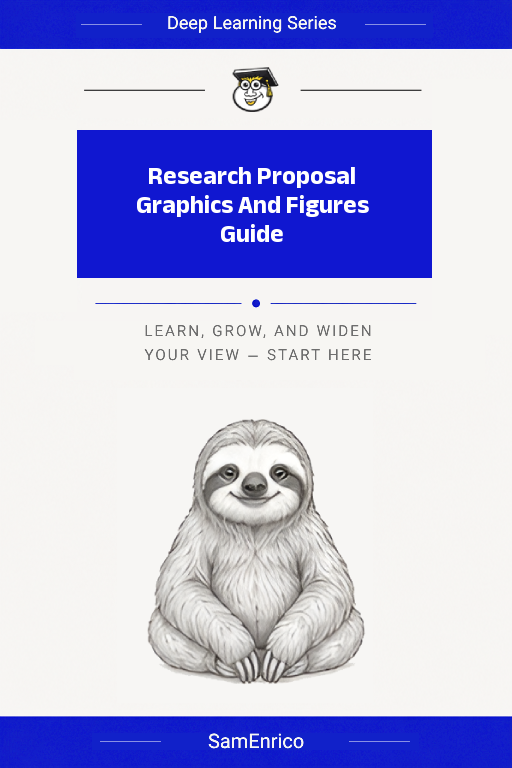
Research Proposal Graphics And Figures Guide
Design conceptual models and workflow diagrams tha
Design conceptual models and workflow diagrams that communicate methods faster than text alone.
Formats
About this book
Free sample
Chapter 1: The 60-Second Execution--You have already lost.Not because your science is weak. Not because your hypothesis is trivial. Not because you forgot to cite a key paper. You have lost because the person reading your proposal will decide its fate before they understand a single sentence you wrote.Let that land.Sixty seconds. That is the average time a grant reviewer spends on the initial screening of a full proposal before making a preliminary judgment.
Some studies put the number closer to ninety seconds. Others, for high-volume programs like the NIH R21 or the ERC Starting Grant, suggest it can be as little as forty-five seconds. The exact number does not matter. What matters is this: in the time it takes to brew a single cup of coffee, a reviewer will form an opinion about whether your work is innovative, whether your methods are credible, and whether you are worth funding.And they will make that decision almost entirely without reading your text.This is not a flaw in the system. It is an efficiency.
Reviewers are overwhelmed. A typical study section might process fifty to a hundred proposals per meeting. Each proposal runs fifteen to thirty pages. If a reviewer read every word of every proposal, they would need weeks of uninterrupted time, which they do not have. They are academics, just like you.
They have labs to run, classes to teach, papers to review, and their own grants to write. The system has therefore evolved an implicit triage process: skim first, read deeply only if the proposal survives the cut.The skimming is not random. Reviewers look for three things in those first sixty seconds. First, the specific aims—usually bullet points, easily scanned. Second, the figures—because pictures are faster than paragraphs.
Third, the methods section, but only if the figures have already convinced them to look. This means your figures are not illustrations. They are not decorations added at the last minute to make the proposal look professional. Your figures are the primary interface between your science and the reviewer's attention span. If your figures…
This is the end of the free sample. Get the eBook to keep going. Buy now
Contents
- Chapter 1
- Chapter 2
- Chapter 3
- Chapter 4
- Chapter 5
- Chapter 6
- Chapter 7
- Chapter 8
- Chapter 9
- Chapter 10
- Chapter 11
- Chapter 12
Details
- Author
- Tompkins Tomoko
- Publisher
- SamEnrico
- Language
- English
- Genre
- research, Student's Shortcut
- Released
- 2026-06-01
- Pages (approx.)
- 154
- Available as
- eBook, Audiobook

Read better in the ZLOADR app
Your eBooks on your phone or tablet. Sign in with your SamEnrico account and start reading.
More by Tompkins Tomoko
 B Vitamin Complex Complete GuideTompkins Tomoko$11.99
 Dissociation Trigger RecoveryTompkins Tomoko$11.99
 The IBS Pantry MakeoverTompkins Tomoko$11.99
 Maritime DecarbonizationTompkins Tomoko$11.99
 Bradley TomTompkins Tomoko$11.99
 The First Year Without PetTompkins Tomoko$11.99
 Sam Sheppard Bedroom ReconstructionTompkins Tomoko$11.99
 Harm OCD GuideTompkins Tomoko$11.99
 Anger Journal For CouplesTompkins Tomoko$11.99
 The Ghost of Checkpoint Charlie: The Untold Story of the Berlin Tunnel 29Tompkins Tomoko$11.99
 The Deep Blue Chronicles: Black Scholars Who Mapped the Ocean's SecretsTompkins Tomoko$11.99
 Growing Verbascum (Mullein)Tompkins Tomoko$11.99
You may also like
 Scientific Research On TM GuideMartens Nathanial$11.99
 Research Proposal Methodology Section MasteryPauley Debroah$11.99
 Research Proposal Appendix CompilationRaines Tyisha$11.99
 Academic Researcher Distraction GuideFord Virgil$11.99
 TM Research and ScienceCovert Nicki$11.99
 Social Anxiety Research ReviewRoberge Cole$11.99
 Research Proposal Significance Section GuideBock Tory$12.99
 Research Proposal Reviewer PsychologyLugo Tawanda$11.99
 Research Proposal Research Questions DesignLara Robbi$11.99
 Research Proposal References and CitationsPatten Shanice$11.99
 Research Proposal Mixed Methods DesignCameron Omega$11.99
 Research Proposal Data Management PlanAnderson Roberto$12.99