
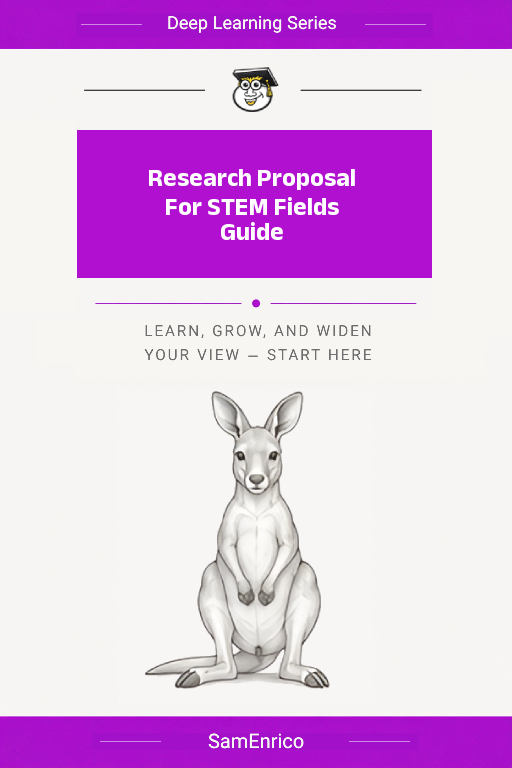
Research Proposal For STEM Fields Guide eBook
Emphasize instrumentation reproducibility and cont
Emphasize instrumentation reproducibility and controlled variables in science and engineering proposals.
Formats
Free sample
Chapter 1: The Metrology Trap--–- Dr. Elena Vasquez had spent eighteen months designing a novel catalyst for carbon capture. Her preliminary data was stunning: a 40% improvement over the state of the art. Her letters of support were impeccable. Her publication record was pristine.
She submitted a $1.2 million proposal to the National Science Foundation with confidence.Six months later, the reviews arrived."The applicant has not demonstrated that their measurement system can distinguish real catalytic improvement from day-to-day instrument drift.""No calibration protocol is provided for the gas chromatograph. How does the applicant know that yesterday's 40% improvement isn't today's 20% degradation?""Preliminary data shows beautiful trends, but there is no discussion of repeatability. Were these three replicates or three thousand?"Rejection. Not because her science was wrong. Not because her idea lacked novelty.
But because she could not prove that her instruments were telling the truth.This chapter is for every Dr. Vasquez who has ever received that review. It dismantles the most dangerous myth in STEM proposal writing: that a good idea is enough. It will show you why the "reproducibility crisis" has spread from psychology into engineering and physics, how uncontrolled variability silently destroys statistical power, and—most importantly—how to reframe measurement uncertainty from a weakness into evidence of expertise that reviewers reward.The Great Masquerade: Why "Cool Science" Fails Without Metrology Let us begin with a uncomfortable truth. The average STEM grant proposal spends approximately 80% of its pages on hypotheses, background, and expected outcomes.
It spends perhaps 5% on how the measurements will be made with sufficient fidelity to trust the conclusions. This ratio is inverted from what actually determines success.A hypothesis can be beautiful. A research plan can be elegant. But if your pressure sensor drifts 2% per day and you do not know it, your beautiful hypothesis will generate beautiful nonsense. Funders have learned this lesson the hard way.The Reproducibility Crisis Comes for Engineering When non-scientists hear "reproducibility crisis," they think of psychology—the famous studies that failed to replicate, the priming experiments that vanished upon re-examination.
What they do not realize is that engineering and physics have their own quiet crisis, hidden behind the assumption that digital readouts are truthful.Consider the humble digital potentiometer. This component, found in thousands of laboratory instruments, is advertised as a precise, programmable resistor. But its resistance drifts with temperature at a rate of approximately 50 to 200 parts per million per degree Celsius. In a lab where the temperature varies by 5°C between morning and afternoon, that digital pot can shift by 0.1% without any warning. No red light flashes.
No error message appears. The data simply changes, and the researcher assumes the sample changed.Or consider MEMS accelerometers—those tiny chips that measure vibration in everything from smartphones to structural health monitors. Their batch-to-batch variance can exceed datasheet claims by a factor of three. Two seemingly identical sensors purchased from the same supplier, manufactured in different weeks, can produce meaningfully different readings. A proposal that assumes all sensors are equal is building on sand.The most chilling example comes from the world of battery research.
A team at a major university published a breakthrough in lithium-ion cathode stability, claiming a 300% improvement over baseline. The paper was cited hundreds of times. Companies expressed interest. Then another lab tried to replicate the result—and failed. The original lab re-ran the experiment and confirmed their original finding.
The second lab re-ran with identical materials and got the baseline performance. For six months, the two labs exchanged angry emails.The culprit? A temperature-controlled chamber. The first lab's chamber had a temperature gradient of 2°C from top to bottom. The second lab's chamber was isothermal.
The battery cycling protocol did not specify where in the chamber the cells were placed. One lab had unknowingly placed cells in the warmer zone; the other had placed them in the cooler zone. Both labs were right, given their conditions. Both labs were wrong to publish without specifying a controlled variable that everyone assumed was trivial.This is the metrology trap. You assume your measurement is straightforward.
You assume your instruments are honest. You assume that "digital" means "precise." All of these assumptions are dangerous.Exploratory Tinkering vs. Confirmatory Experimentation Before we go further, we must make a distinction that most researchers learn only after a rejected proposal—or worse, a retracted paper.Exploratory Tinkering (The Lab Notebook)When you are developing a new method, building a prototype, or exploring a phenomenon you do not yet understand, you are tinkering. In this mode, you are allowed to:Adjust the gain on an amplifier mid-experiment because the signal is saturating Change the integration time on a spectrometer because the signal is noisy Swap out a noisy sensor for a quieter one from a different batch Modify the protocol based on what you observe This is good science. This is how discoveries are made.
And this belongs in your lab notebook, not in a funded proposal.The critical feature of exploratory tinkering is that the experimental conditions are not fixed in advance. You are learning what works. That is legitimate. It is also not fundable as a confirmatory study.Confirmatory Experimentation (The Funded Proposal)When you submit a proposal for funding, you are making a promise: "Given these specific conditions, with these specific instruments calibrated in this specific way, we will measure these specific outcomes with sufficient precision to answer this specific hypothesis."In confirmatory mode, you cannot change the gain mid-run. You cannot swap sensors mid-run.
You cannot adjust the integration time because the signal is noisy. If your signal is too noisy, that means you designed an underpowered experiment—and the reviewers should have caught that.The funded proposal is a contract. You are promising to follow a protocol that you have designed to be robust before you collect a single data point. Exploratory tinkering happens before the proposal, not during the funded work (unless you explicitly budget for a method development phase, which is legitimate but must be labeled as such).Here is the test: If you cannot write down every instrument setting, every calibration step, and every acceptance criterion before you start, you are not ready to write a proposal. You are still in the tinkering phase.The ROI of Rigorous Metrology: Why $50,000 of "Free" Statistical Power Changes Everything Now we arrive at the argument that will transform how you think about measurement quality.
Most researchers view calibration, control charts, and GR&R studies as costs—overhead that consumes budget without generating data. This perspective is financially illiterate.The Basic Calculation Consider a typical $500,000 grant. You plan to run 500 experimental replicates across three conditions. Your preliminary data suggests a standard deviation of 10 units. You want to detect an effect size of 5 units (a signal-to-noise ratio of 0.5).Now imagine that you reduce your uncontrolled variability by 10%.
That is, you implement better environmental controls, stricter calibration protocols, and more careful operator training. Your standard deviation drops from 10 to 9 units.What does that 10% reduction buy you? Statistical power is inversely related to variance. For a fixed sample size, reducing variance by 10% increases your effective sample size by approximately 11% (because power scales with the square root of…
This is the end of the free sample. Get the eBook to keep going. Buy now
About this book
Details
- Author
- Mayhew Karina
- Publisher
- SamEnrico
- Language
- English
- Genre
- research, Student's Shortcut
- Released
- 2026-06-01
- Pages (approx.)
- 147
- Available as
- eBook, Audiobook

Read better in the ZLOADR app
Your eBooks on your phone or tablet. Sign in with your SamEnrico account and start reading.
More by Mayhew Karina
 6G Technology InvestmentMayhew Karina$11.99
 MBSR for Remote WorkersMayhew Karina$11.99
 Triggers and Suicidal IdeationMayhew Karina$11.99
 Postpartum Thrush Treatment GuideMayhew Karina$11.99
 Physical Anger Warning SignsMayhew Karina$11.99
 Sunscreen Ingredients Decoded CourseMayhew Karina$11.99
 Postdrome Migraine GuideMayhew Karina$11.99
 IBS Post Infectious RecoveryMayhew Karina$11.99
 LaGuardia New YorkMayhew Karina$11.99
 Lost Cities of the Coral Sea: The Deep-Sea Archaeologists Who Rediscovered Ancient OceaniaMayhew Karina$11.99
 The Kami’s Last Stand: The Fall of the Thunder God RaijinMayhew Karina$11.99
 Silk Road Unraveled: The Rise and Fall of the Dark Web's Drug EmpireMayhew Karina$11.99
You may also like
 Scientific Research On TM GuideMartens Nathanial$11.99
 Research Proposal Methodology Section MasteryPauley Debroah$11.99
 Research Proposal Appendix CompilationRaines Tyisha$11.99
 Academic Researcher Distraction GuideFord Virgil$11.99
 TM Research and ScienceCovert Nicki$11.99
 Social Anxiety Research ReviewRoberge Cole$11.99
 Research Proposal Significance Section GuideBock Tory$12.99
 Research Proposal Reviewer PsychologyLugo Tawanda$11.99
 Research Proposal Research Questions DesignLara Robbi$11.99
 Research Proposal References and CitationsPatten Shanice$11.99
 Research Proposal Mixed Methods DesignCameron Omega$11.99
 Research Proposal Data Management PlanAnderson Roberto$12.99