
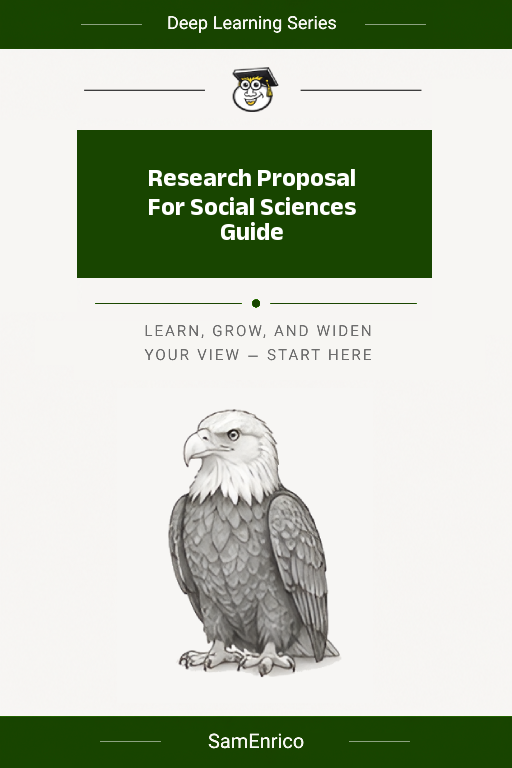
Research Proposal For Social Sciences Guide
Balance generalizability with contextual depth in
Balance generalizability with contextual depth in sociology psychology or political science proposals.
Formats
About this book
Free sample
Chapter 1: The Great Divide--Every incoming doctoral student in sociology, psychology, or political science eventually encounters the same quiet crisis. You have a research question that keeps you awake at night—something about why people protest, how trauma reshapes memory, whether institutions actually deliver on their promises. You bring this question to your advisor, and instead of enthusiasm, you receive a question in return: "Are you quantitative or qualitative?"The assumption embedded in that question is that you must choose. Not just a method, but an identity. A tribe.
A way of seeing the world that comes with its own journals, its own conferences, its own heroes and villains. You will hear that quantitative researchers care about generalizability but ignore context. You will hear that qualitative researchers care about depth but cannot prove anything beyond their specific village or clinic or courtroom. You will be told, explicitly or implicitly, that the strongest proposal is the one that picks a side and stays there.This book argues that the opposite is true. The strongest proposals are not the ones that pretend the other side does not exist.
They are the ones that recognize the trade-off between generalizability and contextual depth, name it transparently, and justify their position on the continuum between these two poles. They may even, as we will see in Chapter 11, traverse that continuum across multiple phases of research. But they never pretend the trade-off isn't there.This chapter dismantles the false dilemma that has paralyzed too many promising research proposals. It introduces the foundational vocabulary that the rest of the book will build upon. And it gives you a diagnostic tool—the Continuum of Intent—that will help you locate your own research question and defend your methodological choices before a hostile reviewer ever gets the chance to question them.The War That Was Never Necessary The quantitative-qualitative divide in the social sciences is not a law of nature.
It is a historical accident, a set of institutional habits hardened into dogma. To understand why this divide persists, we must briefly visit its origins.In the late nineteenth century, the…
This is the end of the free sample. Get the eBook to keep going. Buy now
Contents
- Chapter 1
- Chapter 2
- Chapter 3
- Chapter 4
- Chapter 5
- Chapter 6
- Chapter 7
- Chapter 8
- Chapter 9
- Chapter 10
- Chapter 11
- Chapter 12
Details
- Author
- Butcher Melania
- Publisher
- SamEnrico
- Language
- English
- Genre
- research, Student's Shortcut
- Released
- 2026-06-01
- Pages (approx.)
- 156
- Available as
- eBook, Audiobook

Read better in the ZLOADR app
Your eBooks on your phone or tablet. Sign in with your SamEnrico account and start reading.
More by Butcher Melania
 Mineral Deficiency Signs HandbookButcher Melania$11.99
 Data Center InvestmentButcher Melania$11.99
 Anniversary Reaction TriggersButcher Melania$11.99
 Skin Aging Supplement Evidence GuideButcher Melania$11.99
 Exercise Induced MigraineButcher Melania$11.99
 Competence Log MethodButcher Melania$11.99
 The Academic Conference TalkButcher Melania$11.99
 Narcissist Rage ResponseButcher Melania$11.99
 Koch New YorkButcher Melania$11.99
 The Silicon Oasis: AI and the Secrets of Central Asia's Deep Sea VentsButcher Melania$11.99
 The Nubian Star Charts: Astronomy and the Kushite Scholars of MeroëButcher Melania$11.99
 The Last Broadcast: The Mysterious Signals of Wow! SignalButcher Melania$11.99
You may also like
 Scientific Research On TM GuideMartens Nathanial$11.99
 Research Proposal Methodology Section MasteryPauley Debroah$11.99
 Research Proposal Appendix CompilationRaines Tyisha$11.99
 Academic Researcher Distraction GuideFord Virgil$11.99
 TM Research and ScienceCovert Nicki$11.99
 Social Anxiety Research ReviewRoberge Cole$11.99
 Research Proposal Significance Section GuideBock Tory$12.99
 Research Proposal Reviewer PsychologyLugo Tawanda$11.99
 Research Proposal Research Questions DesignLara Robbi$11.99
 Research Proposal References and CitationsPatten Shanice$11.99
 Research Proposal Mixed Methods DesignCameron Omega$11.99
 Research Proposal Data Management PlanAnderson Roberto$12.99