
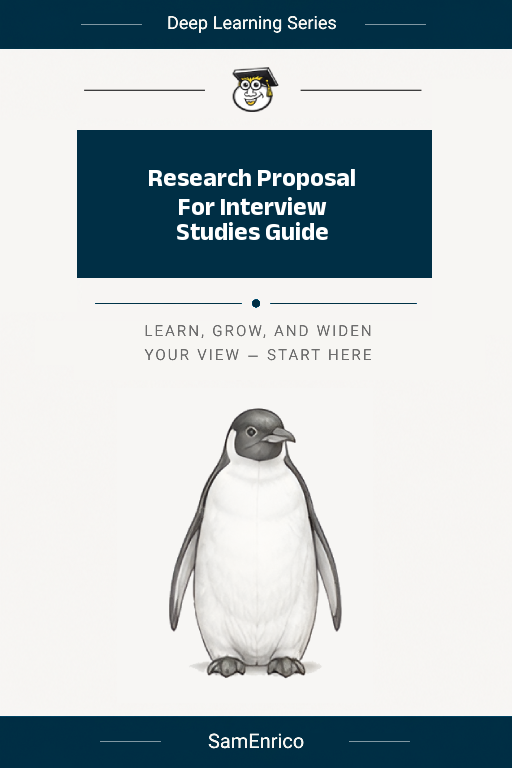
Research Proposal For Interview Studies Guide eBook
Plan semi structured protocols and transcription m
Plan semi structured protocols and transcription methods that show depth without overcommitting.
Formats
Free sample
Chapter 1: The Kitchen Sink Lie--–- The email arrived at 11:47 PM on a Sunday. "Dear Professor Chen, attached is my revised proposal. I am planning to conduct 45 semi-structured interviews with three different stakeholder groups until saturation is reached. Each interview will last approximately 90 minutes. I will transcribe all interviews verbatim.
I expect to complete data collection within eight weeks while also working full-time. Thank you for your feedback on the previous version."Professor Chen closed her laptop without responding. She had seen this exact proposal, with different nouns, at least forty times over her fifteen years on graduate committees. The student was not lazy. The student was not stupid.
The student had simply absorbed the worst possible lesson from qualitative methods textbooks: that more is better, that rigor equals volume, and that promising the moon is the price of admission to academic research.She would write back in the morning. She would gently explain that 45 interviews at 90 minutes each equaled 67.5 hours of audio. At a standard 3:1 transcription ratio, that was 202.5 hours of transcription work—five full 40-hour weeks of nothing but typing. Add interviewing time (another two full weeks), recruitment (unpredictable, but easily another week), analysis (conservatively, four weeks), and writing (six weeks). The student had promised eight weeks.
The math was not just optimistic. It was impossible.The proposal would not pass IRB. It would not pass her committee. It would not be completed. And the student would internalize this rejection as a personal failure rather than a methodological one.This book exists to prevent that Sunday night email.The Core Argument of This Book Depth in interviewing does not come from asking more questions or collecting more data.
It comes from the strategic design of flexible protocols and the disciplined limiting of transcription detail. This book teaches what I call the economy of depth: getting the richest possible data from the smallest feasible investment of time, money, and participant goodwill.The best research proposal is not the most ambitious one. It is the one that most accurately predicts the limits of the researcher's time and the participant's patience. Constraint is not a flaw. It is the engine of depth.This chapter focuses on the single most common reason proposals are rejected or stall during review: the promise of "everything but the kitchen sink." We will diagnose where over-ambition lives, distinguish between productive depth and dangerous breadth, and introduce a methodology-specific framework for knowing—before you write a single interview question—what "enough" actually looks like for your study.The Scene: Graduate Advising at 11:47 PMLet us linger on that Sunday night email for a moment because it contains every sin this book aims to correct.
The student wrote:45 interviews – An impressive number that signals ambition but also signals inexperience. Professional qualitative researchers know that a well-designed study with 15–20 interviews can yield more usable data than a poorly designed study with 50.Three different stakeholder groups – Triangulation sounds rigorous until you realize that each new population requires its own recruitment strategy, its own consent process, and its own analytical lens.Until saturation is reached – A phrase that has become a meaningless incantation. What saturation? Defined how? Measured by what standard?
The student cannot answer these questions because the student has never been taught to ask them.90 minutes each – An ethical violation disguised as thoroughness. Most participants begin to fatigue noticeably after 45 minutes. By 90 minutes, you are not collecting data; you are collecting exhaustion, politeness, and the desire to leave.Transcribe all interviews verbatim – A promise that sounds professional but reveals a misunderstanding of analysis. Verbatim transcription is a specialized tool for conversation analysis and discourse studies. For most semi-structured interview research, it is a vanity project that consumes hundreds of hours for minimal analytical return.Eight weeks while working full-time – The smoking gun.
The student knows, somewhere beneath the anxiety, that this timeline is fiction. But the student has been taught that proposals are performances of competence, not honest estimates of capacity.This student needed permission to do less. Instead, every textbook and every peer example told them to do more. This chapter gives that permission.The Two Types of Over-Promising Over-promising in interview proposals falls into two categories. The first is forgivable inexperience.
The second is structural and requires a complete redesign of how you think about qualitative research.Type 1: Numerical Over-Promising This is the easiest to spot and the easiest to fix. It takes forms like:"We will interview 50 participants" (when the methodology calls for 15)"We will conduct interviews until saturation" (with no check-in points)"Each interview will last 90–120 minutes" (without justification)"All interviews will be transcribed verbatim" (for a study not using discourse analysis)Numerical over-promising comes from conflating qualitative research with quantitative sample size logic. In quantitative research, larger samples generally produce more precise estimates. In qualitative research, larger samples produce more data—but not necessarily more meaning. A phenomenological study of grief does not need 50 participants to identify the essential structure of the experience.
It needs 6 to 10 deeply engaged participants willing to reflect at length.Numerical over-promising is treatable. Show a student the transcription math, and most will revise downward. Show a student the methodology-specific sample size guidelines later in this chapter, and most will feel relief, not disappointment.Type 2: Structural Over-Promising This is harder to see and harder to fix. Structural over-promising happens when the research question itself demands more than any single researcher can reasonably accomplish. Examples include:Comparing three distinct populations without a team Promising to build grounded theory while also conducting ethnographic observation while also collecting life narratives Proposing to interview "until saturation" without defining the thematic map that saturation would fill Structural over-promising requires returning to the research question.
Not every interesting question is answerable by a single researcher with a fixed timeline. This chapter does not ask you to abandon ambitious questions. It asks you to scope them realistically. Sometimes that means narrowing the population from three groups to one. Sometimes that means choosing between grounded theory and phenomenology rather than attempting both.
Sometimes that means accepting that your dissertation will answer a smaller question completely rather than a larger question partially.The diagnostic tool at the end of this chapter will help you distinguish numerical from structural over-promising. They require different interventions.The Five Qualitative Approaches and Their Natural Stopping Points Drawing on Creswell and Poth's Qualitative Inquiry and Research Design, this section reviews the five major qualitative approaches and demonstrates that each implies a different natural stopping point. There is no universal "saturation" number that applies across methodologies. The number of interviews you need is a function of the kind of knowledge you are trying to produce.Narrative Research What it is: The study of individual stories and how people make meaning through narrative structure (beginning, middle, end, turning points, protagonists, antagonists).Typical interview number: 1–5 participants for a single story (one person's life narrative); 10–15 for multiple stories (several people's accounts of a shared event or experience).Why this range: Narrative research prioritizes depth within a single case. You are not trying to generalize across cases; you are trying to understand how one person (or a small number of people) structures their experience into a story.
More participants do not add more narrative insight—they add more narratives, which is a different project (comparative narrative analysis).When you…
This is the end of the free sample. Get the eBook to keep going. Buy now
About this book
Details
- Author
- Mattos Laveta
- Publisher
- SamEnrico
- Language
- English
- Genre
- research, Student's Shortcut
- Released
- 2026-06-01
- Pages (approx.)
- 145
- Available as
- eBook, Audiobook

Read better in the ZLOADR app
Your eBooks on your phone or tablet. Sign in with your SamEnrico account and start reading.
More by Mattos Laveta
 Drag Along Tag AlongMattos Laveta$11.99
 Anger And Caregiver BurnoutMattos Laveta$11.99
 Lotus Flower Opening GuideMattos Laveta$11.99
 Script Recording for ClientsMattos Laveta$11.99
 Manganese Bone And Metabolism GuideMattos Laveta$11.99
 The Mining Engineer Stress GuideMattos Laveta$11.99
 Pet Loss For MuslimsMattos Laveta$11.99
 OCD QuizMattos Laveta$11.99
 Time Blocking For Chronic IllnessMattos Laveta$11.99
 Pandora's Curse: The Box That Never ClosedMattos Laveta$11.99
 The Silk Road of the Sea: Portugal’s Golden ArmadaMattos Laveta$11.99
 Prompt Engineering for Character CreationMattos Laveta$11.99
You may also like
 Scientific Research On TM GuideMartens Nathanial$11.99
 Research Proposal Methodology Section MasteryPauley Debroah$11.99
 Research Proposal Appendix CompilationRaines Tyisha$11.99
 Academic Researcher Distraction GuideFord Virgil$11.99
 TM Research and ScienceCovert Nicki$11.99
 Social Anxiety Research ReviewRoberge Cole$11.99
 Research Proposal Significance Section GuideBock Tory$12.99
 Research Proposal Reviewer PsychologyLugo Tawanda$11.99
 Research Proposal Research Questions DesignLara Robbi$11.99
 Research Proposal References and CitationsPatten Shanice$11.99
 Research Proposal Mixed Methods DesignCameron Omega$11.99
 Research Proposal Data Management PlanAnderson Roberto$12.99