
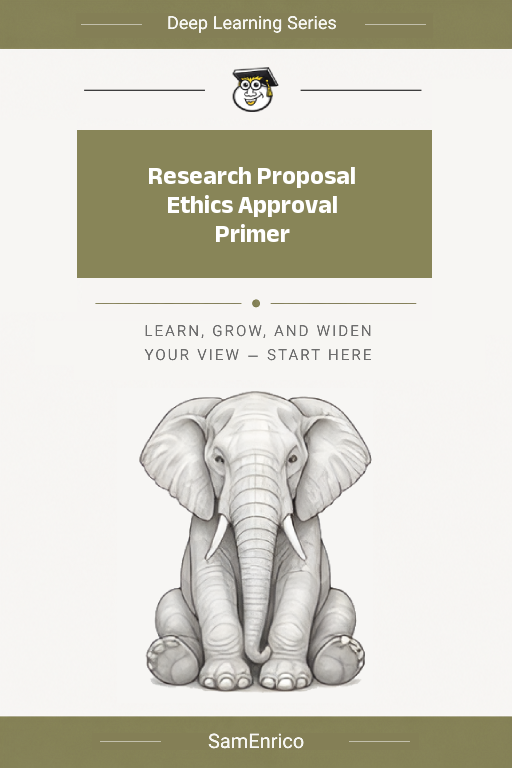
Research Proposal Ethics Approval Primer
Anticipate IRB or ethics committee questions and d
Anticipate IRB or ethics committee questions and draft consent forms before submitting your proposal.
Formats
About this book
Free sample
Chapter 1: The Assumption Trap--Every researcher remembers their first IRB deferral. The email arrives at the worst possible moment – 3:47 AM on a Thursday, or sixty seconds before a grant deadline, or while you are standing in line for coffee, your phone buzzing with a subject line that makes your stomach drop: "IRB Decision – Action Required."You open it expecting approval. You have worked for months. Your advisor signed off. Your methods are sound.
Your intentions are pure. But the letter says something else. "Conditional approval – revisions required." Or worse: "Deferred – resubmission required." And then the vague, maddening language begins. "Please clarify withdrawal procedures." "Revise consent form for readability." "Provide additional detail about data security measures."What did you miss? You read the letter three times, then four.
The comments feel like accusations in a language you barely understand. You were trying to do good research. You recruited carefully, designed ethically, wrote clearly. But somewhere between your good intentions and the IRB's expectations, something broke.This chapter is about that gap. It is about the single most common reason well-meaning researchers fail ethics review.
And it is about how to close that gap permanently – not by becoming a different person, but by adopting a systematic framework that catches what good intentions miss.The Assumption Trap Let us name the problem. The Assumption Trap is the belief that because you are a good person with ethical intentions, your research protocol is automatically ethical. You assume that your goodness will protect your participants. You assume that the IRB will see your character and trust you. You assume that the details – the consent form language, the data security plan, the risk management procedures – are bureaucratic formalities that smart people can skip.Every one of these assumptions is wrong.Consider a real example.
A doctoral candidate in clinical psychology wanted to study the relationship between childhood trauma and adult romantic attachment. She designed a sixty-minute interview asking participants about abuse, neglect, household dysfunction, and current relationship patterns. She recruited through online support groups for trauma survivors. She offered a $50 gift card as compensation. Her intentions…
This is the end of the free sample. Get the eBook to keep going. Buy now
Contents
- Chapter 1
- Chapter 2
- Chapter 3
- Chapter 4
- Chapter 5
- Chapter 6
- Chapter 7
- Chapter 8
- Chapter 9
- Chapter 10
- Chapter 11
- Chapter 12
Details
- Author
- Tirado Amberly
- Publisher
- SamEnrico
- Language
- English
- Genre
- research, Student's Shortcut
- Released
- 2026-06-01
- Pages (approx.)
- 145
- Available as
- eBook, Audiobook

Read better in the ZLOADR app
Your eBooks on your phone or tablet. Sign in with your SamEnrico account and start reading.
More by Tirado Amberly
 Postpartum Social Media PressureTirado Amberly$11.99
 Apartment Strength TrainingTirado Amberly$11.99
 Alternative Protein GuideTirado Amberly$11.99
 Relationship Trigger PatternsTirado Amberly$11.99
 IBS Workplace AccommodationsTirado Amberly$11.99
 Sheppard Case Civil LawsuitTirado Amberly$11.99
 Migraine Trigger Identification GuideTirado Amberly$11.99
 Cuomo New YorkTirado Amberly$11.99
 Anger With Direct ReportsTirado Amberly$11.99
 Operation Northwoods: The False Flag That Almost Started a WarTirado Amberly$11.99
 The Pixel Uprising: How a Single App Toppled a DictatorTirado Amberly$11.99
 Neon Oracle: The Last Diviner of Silicon AlleyTirado Amberly$11.99
You may also like
 Scientific Research On TM GuideMartens Nathanial$11.99
 Research Proposal Methodology Section MasteryPauley Debroah$11.99
 Research Proposal Appendix CompilationRaines Tyisha$11.99
 Academic Researcher Distraction GuideFord Virgil$11.99
 TM Research and ScienceCovert Nicki$11.99
 Social Anxiety Research ReviewRoberge Cole$11.99
 Research Proposal Significance Section GuideBock Tory$12.99
 Research Proposal Reviewer PsychologyLugo Tawanda$11.99
 Research Proposal Research Questions DesignLara Robbi$11.99
 Research Proposal References and CitationsPatten Shanice$11.99
 Research Proposal Mixed Methods DesignCameron Omega$11.99
 Research Proposal Data Management PlanAnderson Roberto$12.99