
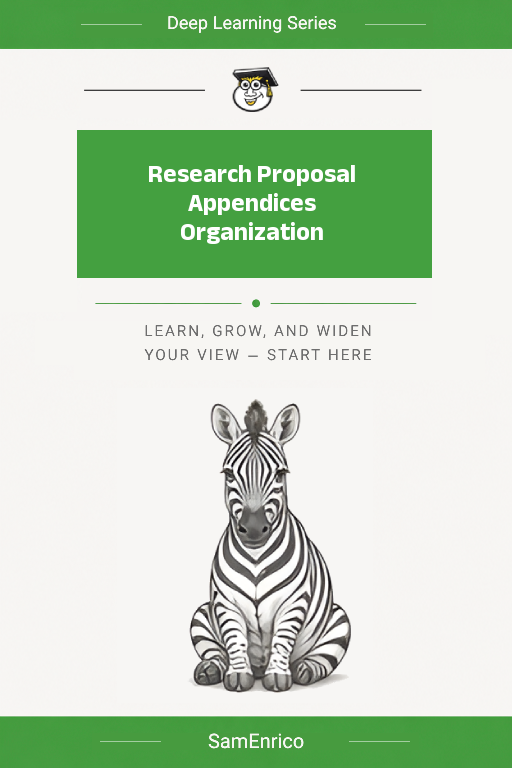
Research Proposal Appendices Organization eBook
Include surveys interview protocols and consent fo
Include surveys interview protocols and consent forms without cluttering your main proposal narrative.
Formats
Free sample
Chapter 1: The Clutter Trap--Every research proposal begins with a noble intention: to be thorough. You want to show your committee, your IRB, or your funding panel that you have thought of everything. So you include the full survey. You paste in the interview protocol. You attach the consent form, the recruitment email, the debriefing script, and the permission letter from the school principal.
You want no one to say, "But where is the evidence?"And then your proposal becomes unreadable.This is the Clutter Trap. It is the single most common mistake that separates rejected proposals from approved ones. And the cruel irony is that the more thorough you try to be, the deeper you fall into the trap.I have watched doctoral students submit 90-page proposals with three full surveys embedded directly in Chapter 3, sandwiched between paragraphs about sampling frames and data analysis plans. I have seen IRB submissions where the consent form was buried on page 27, after two literature review tables and a pilot study debriefing. I have read funding applications where the reviewer wrote, "Unable to locate the actual data collection instruments," even though those instruments were present – they were just invisible, lost in a sea of text.The problem is not your research.
The problem is not your writing ability. The problem is that you have never been taught how to separate story from evidence.This book fixes that.In this chapter, I will show you why appendices are not an afterthought but a strategic asset. I will introduce you to the three audiences who will read your appendices – and why each one looks for something different. I will teach you the three golden rules that will guide every decision in this book. And most importantly, I will help you recognize whether you are currently trapped in the Clutter Trap – and give you the key to get out.The Anatomy of a Proposal Rejection Let me tell you about David.David was a third-year Ph D student in educational psychology.
He had spent eighteen months designing a mixed-methods study on how first-generation college students navigate academic advising. His research questions were sharp. His theoretical framework was elegant. His advisor had signed off on every page.He submitted his dissertation proposal to his committee. Three weeks later, he received a one-paragraph decision: "Revise and resubmit.
The committee finds the proposal methodologically sound but notes that the appendices are disorganized. Please restructure and resubmit within sixty days."David was devastated. He had included everything: his 47-question survey, his semi-structured interview protocol, his consent forms (adult and parental permission), his recruitment flyers, his debriefing script, and a letter of support from a community college partner. He had worked so hard to be complete. And now he was being told that his completeness was actually disorganization.What David did not understand – what no one had ever explained to him – was that his committee had turned to his appendices first.
That is what reviewers do. Before they read your literature review or your analysis plan, they flip to the back of your proposal to verify that you have actually designed feasible data collection instruments. They want to see your survey. They want to read your consent form. They want to understand exactly what you will say to participants in the first thirty seconds of an interview.David's committee opened his appendices and found chaos.
His survey was there, but it was formatted in 8-point font because he had copied it directly from Qualtrics. His consent form was split across two pages with no clear headings. His interview protocol was just a list of twelve questions – no opening script, no probes, no closing. His recruitment flyer used a different font than the rest of the document. And everything was labeled generically: "Appendix A," "Appendix B," "Appendix C," with no indication of what each appendix contained.The committee did not reject David's research.
They rejected his presentation. They could not find what they needed, and they assumed the worst: that he had not actually thought through the mechanics of data collection.David spent the next two weeks reorganizing his appendices. He reformatted his survey at 11-point font. He rewrote his consent form with clear headings. He expanded his interview protocol to include opening and closing scripts.
He created a Table of Appendices. He submitted the exact same research with better-organized appendices. His committee approved it in four days.The difference between rejection and approval was not the quality of David's ideas. It was the quality of his appendices.The Three Audiences You Never Knew You Had Most researchers think of "the reviewer" as a single, monolithic audience. But in reality, your appendices will be read by three distinct groups of people, each with different priorities, different frustrations, and different expectations.
Understanding these differences is the first step toward organizing your appendices strategically.Audience One: The Faculty Committee Member Your dissertation or thesis committee is reading your proposal to assess your readiness to conduct independent research. They want to see that you understand methodology, that you have anticipated practical challenges, and that you can complete the study within a reasonable timeframe. They are evaluating you as a scholar, not just your research.What faculty committee members look for in appendices: clarity of instrument design (e.g., Are your survey questions actually answerable? Do your interview probes make sense?); completeness of ethical safeguards (e.g., Does your consent form properly inform participants?); alignment between your instruments and your research questions (e.g., Can they trace each survey item back to a specific research question?); and professional presentation (e.g., Does the document look like you care about details?).What frustrates faculty committee members: appendices that are incomplete (e.g., a survey with missing skip logic), disorganized (e.g., consent forms buried after irrelevant documents), or unprofessional (e.g., inconsistent fonts, missing page numbers). They also hate when they have to flip back and forth between the main proposal and the appendices because cross-references are missing or incorrect.Audience Two: The IRB Administrator Your Institutional Review Board is reading your proposal to assess risk to human subjects.
They do not care about your theoretical framework or your contribution to the literature. They care about one thing: have you adequately protected participants from harm, and have you documented that protection properly?What IRB administrators look for in appendices: complete and legally sound consent forms (including all required elements: purpose, procedures, risks, benefits, confidentiality, withdrawal rights, signatures); recruitment materials that do not coerce participation (e.g., no excessive incentives, no misleading language); debriefing forms for studies involving deception or stress; and any permissions from external sites (e.g., letters from schools, clinics, or community organizations).What frustrates IRB administrators: consent forms that bury risks on page three, recruitment materials that promise more than the study can deliver, missing debriefing forms for sensitive topics, and appendices that are so disorganized that they cannot find the consent form at all. Unlike faculty committees, IRBs have legal obligations. If they cannot find what they need, they do not ask for revisions – they return your submission unread.Audience Three: The Funding Agency Panelist Your grant reviewer is reading your proposal to assess feasibility and return on…
This is the end of the free sample. Get the eBook to keep going. Buy now
About this book
Details
- Author
- Burrows Glenna
- Publisher
- SamEnrico
- Language
- English
- Genre
- research, Student's Shortcut
- Released
- 2026-05-29
- Pages (approx.)
- 142
- Available as
- eBook, Audiobook

Read better in the ZLOADR app
Your eBooks on your phone or tablet. Sign in with your SamEnrico account and start reading.
More by Burrows Glenna
 The Pet Loss Phone CallBurrows Glenna$11.99
 Eye Fixation Self Trance GuideBurrows Glenna$11.99
 The IBS Breathwork GuideBurrows Glenna$11.99
 Nuclear SMR CapitalBurrows Glenna$11.99
 Anger Trigger to ActionBurrows Glenna$11.99
 Sam Sheppard Co Defense LawyersBurrows Glenna$11.99
 OCD Recovery GuideBurrows Glenna$11.99
 De Blasio BillBurrows Glenna$11.99
 Anger After Partner's AffairBurrows Glenna$11.99
 The Silk Road Tycoon: The Rise of the Swahili MerchantsBurrows Glenna$11.99
 Silicon Alchemist: The Untold Rise of the First Female Tech BillionaireBurrows Glenna$11.99
 Shadows of Versailles: The Secret Affair That Shook a KingdomBurrows Glenna$11.99
You may also like
 Scientific Research On TM GuideMartens Nathanial$11.99
 Research Proposal Methodology Section MasteryPauley Debroah$11.99
 Research Proposal Appendix CompilationRaines Tyisha$11.99
 Academic Researcher Distraction GuideFord Virgil$11.99
 TM Research and ScienceCovert Nicki$11.99
 Social Anxiety Research ReviewRoberge Cole$11.99
 Research Proposal Significance Section GuideBock Tory$12.99
 Research Proposal Reviewer PsychologyLugo Tawanda$11.99
 Research Proposal Research Questions DesignLara Robbi$11.99
 Research Proposal References and CitationsPatten Shanice$11.99
 Research Proposal Mixed Methods DesignCameron Omega$11.99
 Research Proposal Data Management PlanAnderson Roberto$12.99