
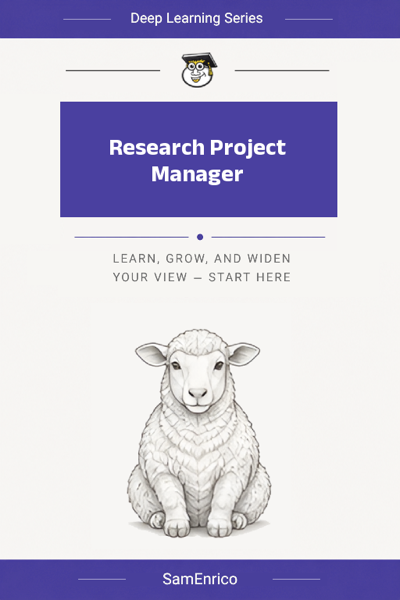
researchInformativeEducational
Research Project Manager eBook
A Coursebook on Research Project Manager
A Coursebook on Research Project Manager
Formats
Free sample
Chapter 1: The RPM Difference--–- You have been trained to ask good questions. You understand hypothesis testing, experimental design, and statistical significance. You can spot a flawed methodology from across a conference hall. But no one ever taught you how to stop a study from bleeding money, how to mediate a screaming match between a Principal Investigator and a postdoc, or how to explain to a funder why enrollment is behind by forty percent and counting.That is not your fault. The traditional education of a researcher—whether you hold a Ph D, an MD, a Master’s degree, or years of lab experience—is almost entirely silent on the subject of project management.
You learned to design experiments, not to manage timelines. You learned to analyze data, not to build budgets. You learned to write grants, not to navigate the labyrinth of institutional review boards, data protection laws, and compliance audits. And yet, here you are. You have been asked—or perhaps voluntold—to manage a research project.
You are the one keeping the spreadsheets, chasing down signatures, reminding the PI about the deadline, and lying awake at night wondering if anyone else realizes how close this study is to falling apart.Welcome to the role you never applied for but somehow ended up occupying: the Research Project Manager, or RPM.This chapter will do three things. First, it will define what an RPM actually is—a hybrid role that exists nowhere in the formal curriculum of research training. Second, it will distinguish research project management from every other form of project management you may have heard about, from construction to software development. Third, it will introduce the RPM Lifecycle, a five-phase framework that will organize the rest of this book and, more importantly, organize your work for the rest of your career.Let us begin with a confession that may save your sanity: you are not a bad manager. You are managing the wrong kind of project with the wrong set of tools.The Hidden Crisis in Research Management In 2019, a clinical trial manager named Dr.
Elena Vasquez inherited a disaster. A Phase II randomized controlled trial for a new anti-inflammatory drug was eighteen months behind schedule and four hundred thousand dollars over budget. The original project manager had resigned after a conflict with the Principal Investigator. The PI, a brilliant immunologist with no management training, had been trying to run the study himself for six months. Enrollment had stalled at forty-two participants instead of the target of two hundred.
The data monitoring committee had flagged concerns about protocol deviations. And the funder had sent a letter threatening to terminate the award unless the study showed “meaningful progress” within ninety days.Dr. Vasquez was not a clinician. She was not a biologist. She held a master’s degree in public health and had spent five years coordinating community health programs.
But in the ninety days that followed, she did something that seemed almost magical to the exhausted research team: she saved the study. She renegotiated timelines with the funder. She implemented a new recruitment strategy that brought enrollment from two participants per month to fifteen. She mediated a truce between the PI and the data manager. She built a simple dashboard that tracked budget burn and enrollment in real time.
The study completed enrollment six months later, published its primary results in a reputable journal, and led to a follow-on grant of two million dollars.What did Dr. Vasquez know that the previous manager did not? She knew that research projects are fundamentally different from every other kind of project. And she knew that managing a research project requires a distinct set of competencies that no one teaches in graduate school.The RPM Defined: A Hybrid Creature A Research Project Manager is someone who bridges three worlds that rarely communicate with one another: the scientific, the administrative, and the ethical. You are part scientist, because you must understand the research question, the methodology, and the meaning of the data.
You are part manager, because you must plan, budget, track, and report. And you are part ethicist, because research involves human participants, animal subjects, sensitive data, and public trust.This hybrid identity is what makes the role so challenging—and so essential. You cannot manage a research project the way you would manage a software launch, because software does not have unknown outcomes, ethical oversight boards, or publication pressure. You cannot manage a research project the way you would manage a construction project, because construction follows predictable linear sequences while research is iterative, uncertain, and full of blind alleys. And you certainly cannot manage a research project by treating it as a collection of administrative tasks, because research lives or dies on the quality of its science, the morale of its team, and the trust of its participants.The RPM, then, is a translator.
You translate the PI’s scientific vision into a project charter. You translate budget categories into laboratory supplies and participant incentives. You translate regulatory requirements into standard operating procedures. And you translate progress reports into the language that funders, ethics boards, and community partners need to hear.Before we go any further, let us name the four core competencies that every RPM must develop. You will not master these in a week or even in a year.
But you can begin practicing them today.Competency One: Scientific Literacy You do not need to be a subject matter expert. You do not need to have a Ph D in the specific field of your research project. But you must be scientifically literate enough to understand what the study is asking, how it plans to answer that question, and what the results might mean.Scientific literacy for the RPM includes understanding the difference between a hypothesis and a research question. It includes knowing what a p-value represents (and what it does not). It includes recognizing the basic architectures of research design: randomized controlled trials, cohort studies, case-control studies, cross-sectional surveys, longitudinal studies, and mixed-methods designs.
It includes enough statistical literacy to know when a sample size calculation is plausible and when it is wishful thinking.You do not have to run the analysis yourself. That is what statisticians are for. But you must be able to ask intelligent questions: “Is our sample size based on an effect size that is actually realistic in this population?” “What is the primary outcome, and how will we measure it reliably?” “If we lose twenty percent of participants to follow-up, will the study still have adequate power?”Without scientific literacy, you will be a paper-pusher, not a partner. PIs will ignore your timeline concerns because they will sense (correctly) that you do not understand the scientific trade-offs. You will make planning decisions that seem administratively sound but scientifically naive.
And you will miss the early warning signs that a study is headed for null results or irreproducible findings.Competency Two: Regulatory Fluency Research is one of the most heavily regulated human activities in modern society. Depending on your field, you may need to navigate the Institutional Review Board (IRB) or Research Ethics Committee (REC), the Health Insurance Portability and Accountability Act (HIPAA)…
This is the end of the free sample. Get the eBook to keep going. Buy now
About this book
Details
- Author
- Mcguire Timmy
- Publisher
- SamEnrico
- Language
- English
- Genre
- research, Informative, Educational
- Released
- 2026-05-06
- Pages (approx.)
- 144
- Available as
- eBook, Audiobook

Read better in the ZLOADR app
Your eBooks on your phone or tablet. Sign in with your SamEnrico account and start reading.
More by Mcguire Timmy
 Roblox Microtransaction TrapMcguire Timmy$11.99
 Early Career ConnectorMcguire Timmy$11.99
 Job Search Task PriorityMcguire Timmy$11.99
 DHT Blocker Natural GuideMcguire Timmy$11.99
 Upwork Hourly Versus Fixed Price GuideMcguire Timmy$11.99
 The Ballot Box Rebellion: How a College Dropout Almost Toppled a Political GiantMcguire Timmy$11.99
 Notion Advanced Database GuideMcguire Timmy$12.99
 Nanotechnology Skills GuideMcguire Timmy$12.99
 Ultimate Handbook Guide to Yantai : (China) Travel GuideMcguire Timmy$11.99
 Understanding Mengel–konigsmark SyndromeMcguire Timmy$17.99
You may also like
 Scientific Research On TM GuideMartens Nathanial$11.99
 Research Proposal Methodology Section MasteryPauley Debroah$11.99
 Research Proposal Appendix CompilationRaines Tyisha$11.99
 Academic Researcher Distraction GuideFord Virgil$11.99
 TM Research and ScienceCovert Nicki$11.99
 Social Anxiety Research ReviewRoberge Cole$11.99
 Research Proposal Significance Section GuideBock Tory$12.99
 Research Proposal Reviewer PsychologyLugo Tawanda$11.99
 Research Proposal Research Questions DesignLara Robbi$11.99
 Research Proposal References and CitationsPatten Shanice$11.99
 Research Proposal Mixed Methods DesignCameron Omega$11.99
 Research Proposal Data Management PlanAnderson Roberto$12.99