
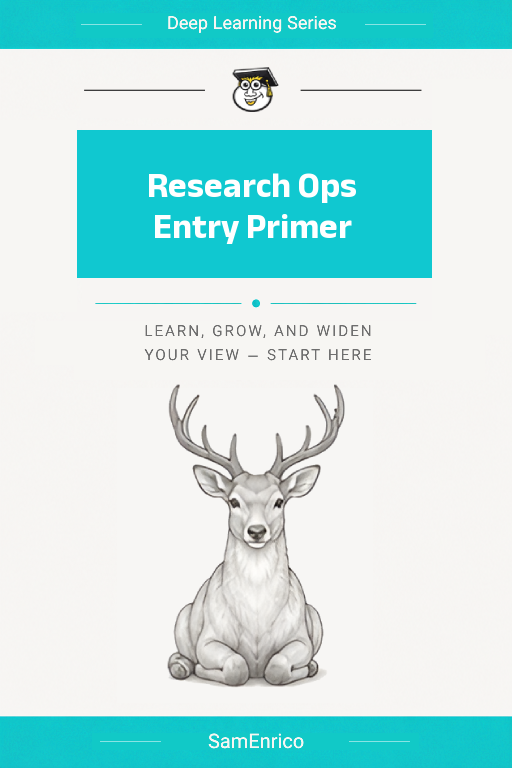
researchNon-Obvious CareerResearch Operations
Research Ops Entry Primer eBook
Start in research operations managing participant
by Avila Ellena
Start in research operations managing participant panels and tool licenses including recruiter coordination and privacy compliance for scalable UX programs.
Formats
Free sample
Chapter 1: The Cost of Chaos--–- On a Tuesday morning in March, a senior user researcher named Maya did something she would later describe as “quietly humiliating.” She opened a Google Sheet that seventeen people had edited in the past month, scrolled past three columns of outdated phone numbers, ignored the highlighted row that said “DO NOT USE – COMPLAINED,” and copy-pasted eight email addresses into a blind carbon copy field. Then she wrote an email that began, “Hi, you participated in a study with us sometime in the last eighteen months…” and hit send. Of those eight emails, three bounced. Two recipients replied asking to be removed from future contact. One asked, “Who are you?” And two never responded at all.
Maya had just spent ninety minutes to secure zero participants for her usability test. She repeated this process three more times that week. By Friday, she had booked exactly two people, one of whom no-showed. Her product manager asked, “Why is research always the bottleneck?” Maya did not have a good answer. The truth was worse than she knew.
She was not the bottleneck. The chaos around her was.This chapter opens with Maya’s story not because it is exceptional, but because it is ordinary. Across the technology industry, thousands of researchers repeat this exact workflow every single day. They build participant panels in spreadsheets that no one owns. They manage tool licenses through memory and goodwill.
They coordinate with recruiters using email threads that stretch longer than product requirements documents. And then they wonder why research takes weeks instead of days, why costs spiral, and why their insights always seem to arrive too late to influence the product decisions that matter most. The answer is not that these researchers are unskilled or unmotivated. The answer is that they are operating without Research Operations. This book exists to fix that.What Is Research Operations, Really?Before we go any further, let us define our terms with precision.
Research Operations—often abbreviated as Re Ops—is the practice of systematizing the people, processes, and tools that enable research to happen at scale. That definition sounds academic, so let me make it visceral. Research Operations is what happens between the moment a researcher says “I need to talk to users” and the moment a participant says “Yes, I will talk to you.” Everything in that gap—finding participants, screening them, scheduling them, incentivizing them, managing their consent, protecting their data, tracking the tools used to do all of this, and measuring whether any of it actually worked—that is Research Operations.For too long, these activities have been treated as invisible, administrative, or simply “someone else’s problem.” The researcher who spends fifteen hours a week recruiting does not put “recruiting” on their performance review as a core competency. The design manager who discovers a forgotten User Testing license costing $24,000 per year does not receive a bonus for finding it. The legal team that gets copied on a participant’s angry GDPR deletion request at 10 PM on a Friday does not celebrate the efficiency of their escalation workflow.
None of this work is celebrated, tracked, or optimized. And that is exactly why it is so expensive.The Eight Pillars of Re Ops Throughout this book, we will organize our thinking around eight foundational pillars of Research Operations. These pillars come from the global Re Ops community, synthesized from hundreds of real-world implementations at companies ranging from early-stage startups to Fortune 500 enterprises. I introduce them here because they will appear as visual icons at the start of every subsequent chapter, helping you see how each topic connects to the broader Re Ops ecosystem.The eight pillars are:Pillar 1: Recruitment and Panel Management. This is the work of finding, screening, tracking, and maintaining relationships with research participants.
It includes everything from building your first proprietary panel (Chapter 3) to setting behavioral screening criteria (Chapter 4) to managing external recruiter relationships (Chapter 5). This pillar is where most entry-level Re Ops professionals spend the majority of their time.Pillar 2: Logistics and Scheduling. This is the operational backbone of research execution. It includes calendar coordination, no-show management, incentive delivery, and the automated workflows that connect recruitment tools to scheduling tools to video conferencing tools (Chapter 7). When this pillar functions well, researchers never think about it.
When it fails, research stops.Pillar 3: Tools and Technology. This pillar covers the software stack that powers research: recruitment platforms, panel databases, scheduling tools, repositories, and license management systems (Chapter 2). It also includes the ongoing work of auditing licenses (Chapter 6), enforcing role-based access control, and ensuring that the stack remains cost-effective as the organization scales.Pillar 4: Governance and Compliance. This is the work of ensuring that research activities comply with legal and regulatory requirements: GDPR, CCPA, HIPAA, and other privacy frameworks. It includes consent management (Chapter 8), data retention policies, vendor risk assessments, and the dreaded but necessary Right to be Forgotten workflow (also Chapter 8).Pillar 5: Ethics and Participant Experience.
Beyond mere legal compliance, this pillar addresses the moral obligation to treat participants with respect. It covers fair incentives (Chapter 5), transparent communication, protection of vulnerable populations, and the design of consent processes that are actually understandable (Chapter 8).Pillar 6: Knowledge Management. This pillar ensures that research insights outlive the researchers who generated them. It includes repository architecture, tagging taxonomies, searchability, and the integration of research findings into product development tools like Jira or Linear. While this book touches on repositories in Chapter 2, a full treatment of knowledge management deserves its own volume.Pillar 7: Measurement and Analytics.
If you cannot measure it, you cannot improve it. This pillar covers the metrics that matter: time-to-recruit, no-show rates, cost-per-participant, license utilization, panel engagement, and diversity representation. Chapter 9 provides a complete dashboard framework.Pillar 8: Participant Relationship Management. This is the long-term work of maintaining trust with your panel. It includes regular communication, feedback loops, panel health audits, and the prevention of both participant fatigue (Chapter 4) and panel attrition (Chapter 10).For entry-level Re Ops professionals, the pillars that will occupy most of your attention are Pillar 1 (Recruitment and Panel Management) and Pillar 3 (Tools and Technology).
These are the visible, measurable, high-impact areas where you can produce immediate results. The other pillars matter enormously, and we will cover them thoroughly, but your fastest path to demonstrating value is through the work of building panels and optimizing licenses.The Hidden Tax You Are Paying Right Now Let us return to Maya, our researcher from the opening story. The ninety minutes she spent copy-pasting email addresses and writing that ineffective recruitment email is not an isolated incident. According to data aggregated from over two hundred companies by the Research Ops Community, researchers spend an average of fifteen hours per week on recruitment, scheduling, and administrative tasks. That is nearly forty percent of a forty-hour work week.
For a researcher earning 120,000peryearplusbenefits,thatisroughly120,000 per year plus benefits, that is roughly 120,000peryearplusbenefits,thatisroughly48,000 of their annual compensation spent on work that no one trained them to do, that they likely dislike, and that a well-designed Re Ops function could handle at a fraction of the cost.But the hidden tax goes far beyond researcher salaries. Consider the cost of shadow IT. Shadow IT refers to software purchased…
This is the end of the free sample. Get the eBook to keep going. Buy now
About this book
Details
- Author
- Avila Ellena
- Publisher
- SamEnrico
- Language
- English
- Genre
- research, Non-Obvious Career, Research Operations
- Released
- 2026-05-29
- Pages (approx.)
- 138
- Available as
- eBook, Audiobook

Read better in the ZLOADR app
Your eBooks on your phone or tablet. Sign in with your SamEnrico account and start reading.
More by Avila Ellena
 Michael Chang Youngest WinnerAvila Ellena$11.99
 Keto For Beginners CourseAvila Ellena$11.99
 EQ Habit Formation GuideAvila Ellena$11.99
 Yahoo Security Question AnswersAvila Ellena$11.99
 The Cozy Cabin Winter RetreatAvila Ellena$11.99
 The Silent Cities of the Aral: Uncovering Central Asia's Lost CivilizationsAvila Ellena$11.99
 Ragnarok and the Fox’s Curse: Loki’s Yokai GambitAvila Ellena$11.99
 Understanding Generalized Anxiety Disorder (Gad)Avila Ellena$17.99
 Adventure Travel RecoveryAvila Ellena$12.99
 Emergency Department TechnicianAvila Ellena$11.99
 How to Start a Catsup Business (Beginners Guide)Avila Ellena$11.99
You may also like
 Scientific Research On TM GuideMartens Nathanial$11.99
 Research Proposal Methodology Section MasteryPauley Debroah$11.99
 Research Proposal Appendix CompilationRaines Tyisha$11.99
 Academic Researcher Distraction GuideFord Virgil$11.99
 TM Research and ScienceCovert Nicki$11.99
 Social Anxiety Research ReviewRoberge Cole$11.99
 Research Proposal Significance Section GuideBock Tory$12.99
 Research Proposal Reviewer PsychologyLugo Tawanda$11.99
 Research Proposal Research Questions DesignLara Robbi$11.99
 Research Proposal References and CitationsPatten Shanice$11.99
 Research Proposal Mixed Methods DesignCameron Omega$11.99
 Research Proposal Data Management PlanAnderson Roberto$12.99