
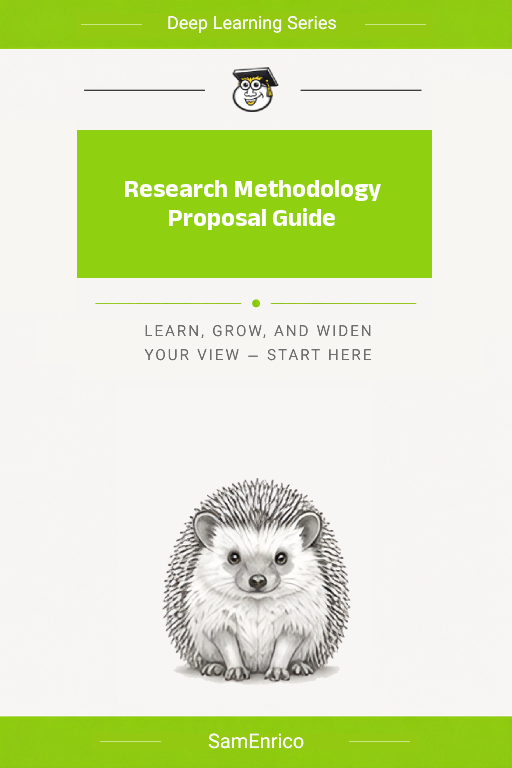
researchStudent's ShortcutResearch MethodsMethodology Guide
Research Methodology Proposal Guide eBook
Describe your research methods clearly including q
by Lin Delma
Describe your research methods clearly including qualitative quantitative or mixed approaches with justification.
Formats
Free sample
Chapter 1: The Justification Imperative--Every rejected research proposal contains a quiet confession hidden between its lines: “I chose this method because I felt comfortable with it.” No committee member will ever say that aloud, but they read it constantly. They read it in the proposal that uses surveys when the research question asks for deep narrative. They read it in the proposal that conducts interviews when the problem demands measurement across a population. They read it in the proposal that lists methods as if selecting items from a catalog—one qualitative, two quantitative, mixed methods for good measure—without a single sentence explaining why these choices belong together.This book exists because that confession is avoidable. More than that, it is unacceptable in serious scholarship.The difference between a proposal that passes and a proposal that perishes is rarely the sophistication of the method.
It is almost always the quality of the justification. Two researchers can propose the exact same survey instrument. One will be approved because they explained why a cross-sectional design fits their specific research question, why their sample size was derived from a power analysis, and why alternative designs would have introduced fatal bias. The other will be rejected because they wrote “I will use a survey” and moved on. The method was identical.
The justification was not.This chapter introduces the central argument of this entire book: methodological justification is not an optional add-on to your proposal. It is the proposal. Everything else—your literature review, your research questions, your theoretical framework—exists to serve the justification of how you will know what you claim to know.We begin with a hard truth. Most novice researchers believe they understand the difference between qualitative and quantitative methods. They can define them.
They can name examples. But when asked to defend a choice under pressure—in writing, before a committee, or during a viva—they fall back on preferences, habits, or vague appeals to “what makes sense.” This chapter dismantles those habits and replaces them with a structured, defensible framework for justifying any methodological choice.You will learn why “I like surveys” is an academic failure. You will learn why “everyone in my department uses interviews” is not a justification but an admission of intellectual laziness. And you will learn the single most important question you must answer before writing a single word of your methods chapter: What kind of answer does my research question demand?That question is the justification imperative. It is the lens through which every subsequent decision—sampling, data collection, analysis, ethics—must be evaluated.
Ignore it, and your proposal becomes a list of techniques in search of a reason. Embrace it, and every method you choose becomes an inevitable conclusion rather than an arbitrary selection.Let us begin by understanding why justification matters more than method selection itself.The Hidden Epidemic of Unjustified Proposals Every academic year, thousands of proposals are submitted to graduate committees, ethics boards, and funding agencies. The majority contain methods chapters that describe what the researcher will do but not why those choices are the only credible options. This is not hyperbole. A review of proposal rubrics across twenty major research universities found that “justification of methodological choices” was the single most common deficiency cited in proposal rejections, appearing in over sixty percent of negative decisions.The problem is not that researchers are lazy.
The problem is that they have been trained to think about methods as techniques rather than as arguments. A survey is not a thing you use. It is a claim about the world: that the phenomena you study can be meaningfully reduced to measurable variables, that your sample can represent a population, and that statistical inference is the appropriate path to knowledge. An interview is also a claim: that meaning is constructed through language, that context matters more than generalizability, and that the researcher’s interpretive labor is a feature, not a bug.When you propose a method without justifying it, you are making these claims silently. And silent claims are undefended claims.
A committee member who disagrees with your implicit assumptions cannot engage with them because you never stated them. They can only reject your proposal for being methodologically incoherent.Consider a typical proposal passage: “This study will use semi-structured interviews with fifteen participants.” A generous reader might infer that the researcher prefers qualitative methods. A critical reader—the kind who sits on dissertation committees—will ask: Why fifteen? Why not thirty? Why not five?
Why interviews rather than focus groups? Why semi-structured rather than unstructured or fully structured? Why this population? Why not surveys, which would reach more people? Why not ethnography, which would capture behavior rather than self-report?The proposal that cannot answer these questions is not a proposal.
It is a wish list.This book trains you to anticipate every one of those questions and to build the answers into your proposal before they are asked. By the time you finish Chapter 12, you will not merely describe your methods. You will be able to defend them against any reasonable challenge, in writing and in person, because you will understand the logical architecture that connects your research problem to every methodological choice you make.The Three Paradigms and the Primacy of the Problem Before you can justify a method, you must understand the worldview that makes that method sensible. Philosophers of science call these worldviews paradigms. A paradigm is a set of beliefs about the nature of reality (ontology), the nature of knowledge (epistemology), and the appropriate methods for producing knowledge (methodology).
Every research proposal implicitly adopts a paradigm, whether the researcher knows it or not.Most introductory textbooks present paradigms as a menu: choose Positivism for quantitative research, Interpretivism for qualitative research, or Pragmatism for mixed methods. This book rejects that framing entirely. Paradigms are not choices you make like selecting a meal from a menu. They are logical consequences of your research problem. You do not decide to be a Positivist and then go looking for a problem that fits.
You diagnose your problem first, and the paradigm reveals itself.Here is the hierarchical relationship that governs this entire book, stated explicitly and defensibly:Your research problem determines your paradigm. Your paradigm determines your methodology. Your methodology determines your methods.Reverse this sequence at your peril. Researchers who start with a favorite method and then search for a problem that justifies it produce forced, unconvincing proposals. Researchers who start with a paradigm and then seek problems that fit produce philosophically rigid work that ignores the complexity of real-world questions.
But researchers who start with a genuine, well-specified research problem and let it tell them what kind of answer it demands produce proposals that feel inevitable rather than arbitrary.This hierarchy resolves a common confusion. Many students believe they must declare a philosophical allegiance before they can proceed. They worry about whether they are “really” a Positivist or an Interpretivist. This book relieves that anxiety. You do not need a philosophical identity.
You need a well-specified problem. The paradigm will follow.With that hierarchy in place, let us examine the three major paradigms. Understand them not as identities to adopt but as logical…
This is the end of the free sample. Get the eBook to keep going. Buy now
About this book
Details
- Author
- Lin Delma
- Publisher
- SamEnrico
- Language
- English
- Genre
- research, Student's Shortcut, Research Methods, Methodology Guide
- Released
- 2026-06-01
- Pages (approx.)
- 155
- Available as
- eBook, Audiobook

Read better in the ZLOADR app
Your eBooks on your phone or tablet. Sign in with your SamEnrico account and start reading.
More by Lin Delma
 Parental Addiction and BoundariesLin Delma$11.99
 LBO Sensitivity Analysis GuideLin Delma$11.99
 Bariatric Surgery Body Image WorkbookLin Delma$11.99
 Getaway Driver UntoldLin Delma$11.99
 Lactose Free Meal Prep ManualLin Delma$11.99
 The Impossible 18: How a Baseball Miracle Defied the OddsLin Delma$11.99
 Bread or Blood: The 1919 Winnipeg General Strike That Shook a NationLin Delma$11.99
 Understanding Cataract Anterior Polar DominantLin Delma$17.99
 US SBA Loan Credit GuideLin Delma$12.99
 How to Become a DetailerLin Delma$11.99
 FormulatorLin Delma$11.99
You may also like
 Scientific Research On TM GuideMartens Nathanial$11.99
 Research Proposal Methodology Section MasteryPauley Debroah$11.99
 Research Proposal Appendix CompilationRaines Tyisha$11.99
 Academic Researcher Distraction GuideFord Virgil$11.99
 TM Research and ScienceCovert Nicki$11.99
 Social Anxiety Research ReviewRoberge Cole$11.99
 Research Proposal Significance Section GuideBock Tory$12.99
 Research Proposal Reviewer PsychologyLugo Tawanda$11.99
 Research Proposal Research Questions DesignLara Robbi$11.99
 Research Proposal References and CitationsPatten Shanice$11.99
 Research Proposal Mixed Methods DesignCameron Omega$11.99
 Research Proposal Data Management PlanAnderson Roberto$12.99