
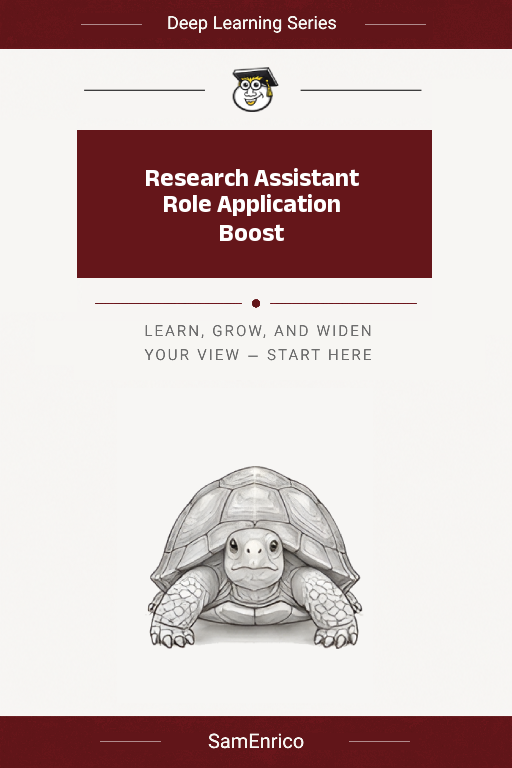
researchStudent's ShortcutRA Positions
Research Assistant Role Application Boost eBook
Secure a paid research assistant position to gener
Secure a paid research assistant position to generate working papers before applying to PhDs.
Formats
Free sample
Chapter 1: Beyond Job Boards--The day Sarah lost her Ph D dream was the same day she discovered the hidden research economy. For six months, she had done everything right. She woke at 6 AM to refresh the Harvard jobs page. She set alerts for every “research assistant” posting on Linked In within two hundred miles. She applied to forty-seven positions, each time uploading the same carefully polished CV and the same generic cover letter that began “Dear Hiring Committee.” She received three automated rejections and forty-four silences.
Not one interview. Not one phone call. Not even a “we have decided to move forward with other candidates.”Sarah was not lazy. She was not unqualified. She had a 3.8 GPA in economics from a respectable state university, two summers of undergraduate research experience, and enough Stata coding to run a difference-in-differences regression in her sleep.
By every conventional measure, she was a strong candidate. And she was failing because she was playing a game whose rules had changed a decade ago without anyone telling her.The truth that no university career center will tell you is this: the majority of paid research assistant positions are never advertised on public job boards. They are filled through networks, cold emails, back-channel recommendations, and professors who decide to hire someone long before they bother writing a job description. The postings you see on university HR sites, Linked In, and academic job boards represent the visible tip of a very large iceberg. Below the waterline lies a sprawling, chaotic, opportunity-rich hidden market that most applicants never even know exists.This chapter is about making the invisible visible.
You will learn the four distinct species of paid RA roles, each with its own ecology, its own application timeline, and its own set of unwritten rules. You will discover why working for a pre-doc program feels nothing like working for a think tank, and why a remote RA gig with a solo professor might be the best-kept secret in academic hiring. More importantly, you will learn how to stop chasing postings and start creating opportunities—by understanding where the real jobs hide and how to position yourself in front of them before they are ever advertised.By the end of this chapter, you will have a targeted list of twenty to thirty potential RA positions, organized by deadline and required materials. You will know exactly which type of role fits your skills, your timeline, and your Ph D ambitions. And you will never again waste weeks spraying generic applications into the void of an online portal.Let us begin by dismantling the single biggest myth about paid RA positions: that they are all found in the same places.The Four Species of Research Assistant Roles Not all RA jobs are created equal.
In fact, they differ so dramatically in structure, compensation, expectations, and career trajectory that comparing a pre-doc at J-PAL to a remote RA gig with a solo professor is like comparing Navy SEAL training to a community garden club. Both have value. Both will teach you something. But they prepare you for radically different futures.Through analysis of over three hundred job descriptions, interviews with principal investigators across six disciplines, and tracking of placement outcomes from more than two hundred RA positions, we have identified four distinct categories. Each appeals to a different type of applicant, requires a different application strategy, and leads to a different set of Ph D placement outcomes.
Understanding these differences is not academic. It is the difference between spending a year cleaning data in frustration versus producing a working paper that opens doors to your dream Ph D program.Type One: University-Based Pre-Doctoral Fellowships These are the Ferraris of the RA world. Pre-doc programs—most famously at institutions like the National Bureau of Economic Research (NBER), the Tobin Center for Economic Policy at Yale, the Abdul Latif Jameel Poverty Action Lab (J-PAL) at MIT, the Becker Friedman Institute at the University of Chicago, and the Opportunity Insights group at Harvard—are highly structured, intensely competitive, and overwhelmingly focused on quantitative social science, particularly economics and related fields.A typical pre-doc runs one to two years. You will be embedded in a research lab or attached to a specific faculty member. Your days will involve cleaning massive datasets, writing code in Stata, R, or Python, running regressions, producing tables and figures for working papers, and possibly co-authoring if you prove yourself.
The emphasis is on causal inference methods: difference-in-differences, instrumental variables, regression discontinuity, randomized controlled trials. You will work long hours. You will be surrounded by other hyper-ambitious recent graduates. You will learn more in twelve months than in three years of coursework.The prestige of these programs is undeniable. Graduates of top pre-docs routinely place into the best Ph D programs in their fields—Harvard, MIT, Stanford, Princeton, Berkeley.
The letter of recommendation from a well-known principal investigator is worth more than a perfect GRE score. But the competition is brutal. Acceptance rates at programs like J-PAL often fall below five percent. You will be competing against students from Ivy League universities, many of whom have prior research experience, multiple published papers, and glowing letters from economists you have never heard of.Who should pursue this path? Candidates with strong quantitative training—multiple courses in econometrics or advanced statistics.
Demonstrated coding ability, not just familiarity but actual project experience that you can show on Git Hub. A clear research interest that matches the lab's focus. If you dream of a Ph D in economics, political science (quantitative track), public health (epidemiology or health economics), or computational social science, a pre-doc is your golden ticket.But there is a catch. Pre-docs are not for everyone. They are intensely demanding, often requiring sixty-hour weeks during grant deadlines or conference submission seasons.
The culture can be competitive and high-pressure. They are also heavily skewed toward economics and quantitative methods. If your field is qualitative political science, history, sociology, anthropology, or English, you will find few pre-doc options. And if you are not sure you want a Ph D, the intensity may burn you out rather than inspire you.Type Two: Think Tanks and Policy Research Organizations Think tanks like the Brookings Institution, the Urban Institute, the RAND Corporation, the Center for American Progress, and the American Enterprise Institute occupy a different universe. These organizations conduct policy-relevant research, often for government agencies or private foundations.
Their RA positions are less purely academic and more applied. You will still analyze data, but you will also write policy memos, brief congressional staff, and translate complex findings into plain English that a busy legislator can understand in ninety seconds.The skill set required overlaps with pre-docs but places greater weight on writing and communication. You need to be able to produce a regression table in Stata and then explain what it means to a non-specialist audience in three clear paragraphs. The coding demands are slightly lower—Stata or R proficiency is essential, but you may not need Python or machine learning—while the writing demands are significantly higher. You will learn to write for impact, not just for academic peers.Think tank RAs also differ in their career trajectories.
While many go on to Ph D programs, others move into government, nonprofit leadership, or the private sector. The network…
This is the end of the free sample. Get the eBook to keep going. Buy now
About this book
Details
- Author
- Forrester Harriette
- Publisher
- SamEnrico
- Language
- English
- Genre
- research, Student's Shortcut, RA Positions
- Released
- 2026-05-30
- Pages (approx.)
- 142
- Available as
- eBook, Audiobook

Read better in the ZLOADR app
Your eBooks on your phone or tablet. Sign in with your SamEnrico account and start reading.
More by Forrester Harriette
 The Four Phrases Metta MethodForrester Harriette$11.99
 The Pet Care Money StressForrester Harriette$11.99
 Drug Dependency Exercise TherapyForrester Harriette$11.99
 Meditation For Anxious BeginnersForrester Harriette$11.99
 Networking for Fitness ProfessionalsForrester Harriette$11.99
 Fire Dream MeaningForrester Harriette$11.99
 Yoga Class Anxiety GuideForrester Harriette$11.99
 Medicaid Parent GuideForrester Harriette$11.99
 Anapanasati for Work StressForrester Harriette$11.99
 Voyage of the Endurance: The Generation Ship That Could Save HumanityForrester Harriette$11.99
 Dirt to Glory: The Rise of Aussie Freestyle LegendsForrester Harriette$11.99
 The Corsair King: Hayreddin Barbarossa and the Rise of the Ottoman NavyForrester Harriette$11.99
You may also like
 Scientific Research On TM GuideMartens Nathanial$11.99
 Research Proposal Methodology Section MasteryPauley Debroah$11.99
 Research Proposal Appendix CompilationRaines Tyisha$11.99
 Academic Researcher Distraction GuideFord Virgil$11.99
 TM Research and ScienceCovert Nicki$11.99
 Social Anxiety Research ReviewRoberge Cole$11.99
 Research Proposal Significance Section GuideBock Tory$12.99
 Research Proposal Reviewer PsychologyLugo Tawanda$11.99
 Research Proposal Research Questions DesignLara Robbi$11.99
 Research Proposal References and CitationsPatten Shanice$11.99
 Research Proposal Mixed Methods DesignCameron Omega$11.99
 Research Proposal Data Management PlanAnderson Roberto$12.99