

Non-FictionSelf-HelpDevelopmental Trauma
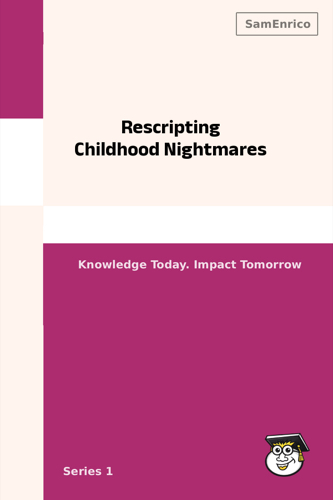
Rescripting Childhood Nightmares eBook
Helps adults reprocess recurring nightmares rooted
Helps adults reprocess recurring nightmares rooted in early developmental fears.
Formats
Free sample
Chapter 1: The Uninvited Familiar--–- It arrives without knocking. Never has, never will. One moment you are drifting—that pleasant, boneless float just before sleep claims you—and the next, the scenery changes. The bedroom dissolves. In its place, a hallway you have never seen but know intimately.
A staircase that leads to a basement you have visited a hundred times in dread. A door that opens onto a room where the lights do not work and something breathes in the corner.You are not confused. That is the strangest part. In waking life, a sudden change of location would trigger alarm, curiosity, a search for explanation. But in the nightmare, you accept the impossible without question.
Of course the hallway is here. Of course the stairs go down. Of course you are running, or hiding, or falling, or trying to scream with a throat full of cotton. You have done this before. You will do it again.
The dream does not ask for your permission. It does not care that you paid the mortgage and ate your vegetables and went to therapy. It pulls you under like a riptide, and you go because some part of you has always known that this is simply what happens when the lights go out.You wake with a gasp. The clock says 3:14 AM. Your shirt is damp.
Your mouth tastes of metal. For a long moment, you cannot remember where you are—the bedroom looks foreign, the shadows on the wall unfamiliar. Then reality snaps back into place. You are an adult. You are safe.
The monster was not real. You take a breath. Then another. You check your phone. You scroll social media until your eyes burn.
Eventually, you sleep again, and in the morning, you tell yourself it was just a dream. Just a bad dream. Just the same bad dream you have been having since you were six years old, the one with the faceless man, the one where you are lost in the mall, the one where your teeth crumble into powder, the one where you fall and fall and never hit the ground.Just a dream.But here is the question that haunts the margins of every such morning: If it is just a dream, why does it feel more real than anything that happens today? And why, after decades of telling yourself it isn't real, hasn't it stopped?This book exists because that question has an answer. Not a comforting answer, perhaps, but a useful one.
The nightmare is not a random malfunction of a tired brain. It is not a punishment for hidden sin. It is not evidence of weakness or madness. The nightmare is a stuck communication—a message from a younger self that never learned the language of adult safety. And until that message is received, the nightmare will continue to arrive, night after night, decade after decade, as faithful and unwelcome as a letter carrier delivering mail to an address that no longer exists.The first step to ending the nightmare is to stop asking what it means and start asking when it began.
Not the date. Not the trigger. The developmental era. Because nightmares, like all deep fears, have accents. And your nightmare's accent tells you exactly how old the scared part of you really is.The Myth of the Random Nightmare Let us dispense with a common misconception immediately.
Popular culture—and even some well-meaning therapists—often treats nightmares as the brain's way of "processing" daily stress. Had a fight with your partner? You might dream of being chased. Worried about that presentation? You might dream of showing up naked to the meeting.
This is called the continuity hypothesis of dreaming, and it has some truth to it. Yes, daily stress can influence dream content. Yes, anxious people have more nightmares than non-anxious people. But the continuity hypothesis fails to explain the single most distinctive feature of the developmental nightmare: its stubborn, almost obsessive repetition.A stress dream about a presentation goes away when the presentation is over. A fight-related chase dream fades when the conflict resolves.
But the developmental nightmare—the one with the monster, the lost child, the falling teeth, the paralysis demon—does not respond to changes in your daily circumstances. It persists through promotions and layoffs, through marriages and divorces, through years of therapy and medication. It persists even when you are genuinely happy. This persistence is not a sign that the nightmare is "true" in some supernatural sense. It is a sign that the nightmare is old.
It was installed on an earlier operating system, and it runs independently of whatever software you have added since.Consider the following clinical observation, drawn from sleep research conducted at the University of New Mexico and replicated in multiple subsequent studies: among adults who report recurring nightmares with the same content (identical monster, same chase, identical setting), more than eighty percent report that the nightmare first occurred before the age of ten. Not only that, but the content of the nightmare rarely updates. The monster that terrified you at six is the same monster that terrifies you at forty-six. The mall you got lost in as a child is the same mall—same escalators, same fluorescent lights, same empty anchor stores—decades later. The nightmare is frozen in time because the fear it carries is frozen in time.This is the crucial insight that transforms nightmare work from exorcism to archaeology.
You are not haunted by a demon. You are haunted by a developmental fossil—a fear that was perfectly appropriate for a three-year-old or a six-year-old or an eight-year-old, but that your adult brain never received permission to outgrow. The nightmare is not a prediction of future danger. It is a recording of past danger, played on a loop, because the tape was never erased.The Archaeology of Fear If your nightmares are fossils, then your task is not to fight them. Your task is to excavate them.
To brush away the dirt of metaphor and symbol until you can see the original bone—the original fear—in its authentic shape. This is delicate work. It requires patience, curiosity, and a willingness to sit with discomfort without being consumed by it. But it is not mysterious. The tools are simple.
And the first tool is a single question, asked not to your waking, logical brain, but to the body that holds the fear.Here is the question: When I am in the nightmare, how old do I feel?Not how old you are in the dream. Your dream-self may be an adult, a teenager, or a child. That is not the question. The question is about affective age—the emotional register of the fear. Does the fear feel like a toddler's fear (abandonment, separation, the loss of the caregiver)?
Does it feel like a preschooler's fear (punishment, the monster under the bed, the authority figure who cannot be appeased)? Does it feel like a school-aged child's fear (shame, exposure, the body betraying itself through falling teeth or wetting pants)? Or does it feel like an adolescent's fear (social annihilation, being seen as defective, the judgment of the…
This is the end of the free sample. Get the eBook to keep going. Buy now
About this book
Details
- Author
- Adkins Andrew
- Publisher
- SamEnrico
- Language
- English
- Genre
- Non-Fiction, Self-Help, Developmental Trauma
- Released
- 2026-06-10
- Pages (approx.)
- 147
- Available as
- eBook, Audiobook

Read better in the ZLOADR app
Your eBooks on your phone or tablet. Sign in with your SamEnrico account and start reading.
More by Adkins Andrew
 Tibetan Plateau ExpeditionAdkins Andrew$11.99
 Multi Platform Gig Income StrategyAdkins Andrew$11.99
 Indonesian Domestic Worker To EntrepreneurAdkins Andrew$11.99
 Surgeon Anger Cognitive GuideAdkins Andrew$11.99
 Atomic Habits For Mood ManagementAdkins Andrew$11.99
 Weekly Weigh In GuideAdkins Andrew$11.99
 Loci Method For Dream RecallAdkins Andrew$11.99
 The Grid That Changed Everything: How Barcelona’s Superblocks Redefined Urban LivingAdkins Andrew$11.99
 Silk & Spice: The Rise and Fall of the Pepper EmpireAdkins Andrew$11.99
 India Franchise Development GuideAdkins Andrew$12.99
 Turkish Student Residence PermitAdkins Andrew$12.99
 How to Start a Cable and Other Subscription Programming BusinessAdkins Andrew$11.99
You may also like
 Hong Kong Handover 1997Dunn Johnnie$11.99
 Zumba For Postnatal Recovery CourseNeal Christian$11.99
 Zumba for BeginnersLadner Nikia$11.99
 YouTube Comment Mining GuideHumes Pandora$12.99
 Worry Box MeditationCarlin Rudy$11.99
 Workplace Stress MeditationNguyen Lynn$11.99
 Workplace Stress and Sleep RepairHawley Ivory$11.99
 Workplace Perfectionism CureDelaney Jeffry$11.99
 Workplace Injustice Anger GuideWallen Isabelle$11.99
 Work Addiction and Burnout LinkGreenwood Ester$11.99
 Women in Yoga and WellnessBeattie Galina$11.99
 Women in Stand Up ComedyChun Evangeline$11.99