
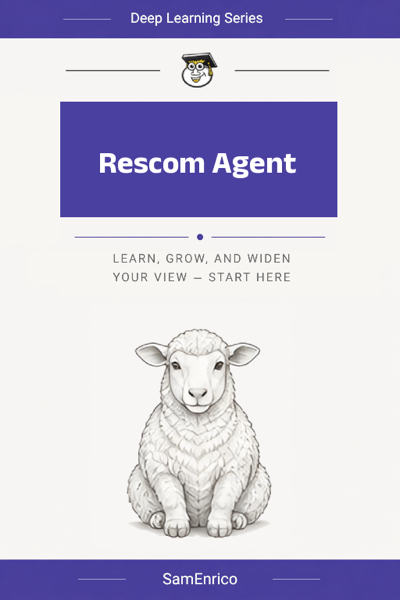
Non-FictionInformativeEducational
Rescom Agent eBook
A Coursebook on Rescom Agent
A Coursebook on Rescom Agent
Formats
Free sample
Chapter 1: The Wake-Up Call...--The explosion happened at 3:47 AM on a Tuesday.It was not a bomb. It was a Mercedes G-Wagon crashing through the wrought-iron gate of a twelve-million-dollar estate in Potomac, Maryland. The gate, which the homeowners’ association had assured everyone was “burglar-resistant,” folded like aluminum foil. The vehicle tore across the front lawn, plowed through a hedgerow, and stopped against the base of a fountain. Three masked men exited.
They were inside the house forty-seven seconds later.The security guard on duty that night was a fifty-nine-year-old former truck driver named Harold. He had been working for Elite Protection Services for eight months. His training consisted of a four-hour online course and two days of shadowing a senior guard who had since been fired for sleeping on the job. Harold did not know how to use the alarm system’s override codes. He did not know that the camera covering the driveway had been misaligned for three weeks.
He did not know that the gate’s emergency release was located on the driver’s side, easily accessible from any vehicle that pulled alongside it.What Harold did know, with absolute certainty, was that he was not paid enough to die.He retreated to the guardhouse, locked the door, and called 911. The dispatcher told him that police would arrive in approximately twelve minutes. Harold relayed this information to the homeowners via the intercom system, which he had never tested and which was not functioning properly. The homeowners received only static.The three masked men spent nine minutes inside the house. They took jewelry, cash, a safe bolted to the floor of the master closet, and two paintings worth an estimated eight hundred thousand dollars.
They exited through the same broken gate, transferred to a waiting sedan, and were gone before the first police cruiser arrived.Harold was fired the next day. Elite Protection Services lost the contract for the property and two other high-value estates in the same area. The homeowners’ association filed a lawsuit alleging negligence, breach of contract, and emotional distress. Elite settled for an undisclosed amount, but the damage was done. The company’s reputation never recovered.Harold now works as a security guard at a parking garage in Baltimore.
He tells anyone who asks that he did the right thing—that he followed his training, that he prioritized his own safety, that he was not a hero and never claimed to be.He is correct about one thing: he was not a hero.But he was not a villain either. Harold was a symptom. He was the predictable outcome of an industry that treats security as a cost to be minimized rather than an asset to be optimized. He was hired cheap, trained poorly, equipped inadequately, and supervised negligently. Then he was blamed when the inevitable happened.This book exists because Harold’s story is not an exception.
It is the rule. And the rule is getting people killed.The Illusion of Security There is a fundamental misunderstanding about residential security that pervades both the industry and the public. That misunderstanding is this: that the presence of a uniform, a badge, and a fence creates security.It does not.Uniforms can be purchased online for forty dollars. Badges can be printed at any office supply store. Fences can be climbed, cut, or driven through.
What creates security is not the presence of protective measures but their effectiveness. And effectiveness requires three things that are systematically undervalued in the residential security industry: training, intelligence, and accountability.Training is not a four-hour online course. Training is hundreds of hours of instruction, practice, and testing across a range of disciplines: threat assessment, legal boundaries, defensive tactics, medical response, report writing, and communications. Training is not something you complete once and then forget. Training is continuous, recurring, and demanding.Intelligence is not a logbook filled with “all quiet.” Intelligence is the systematic collection, analysis, and application of information about the environment, the adversary, and the vulnerabilities of the property.
Intelligence is what allows a Rescom Agent to predict a threat before it materializes and to prevent an incident before it occurs.Accountability is not a quarterly performance review. Accountability is a culture in which every action—and every inaction—is documented, reviewed, and subject to improvement. Accountability is what separates a profession from a job. In a profession, you are responsible for the outcomes of your decisions. In a job, you are responsible only for showing up.The residential security industry has systematically failed at all three.
Training is minimal because it costs money. Intelligence is nonexistent because it requires effort. Accountability is avoided because it exposes liability.The result is Harold.The Cost of Complacency The financial cost of residential security failures is staggering. According to data compiled from insurance claims, law enforcement reports, and civil litigation filings, residential burglaries and home invasions in high-net-worth properties cost victims an estimated 2.3 billion dollars annually in direct losses. This figure does not include the cost of legal fees, insurance premium increases, security upgrades, or the intangible cost of psychological trauma.But the financial cost, however large, is not the most important cost.Consider the case of the Henderson family in Greenwich, Connecticut.
In 2018, a home invasion at their estate resulted in the death of the father, a sixty-two-year-old retired investment banker who was shot when he confronted the intruders. The security guard on duty was found hiding in a maintenance shed. The guard had been hired three months earlier. His background check consisted of a phone call to his previous employer, who confirmed that he had “shown up for work most days.” He had no training in active threat response. He had never practiced a lockdown drill.
He had never even been shown where the safe room was located.The guard was not charged criminally. The state’s attorney determined that he had no legal duty to intervene—that his role, as defined by his employment contract, was to “observe and report,” not to “engage and protect.” The family’s civil lawsuit against the security company resulted in a settlement of 14.5 million dollars, but no amount of money can replace a husband and father.The Henderson case is frequently cited by security experts as an example of catastrophic failure. But it is also cited by defense attorneys as an example of precisely why security companies limit the scope of their guards’ duties. If a guard has no duty to intervene, the company cannot be sued for failing to train the guard to intervene. This is not an accident.
This is a deliberate legal strategy.The strategy works—until it doesn’t. Juries are increasingly unwilling to accept the “observe and report” defense when the property in question is a multi-million-dollar estate and the residents expected something more than a passive observer. The standard of care for residential security is rising, and the industry is struggling to keep pace.The Birth of the Rescom Agent The term “Rescom Agent” did not emerge from a marketing focus group. It emerged from the field—from security professionals who recognized that the traditional model was broken and that a new model was needed.The first documented use of the…
This is the end of the free sample. Get the eBook to keep going. Buy now
About this book
Details
- Author
- Langdon Iraida
- Publisher
- SamEnrico
- Language
- English
- Genre
- Non-Fiction, Informative, Educational
- Released
- 2026-06-02
- Pages (approx.)
- 157
- Available as
- eBook, Audiobook

Read better in the ZLOADR app
Your eBooks on your phone or tablet. Sign in with your SamEnrico account and start reading.
More by Langdon Iraida
 Sexual Addiction vs High DriveLangdon Iraida$11.99
 The Oklahoma Girl Scout MysteryLangdon Iraida$11.99
 IBS Post Infectious Recovery WorkbookLangdon Iraida$11.99
 Harvard Extension Alumni Success StoriesLangdon Iraida$11.99
 The Silent Roar: Kiyoo Wadati and the Birth of Seismology in Southeast AsiaLangdon Iraida$11.99
 The Bone Collector of the Andes: The Curse of the ChullachakiLangdon Iraida$11.99
 Understanding Hunter SyndromeLangdon Iraida$17.99
 Discord Community Builder WorkbookLangdon Iraida$12.99
 CBDC Outlook 2026Langdon Iraida$12.99
 Ultimate Handbook Guide to Tampico : (Mexico) Travel GuideLangdon Iraida$11.99
You may also like
 Hong Kong Handover 1997Dunn Johnnie$11.99
 Zumba For Postnatal Recovery CourseNeal Christian$11.99
 Zumba for BeginnersLadner Nikia$11.99
 YouTube Comment Mining GuideHumes Pandora$12.99
 Worry Box MeditationCarlin Rudy$11.99
 Workplace Stress MeditationNguyen Lynn$11.99
 Workplace Stress and Sleep RepairHawley Ivory$11.99
 Workplace Perfectionism CureDelaney Jeffry$11.99
 Workplace Injustice Anger GuideWallen Isabelle$11.99
 Work Addiction and Burnout LinkGreenwood Ester$11.99
 Women in Yoga and WellnessBeattie Galina$11.99
 Women in Stand Up ComedyChun Evangeline$11.99