
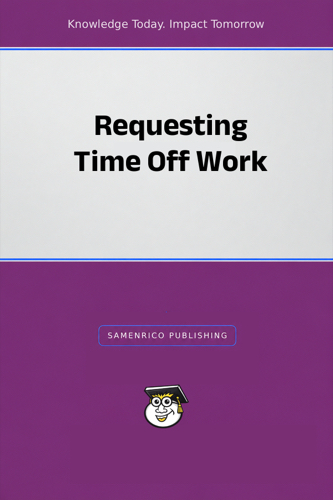
Requesting Time Off Work eBook
Navigates tricky vacation requests and family leav
Navigates tricky vacation requests and family leave discussions.
Formats
Free sample
Chapter 1: The Guilt Economy--–- The first time Sarah canceled her own vacation, she told herself it was practical. She was a senior accountant at a mid-sized firm, and the quarterly close fell right in the middle of her planned week off. “I’ll go next year,” she said, closing the booking website. The second time, her mother’s health was declining, but instead of requesting emergency leave, Sarah worked from the hospital waiting room, her laptop balanced on her knees. “They need me,” she whispered to a nurse who asked why she wasn’t sitting with her mother.
The third time, Sarah didn’t even bother planning a vacation. She had internalized a simple, devastating equation: My presence equals my value. My absence equals my replacement.Sarah is not lazy. She is not unambitious. She is not a martyr.
Sarah is a prisoner of what this book calls the Guilt Economy—an invisible system of emotional currency where employees trade their time, their rest, and their dignity for the fleeting feeling of being indispensable. In the Guilt Economy, requesting time off feels less like a logistical conversation and more like a confession of failure. You are not asking for a break; you are admitting that you are tired, and tiredness in a scarcity-minded workplace is indistinguishable from weakness.This chapter is not about how to write an email. It is not about company policy or the legal minimums of the Family and Medical Leave Act. Those topics will come later.
This chapter is about the war inside your own head—the voice that says, “If I ask for Tuesday off, they’ll know I’m not committed.” The voice that whispers, “Everyone else works through lunch. Why shouldn’t you?” The voice that screams, “You just started this job. You cannot ask for time off.”We are going to kill that voice. Not by pretending it doesn’t exist, but by understanding exactly where it comes from, why your boss hears a different version of it, and how to separate your worth as a human being from your attendance record as an employee.The Emotional Transaction No One Talks About Every time-off request is actually two conversations happening simultaneously. The first conversation is the spoken one: “I would like to take five days off starting the 15th.” The second conversation is the unspoken emotional transaction.
On your side, you are thinking: “Am I asking for too much? Will they think I’m lazy? What if they realize they can function without me?” On your manager’s side, they are thinking: “Who will cover that client report? What if the server crashes? How will I explain this to my boss?”Here is the radical reframe that underpins this entire book: Your guilt is not about you.
And your boss’s anxiety is not about you, either.Your guilt is a structural byproduct of a work culture that has spent a century rewarding presence over productivity. The modern office was designed in an era of factories and assembly lines, where time physically spent at a machine correlated directly with output. That model is obsolete, but our psychology has not caught up. We still measure loyalty in hours logged, not problems solved. When you feel guilty for leaving, you are not feeling a moral failing; you are feeling the ghost of industrial capitalism rattling its chains.Your boss’s anxiety, meanwhile, is not personal.
They are not lying awake wondering if you, specifically, deserve a beach. They are lying awake wondering how to cover your tasks without burning out the rest of the team. Their fear is operational, not relational. They are afraid of failure, not afraid of your happiness. Once you understand that, the entire negotiation shifts.
You are no longer asking for a favor. You are offering to solve an operational problem.Presenteeism: The Silent Career Killer There is a term for the belief that simply showing up is enough: presenteeism. It is the opposite of absenteeism, and it is far more dangerous because it is rewarded. The employee who comes in with a fever, who answers emails from their honeymoon, who never takes a full lunch—that employee is praised. They are called “dedicated.” They are called “team players.” They are called, often, “on the fast track.”But presenteeism is a lie dressed up as virtue.
Study after study shows that employees who never disconnect have higher error rates, lower creativity, and significantly worse decision-making skills after just two weeks of sustained work without rest. A 2019 study in the Journal of Occupational Health Psychology found that employees who worked through vacation reported the same levels of burnout as employees who never took vacation at all. In other words, physical presence without mental restoration is indistinguishable from exhaustion.The guilt you feel is the price of admission to the presenteeism cult. And the first step to leaving that cult is recognizing that your employer benefits more from a rested, focused, present version of you than from a burnt-out, resentful, physically present version of you. But you cannot just know this intellectually.
You have to believe it in your bones.The Scarcity Mindset vs. The Regenerative Mindset Let us travel across the Atlantic for a moment. In much of the United States, time off is viewed through what this book calls the Scarcity Mindset. In this framework, work is a finite pie. Every hour you take off is an hour stolen from the company.
Rest is a cost, not an investment. Vacation is a perk, not a necessity. This mindset produces guilt, hoarding of time, and a peculiar form of competitive suffering where the employee who works the longest hours wins an unspoken trophy.Now consider much of Western Europe, particularly Germany and the Netherlands, where a different framework operates: the Regenerative Mindset. In this framework, rest is an input, not an output. Time off is viewed as maintenance, like changing the oil in a car.
Companies with a Regenerative Mindset actually see higher productivity per hour worked because employees return with renewed focus, fewer errors, and lower turnover. The German approach to vacation—typically four to six weeks per year, often legally mandated—did not collapse the economy. It made the workforce more efficient.You cannot change your company’s mindset overnight. But you can change your own. The first step is to stop apologizing for being human.
The second step is to understand exactly what your boss is afraid of.Your Boss’s Secret Fear (It’s Not You)Let us sit in your manager’s chair for a moment. Your boss wakes up at 3 AM not because they hate you, but because they have a list of deliverables that must be met by Friday. Their own boss sends terse emails. There is a budget review next week. Someone on the team just quit.
And now you—a reliable, competent employee—are asking to disappear for a week.Your boss’s brain immediately runs a risk assessment. It is not personal. It is algorithmic. The algorithm asks three questions:Who will do your critical tasks while you are gone? (Coverage)Will those tasks fall behind and make me look bad?…
This is the end of the free sample. Get the eBook to keep going. Buy now
About this book
Details
- Author
- Burchfield Khadijah
- Publisher
- SamEnrico
- Language
- English
- Genre
- Non-Fiction, Self-Help, Work Life Balance
- Released
- 2026-06-10
- Pages (approx.)
- 142
- Available as
- eBook, Audiobook

Read better in the ZLOADR app
Your eBooks on your phone or tablet. Sign in with your SamEnrico account and start reading.
More by Burchfield Khadijah
 The Mindfulness for EmotionsBurchfield Khadijah$11.99
 IBS Hydration Strategies GuideBurchfield Khadijah$11.99
 Teresas Concept of Spiritual BetrothalBurchfield Khadijah$11.99
 Thiamine for Alcohol DetoxBurchfield Khadijah$11.99
 Substance Use Recovery and SmokingBurchfield Khadijah$11.99
 Opioid Withdrawal ManagementBurchfield Khadijah$11.99
 Antibiotic RecoveryBurchfield Khadijah$11.99
 The Great Escape of the Plastic Bandits: Colombia's Credit Card ConspiracyBurchfield Khadijah$11.99
 Service Providers Guide to GeriatricsBurchfield Khadijah$11.99
 How to Produce Traffic Cones and BarrelsBurchfield Khadijah$11.99
 A Collector's Handbook to the Humber Super Snipe IBurchfield Khadijah$11.99
 Indian Designation UpgradeBurchfield Khadijah$12.99
You may also like
 Workaholism Recovery WorkbookBrowne Lucrecia$11.99
 Work Stress Home Peace ManualFrazier Elena$11.99
 The Remote Work Shutdown RitualCalvin Danyel$11.99
 Parental Anger After Work HoursPritchett Almeta$11.99
 Anger After Work Hours GuideHerring Jonelle$11.99
 Work Life Integration PlanBarclay Milda$11.99
 The Work Life Balance for WorkaholicsRosenberg Inger$11.99
 Work Stress Home SpilloverGordon Debbie$11.99
 WFH Schedule OptimizationAlmeida Dario$11.99
 Work Stress Home Relationship GuideVilla Verline$11.99
 End Of Workday RitualWooten Wen$11.99
 Work Commute Rage SolutionsStubblefield Christin$11.99