
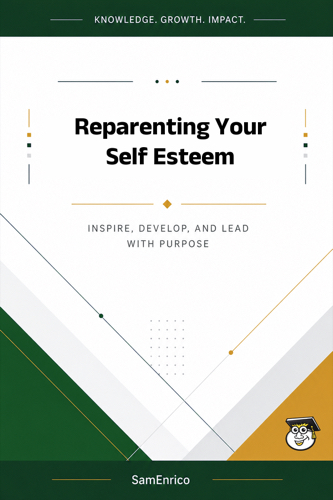
Non-FictionSelf-HelpReparenting
Reparenting Your Self Esteem eBook
Learns to give yourself the validation you never r
Learns to give yourself the validation you never received growing up.
Formats
Free sample
Chapter 1: The Quiet Betrayal--You are reading this book for one of two reasons. Either someone recommended it to you because they saw something in you that you cannot see in yourself, or you stumbled across it in a moment of quiet desperation—late at night, maybe, after yet another day of feeling like you were performing competence while drowning inside. Either way, you are here because something is not right. You have achieved things. You have survived things.
You have learned to smile at the right times and say the right words and keep the messy parts of yourself hidden behind a door that you have gotten very good at closing. But the door does not lock. And late at night, or in the car after a meeting, or in the bathroom at a party where you suddenly cannot breathe, the mess comes out. You tell yourself you are overreacting. You tell yourself other people have real problems.
You tell yourself to try harder, be better, do more. And then you collapse again, and the cycle repeats.This is not a character flaw. This is not weakness. This is not a failure of effort or discipline or moral fiber. This is a wound.
And like all wounds, it did not appear out of nowhere. It was made. Not by you. By something that happened—or more precisely, by something that did not happen—a very long time ago.The Paradox That Breaks People There is a specific kind of suffering that does not get talked about enough, because it wears a mask of success. The person suffering from it shows up on time.
They meet deadlines. They anticipate needs. They are the one everyone calls when something goes wrong because they will fix it without complaining. They are praised for being so "together," so "capable," so "low-maintenance." And inside, they are a raw nerve. Every piece of feedback feels like a verdict on their worth as a human being.
Every silence from a loved one feels like abandonment. Every mistake—no matter how small—triggers a spiral of self-hatred that can last for days.If this describes you, you have likely spent years trying to solve the problem by doing more. You thought if you just worked harder, achieved more, earned more, looked better, pleased more people, then finally the voice in your head would quiet down. But the voice did not quiet. It got louder.
Because you were treating the wrong problem. You were trying to fill a hole that was never created by a lack of achievement. It was created by a lack of mirroring.Let me explain what mirroring is. When a baby cries, a good enough parent does not say, "Stop crying, you are fine." They pick up the baby. They make eye contact.
They mirror the baby's expression—widening their own eyes in concern, softening their face when the baby calms. They say, "Oh, you are hungry. I hear you. I am here." This is not just affection. This is neurological scaffolding.
The parent's face, voice, and touch teach the baby's developing brain how to recognize, name, and regulate emotions. The parent acts as an external nervous system until the child's own nervous system is mature enough to take over. This is how we learn that our feelings matter. This is how we learn that we exist—because someone sees us and reflects us back to ourselves.Now imagine that the parent is physically present but emotionally absent. They feed you.
They clothe you. They drive you to school. But they do not mirror you. When you cry, they look away. When you are excited, they change the subject.
When you are sad, they tell you to cheer up. When you are angry, they punish you for being "difficult." You learn, very quickly, that your internal world is not welcome. You learn to hide it. You learn to perform the emotions that keep you safe—pleasantness, compliance, achievement—and bury the rest. This is not abuse in the way the law defines it.
No one hit you. No one left you alone for days. No one did anything that would make a neighbor call social services. But something essential was still missing. This is called Childhood Emotional Neglect (CEN), and it is the invisible wound that underlies more cases of low self-esteem than any other single cause.The Difference Between Abuse and Neglect We need to be precise here, because many people will read the word "neglect" and think, That was not me.
My parents tried. They did their best. They were not monsters. And they are right. Most parents are not monsters.
Most parents love their children in the only way they know how. But love and attunement are not the same thing. You can love someone completely and still fail to see them. You can provide everything material and still leave them starving emotionally.Abuse is an act of commission. Someone does something harmful—hits, yells, shames, violates.
Neglect is an act of omission. Someone fails to do something necessary—fails to see, fails to respond, fails to validate, fails to connect. Abuse is easier to recognize because it leaves visible marks. Neglect leaves invisible marks that you carry inside your own body and mistake for your own personality. You do not think, I was neglected.
You think, I am too sensitive. I am needy. I am broken. I am too much. I am not enough.Here is what Childhood Emotional Neglect looks like in practice, in families that from the outside look perfectly normal:A parent who only notices you when you achieve something (good grades, a win at a competition, a performance) and remains indifferent to your daily emotional life.A parent who changes the subject whenever you express a "negative" feeling—sadness, anger, fear, disappointment—because they themselves cannot tolerate those feelings.A parent who tells you that you are "too sensitive" or "dramatic" or "making a big deal out of nothing" when you are genuinely hurt.A parent who is physically present but mentally elsewhere—distracted by work, by their own unhappiness, by a phone, by a television—such that you learn not to bother them with your needs.A parent who responds to your distress with solutions rather than presence.
("Stop crying, here is what you need to do...") This teaches you that feelings are problems to be solved, not signals to be heard.A parent who praises your independence and self-sufficiency from a very young age—not realizing that a five-year-old who never cries for comfort is not "strong." They are dissociated.If any of these sound familiar, you do not need to be angry at your parents. Anger may come later, and it may be appropriate. But right now, you only need to see the pattern. You learned, somewhere along the way, that your feelings were not welcome. And because a child cannot survive without attachment, you did the only thing you could do: you buried your feelings and became the person your parents could tolerate.
You became "easy." You became "good." You became invisible to yourself.Why "Tough Love" Makes It Worse The self-help industry has…
This is the end of the free sample. Get the eBook to keep going. Buy now
About this book
Details
- Author
- Shook Santina
- Publisher
- SamEnrico
- Language
- English
- Genre
- Non-Fiction, Self-Help, Reparenting
- Released
- 2026-06-05
- Pages (approx.)
- 147
- Available as
- eBook, Audiobook

Read better in the ZLOADR app
Your eBooks on your phone or tablet. Sign in with your SamEnrico account and start reading.
More by Shook Santina
 Autism Partner Relationship GuideShook Santina$11.99
 Eisenhower For Side HustlesShook Santina$11.99
 Campbell's Winter CampaignShook Santina$11.99
 Immigrant Women Entrepreneurs Success GuideShook Santina$11.99
 The Assertiveness for Freelancers GuideShook Santina$11.99
 Hospitality Emotion GuideShook Santina$11.99
 Anger And Child Anxiety TransferShook Santina$11.99
 Doctor Weight Bias NavigationShook Santina$11.99
 Fentanyl’s Shadow: The Silent Killer in Your Medicine CabinetShook Santina$11.99
 The Silk Road Tycoon: The Rise of Biyaa the Great of the SahelShook Santina$11.99
 The Clockmaker of Strasbourg: The Timekeeper Who Defied the UniverseShook Santina$11.99
 Machine Learning for UAV ApplicationsShook Santina$11.99
You may also like
 Hong Kong Handover 1997Dunn Johnnie$11.99
 Zumba For Postnatal Recovery CourseNeal Christian$11.99
 Zumba for BeginnersLadner Nikia$11.99
 YouTube Comment Mining GuideHumes Pandora$12.99
 Worry Box MeditationCarlin Rudy$11.99
 Workplace Stress MeditationNguyen Lynn$11.99
 Workplace Stress and Sleep RepairHawley Ivory$11.99
 Workplace Perfectionism CureDelaney Jeffry$11.99
 Workplace Injustice Anger GuideWallen Isabelle$11.99
 Work Addiction and Burnout LinkGreenwood Ester$11.99
 Women in Yoga and WellnessBeattie Galina$11.99
 Women in Stand Up ComedyChun Evangeline$11.99