
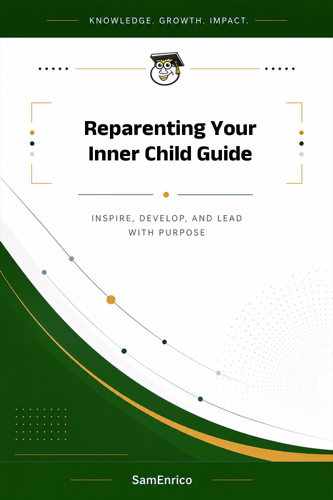
Non-FictionSelf-HelpReparenting
Reparenting Your Inner Child Guide eBook
Give your younger self the unconditional love and
by Patino Alda
Give your younger self the unconditional love and validation you missed.
Formats
Free sample
Chapter 1: The Ghost Driver--You are driving down a familiar road on a perfectly ordinary Tuesday. The sun is out. You had a decent lunch. Nothing is wrong. Then your phone buzzes—a text from your partner that says, “Can we talk tonight?” Or your boss sends an email with the word “urgent.” Or your mother’s name appears on your screen.
And in less than one second, your chest tightens, your throat closes, your stomach drops, and you are no longer a capable adult in control of your life. You are four years old again, hiding under the bed, waiting for the yelling to stop. You are eight, holding your breath so no one notices you. You are twelve, plastering on a smile while dying inside.The text is just words. The email is just a request.
The phone call is just a conversation. But your body does not know that. Your body has been hijacked by a ghost.This book is about that ghost. It is about the wounded inner child who lives in the basement of your nervous system, who never got the memo that you grew up, who still believes that if you make one wrong move, you will be abandoned, humiliated, or destroyed. And this book is about how to take back the wheel.The first step is not healing.
The first step is not understanding. The first step is simply learning to recognize when you are no longer driving your own bus.The 3 AM Kitchen Floor Phenomenon Let me tell you about a woman named Sarah. Sarah is forty-two years old. She has a master’s degree, a senior management position, a retirement account, and a mortgage. She is competent by every external measure.
One evening, her husband leaves a spoon in the sink. Not a pile of dishes. Not a mess. A single spoon. And Sarah loses her mind.She does not yell.
That is not her style. Instead, she finds herself at 3 AM sitting on the kitchen floor, sobbing so hard she cannot breathe, convinced that her husband does not love her, that her marriage is a lie, that she has failed at the one thing that matters. The spoon is still in the sink. Nothing else has changed.The next morning, Sarah is mortified. She knows, intellectually, that a spoon is not a marriage-ending event.
She knows her husband loves her. She knows she overreacted. But knowing does not stop the shame spiral. She tells herself she is crazy. She tells herself she is too sensitive.
She tells herself to get it together.Here is what no one told Sarah: that spoon was never a spoon.That spoon was every time her father left the room when she started to cry. That spoon was the silence at the dinner table when she tried to share something from her day. That spoon was the birthday party where her mother forgot the cake, and when Sarah got upset, her mother said, “You’re so dramatic. It’s just a cake.” That spoon was a lifetime of being told that her feelings did not matter, and the one person who was supposed to see her kept walking away.The spoon was the trigger. The ghost was the driver.You have your own spoon.
Maybe it is a tone of voice that makes you see red. Maybe it is the feeling of being interrupted in a meeting, which sends you into a silent rage that lasts for hours. Maybe it is a cancelled plan that feels like abandonment, or a piece of constructive criticism that lands like a punch to the gut. Whatever your spoon is, it is not the problem. The problem is the ghost that wakes up when the spoon appears.What Exactly Is the Inner Child?The term “inner child” has been used so often in popular psychology that it has lost some of its power.
For some people, it sounds precious or new-agey. For others, it sounds like an excuse for bad behavior. So let me be very specific about what I mean.Your inner child is not a metaphor. It is a neurological reality.The brain develops from the bottom up. The oldest parts—the brainstem and the limbic system—are fully formed in childhood.
These are the parts that regulate survival, emotion, and memory. The newer parts—the prefrontal cortex, responsible for rational thought, impulse control, and long-term planning—do not finish developing until your mid-twenties.This means that the emotional memories and survival patterns you formed as a child are literally encoded in the architecture of your brain. They are not just memories you can think your way out of. They are neural pathways that fire automatically, below the level of conscious awareness, whenever the present moment resembles the past.When you are triggered, your prefrontal cortex goes offline. Your amygdala—the brain’s alarm system—takes over.
It scans for threat, finds something that looks like the old wound, and activates the same fight, flight, freeze, or fawn response that protected you when you were small. You do not choose this response. It chooses you.That is the inner child. It is not a separate entity living inside you. It is a set of neural pathways and emotional memories that were formed before you had the language or the cognitive capacity to process them.
It is the part of you that still believes the danger is real because it never got the update that you survived.Why You Are Not Crazy, Weak, or Broken Before we go any further, I need you to hear something that might be hard to believe: your reactions are not flaws. They are not signs of weakness. They are not evidence that you are fundamentally broken.They are survival strategies. And they worked.Think about the child you once were. If you grew up in a home where anger was dangerous, you learned to become small, quiet, and invisible.
That kept you safe. If you grew up in a home where your needs were ignored, you learned to anticipate what everyone else needed so that maybe, someday, someone would anticipate yours. That kept you connected. If you grew up in a home where you were criticized no matter what you did, you learned to become perfect, because perfection was the only thing that earned a moment of peace. That kept you from being destroyed.These strategies were brilliant.
They were creative. They were the best solutions a small child could come up with to survive an impossible situation.The problem is not the strategies. The problem is that you are not a small child anymore, and you are still using them.The quiet child who learned to disappear is now an adult who cannot ask for help, who feels invisible in relationships, who has panic attacks when someone raises their voice. The pleaser who learned to anticipate everyone’s needs is now an adult who has no idea what they themselves want, who feels resentful and exhausted, who cannot say no. The perfectionist who learned to be flawless is now an adult who never feels good enough, who works eighty hours a week and still feels…
This is the end of the free sample. Get the eBook to keep going. Buy now
About this book
Details
- Author
- Patino Alda
- Publisher
- SamEnrico
- Language
- English
- Genre
- Non-Fiction, Self-Help, Reparenting
- Released
- 2026-06-07
- Pages (approx.)
- 144
- Available as
- eBook, Audiobook

Read better in the ZLOADR app
Your eBooks on your phone or tablet. Sign in with your SamEnrico account and start reading.
More by Patino Alda
 Thunberg Criticism ResiliencePatino Alda$11.99
 Facebook Comparison Trap EscapePatino Alda$11.99
 Financial Mindfulness Practice CoursePatino Alda$11.99
 Saving Habit GuidePatino Alda$11.99
 Dream Completion TechniquePatino Alda$11.99
 Bye Week Reflection ProtocolPatino Alda$11.99
 Imposter Syndrome At WorkPatino Alda$11.99
 Email Overload BurnoutPatino Alda$11.99
 The Last Broadcast: How a Single Mistake Erased a LegendPatino Alda$11.99
 The First Ice Pioneers: Ancient Aboriginal Journeys to Antarctica's EdgePatino Alda$11.99
 The Shadow of Anubis: The Jackal’s Wisdom in the AfterlifePatino Alda$11.99
 How to Start a Current Checking Instruments (electronic) Business (Beginners Guide)Patino Alda$11.99
You may also like
 Hong Kong Handover 1997Dunn Johnnie$11.99
 Zumba For Postnatal Recovery CourseNeal Christian$11.99
 Zumba for BeginnersLadner Nikia$11.99
 YouTube Comment Mining GuideHumes Pandora$12.99
 Worry Box MeditationCarlin Rudy$11.99
 Workplace Stress MeditationNguyen Lynn$11.99
 Workplace Stress and Sleep RepairHawley Ivory$11.99
 Workplace Perfectionism CureDelaney Jeffry$11.99
 Workplace Injustice Anger GuideWallen Isabelle$11.99
 Work Addiction and Burnout LinkGreenwood Ester$11.99
 Women in Yoga and WellnessBeattie Galina$11.99
 Women in Stand Up ComedyChun Evangeline$11.99