
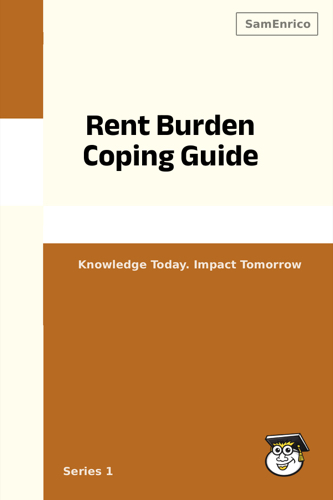
Rent Burden Coping Guide eBook
Find housing assistance, negotiate rent, or explor
by Mast Jimmie
Find housing assistance, negotiate rent, or explore shared living options.
Formats
Free sample
Chapter 1: The 30% Lie...--Imagine you’ve just woken up in a cold sweat at 3:00 AM. Your phone is dead. Your landlord’s voicemail is full. And in your email inbox sits a notice: “Rent increase of $300 per month starting next lease cycle.” Your stomach drops. You do the math.
You’ve done it before. But this time, it’s different. This time, you realize something that feels like a secret everyone else has been hiding from you: You cannot budget your way out of this.This is not a personal failing. It is not because you bought coffee, ate avocado toast, or took a vacation you couldn’t afford. It is because the single most important financial rule you were taught about housing — the one your parents repeated, the one your financial advisor mumbled, the one that appears in every “how to live on a budget” article — is a lie.
The 30% rule is dead. And it has been dead for a long time. The only thing left is the corpse, and we’ve been propping it up and pretending it’s still breathing.This chapter is not here to make you feel bad. It is here to liberate you. We are going to dismantle the 30% rule, show you exactly why it no longer applies to your life, and give you a new framework for understanding your finances — one that acknowledges the reality of rent burden without the shame.The Origin Story of a Myth Before we bury the 30% rule, we need to understand where it came from.
Because once you see its origin, you will realize it was never designed for people like you.The 30% standard traces its roots to 1969, with the Brooke Amendment to the U.S. Housing Act. This piece of legislation capped public housing rent at 25% of a tenant’s income. Later, in 1981, it was raised to 30%. That’s it.
That’s the entire origin story. A bureaucratic decision about public housing — not about private market renters, not about gig economy workers, not about people with student loans or medical debt.In the 1980s, mortgage lenders and landlords began adopting the 30% rule as a shortcut. They needed a simple number to screen applicants. “If you spend more than 30% of your gross income on housing, you are ‘cost-burdened.’” That phrase — “cost-burdened” — was cooked up by the Department of Housing and Urban Development (HUD) in the 1990s. It was a technical term for grant distribution, not a moral judgment.
But over time, it became a moral judgment.Fast forward to today. The median rent in the United States has increased by 300% since 1985, adjusted for inflation. The median wage has increased by only 120%. That gap — 180 percentage points — is the story of your rent burden. It is not a story about your spending habits.
It is a story about housing policy, corporate consolidation, and wage stagnation.Here is the math that proves it. In 1985, the median rent was about $350 per month (in 1985 dollars). The median income was about $22,000 per year. A renter earning the median income would need to spend about 19% of their income on the median rent. That’s comfortable.
That’s manageable. That’s the world the 30% rule was born into — a world where most people spent far less than 30%.Today, the median rent is over $1,700 per month. The median income is about $59,000 per year. That same renter would need to spend 35% of their income on the median rent — and that’s before utilities, before parking, before the pet fee, before the “amenity fee” that gives you access to a gym you’ve never used. And that’s the median.
In major cities like New York, Los Angeles, San Francisco, Boston, Miami, Austin, and Seattle, the percentage is routinely 50% to 70%.The 30% rule is not a rule. It is a relic.The Reality Ratio: What You Actually Spend Let’s get specific. I want you to take out your phone, a notebook, or a spreadsheet. We are going to calculate your personal “Reality Ratio.” This is not the same as the 30% rule. The 30% rule only looks at rent divided by income.
That is a lie because it ignores everything else you need to survive.Here is what you actually need to calculate: your Rent-to-Needs Ratio.Step one: Write down your monthly take-home pay (after taxes, after health insurance, after any automatic deductions). Do not use gross income. Gross income is a fiction. Your landlord cannot spend gross income. Neither can you.Step two: Write down your fixed survival costs — the things you cannot cut no matter how hard you try.
These include:Groceries (not dining out, just food to cook)Utilities (electricity, gas, water, trash)Transportation (bus pass, gas for your car, minimum car payment if you need it for work)Minimum debt payments (student loans, credit card minimums, medical bills)Phone and internet (required for job applications, remote work, and housing searches)Health expenses (medications, co-pays, therapy)Step three: Add your rent to these fixed survival costs.Step four: Divide that total by your monthly take-home pay.If the result is 90% or higher, you are in what we call the Red Zone. That means you have less than 10% of your income left for everything else — clothes, haircuts, gifts, emergencies, savings, entertainment, mental health, and the thousand small expenses that make life bearable. One flat tire, one root canal, one unexpected trip to a funeral, and you are choosing between that expense and your rent.If the result is 70% to 89%, you are in the Yellow Zone. You are not in immediate danger, but you have no margin. You are one missed paycheck away from the Red Zone.If the result is below 70%, you are in the Green Zone.
Congratulations. You are also in the minority of renters under 40. Most people reading this book are in the Red or Yellow Zone.Here is the liberating part: This calculation is not a judgment. It is a map. It tells you where you are, so you can decide where to go.
If you are in the Red Zone, the rest of this book will give you specific tools to change that — not by cutting coffee, but by changing your housing situation, your negotiation power, or your income strategy.Why the Old Advice Fails You You have heard it all before. “Stop eating out.” “Cancel your streaming services.” “Make coffee at home.” “Use a budget app.” “Take on a side hustle.”None of this advice is wrong. It is just irrelevant when your rent is 60% of your income. Let me show you why.Imagine you are spending 60% of your take-home pay on rent. That leaves 40% for everything else.
Let’s say your take-home pay is $3,000 per month. Rent is $1,800. You have $1,200 left for groceries, utilities, transportation, debt, phone, and medical expenses. You are already in the Red Zone before you buy a single cup of coffee.Now, someone tells you to “cut back.” You cancel Netflix ($15), stop buying coffee ($40), and eat rice and beans for a week ($30 saved). You have saved $85.
That is less than 3% of your rent. You have done everything right, and you are still in the Red Zone. The problem is not your spending. The problem is the ratio.This is…
This is the end of the free sample. Get the eBook to keep going. Buy now
About this book
Details
- Author
- Mast Jimmie
- Publisher
- SamEnrico
- Language
- English
- Genre
- Non-Fiction, Self-Help, Housing
- Released
- 2026-06-06
- Pages (approx.)
- 126
- Available as
- eBook, Audiobook

Read better in the ZLOADR app
Your eBooks on your phone or tablet. Sign in with your SamEnrico account and start reading.
More by Mast Jimmie
 Undermined By Peer Anger HandbookMast Jimmie$11.99
 Nobel Laureates in EnzymologyMast Jimmie$11.99
 Rosie O Donnell Loud LifeMast Jimmie$11.99
 The Flexible Time Blocking SystemMast Jimmie$11.99
 The Djinn’s Last Bargain: A Sultan’s FollyMast Jimmie$11.99
 Understanding QuadriparesisMast Jimmie$17.99
 Shopify PLG GuideMast Jimmie$12.99
 Mobile Money Export PaymentsMast Jimmie$12.99
 Ghost HuntingMast Jimmie$11.99
 How to Start a Chicken Ready To Eat Meals Business (Beginners Guide)Mast Jimmie$11.99
You may also like
 Hong Kong Handover 1997Dunn Johnnie$11.99
 Zumba For Postnatal Recovery CourseNeal Christian$11.99
 Zumba for BeginnersLadner Nikia$11.99
 YouTube Comment Mining GuideHumes Pandora$12.99
 Worry Box MeditationCarlin Rudy$11.99
 Workplace Stress MeditationNguyen Lynn$11.99
 Workplace Stress and Sleep RepairHawley Ivory$11.99
 Workplace Perfectionism CureDelaney Jeffry$11.99
 Workplace Injustice Anger GuideWallen Isabelle$11.99
 Work Addiction and Burnout LinkGreenwood Ester$11.99
 Women in Yoga and WellnessBeattie Galina$11.99
 Women in Stand Up ComedyChun Evangeline$11.99