
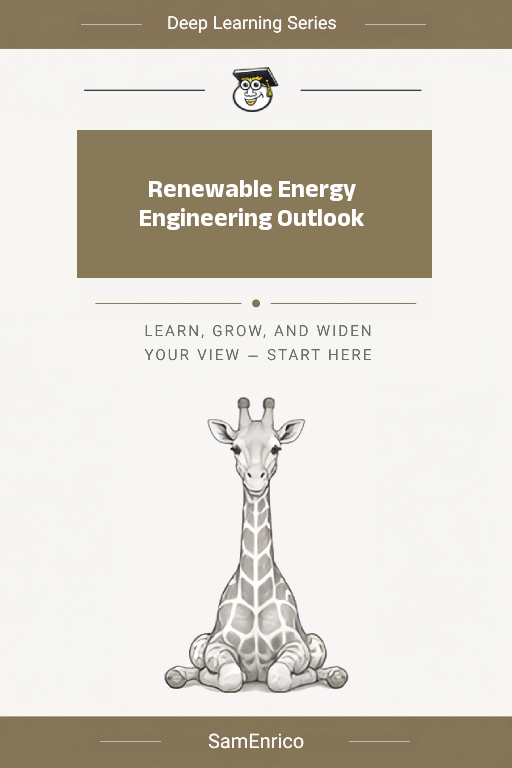
Non-FictionForecast & OutlookEnergy Engineering
Renewable Energy Engineering Outlook
Project civil, electrical, and structural design s
Project civil, electrical, and structural design software advances, weather modeling, and yield prediction accuracy improvements.
Formats
About this book
Free sample
Chapter 1: The Broken Handshake--–- In the summer of 2022, a 150-megawatt solar farm in West Texas missed its commercial operation date by eleven months. The delay was not caused by supply chain issues, weather, or labor shortages—the usual suspects in renewable energy construction. The culprit was a single cable trench, eighty-seven meters long, dug through a patch of ground that every civil engineer on the project had flagged as unstable. The electrical engineers, working in a different software platform, had never seen those flags. They routed their medium-voltage collector line straight through the worst possible location.
When heavy rains came, the trench collapsed twice. Each collapse required re-excavation, re-laying of cables, and re-compaction. The total cost of that single oversight: $2.3 million and nearly a year of lost revenue. This is the cost of a broken handshake—the term engineers now use for what happens when design disciplines fail to speak to one another.This chapter is about why that failure happens, how it has been tolerated for decades, and what finally changed as of 2026. The answer is not a single software package or a new standard.
The answer is a fundamental rethinking of how civil, structural, electrical, and atmospheric models interact. We call this rethinking the Unified Digital Twin, and it is the central argument of this book: the future of renewable energy engineering lies not in mastering individual software packages but in building seamless digital workflows from site survey to financial close. Every chapter that follows will build on this foundation.The Fragmented Legacy To understand where we are going, we must first understand how we arrived at the current state of fragmentation. For the past thirty years, renewable energy design has been organized around software tribes. The civil engineers live in GIS and CAD platforms—Auto CAD Civil 3D, Arc GIS, QGIS.
The structural engineers inhabit finite element analysis tools—STAAD, RISA, SAP2000. The electrical engineers work in specialized electrical design software—PVsyst, CYPELEC, ETAP, PLS-CADD. The energy analysts, increasingly important as projects grow larger and financing tighter, reside in weather and yield modeling tools—Wind Sim, WAs P, PVLib…
This is the end of the free sample. Get the eBook to keep going. Buy now
Contents
- Chapter 1
- Chapter 2
- Chapter 3
- Chapter 4
- Chapter 5
- Chapter 6
- Chapter 7
- Chapter 8
- Chapter 9
- Chapter 10
- Chapter 11
- Chapter 12
Details
- Author
- Zielinski Rueben
- Publisher
- SamEnrico
- Language
- English
- Genre
- Non-Fiction, Forecast & Outlook, Energy Engineering
- Released
- 2026-06-01
- Pages (approx.)
- 138
- Available as
- eBook, Audiobook

Read better in the ZLOADR app
Your eBooks on your phone or tablet. Sign in with your SamEnrico account and start reading.
More by Zielinski Rueben
 Sex Addiction And Sports Celebrity Culture HandbookZielinski Rueben$11.99
 Death Reflection PurposeZielinski Rueben$11.99
 Mindful Anger MBSRZielinski Rueben$11.99
 Dreams in Acupuncture Trauma CareZielinski Rueben$11.99
 The Unseen Hand: How a 19th-Century Lawyer Shaped Modern DemocracyZielinski Rueben$11.99
 The Last Stand of the Iron Princess: How a 12-Year-Old Queen Outwitted an EmpireZielinski Rueben$11.99
 How to Become a Second HelperZielinski Rueben$11.99
 International Student Work HandbookZielinski Rueben$12.99
 Implementation ManagerZielinski Rueben$11.99
 Understanding Hemihypertrophy In Context of NfZielinski Rueben$17.99
You may also like
 Hong Kong Handover 1997Dunn Johnnie$11.99
 Zumba For Postnatal Recovery CourseNeal Christian$11.99
 Zumba for BeginnersLadner Nikia$11.99
 YouTube Comment Mining GuideHumes Pandora$12.99
 Worry Box MeditationCarlin Rudy$11.99
 Workplace Stress MeditationNguyen Lynn$11.99
 Workplace Stress and Sleep RepairHawley Ivory$11.99
 Workplace Perfectionism CureDelaney Jeffry$11.99
 Workplace Injustice Anger GuideWallen Isabelle$11.99
 Work Addiction and Burnout LinkGreenwood Ester$11.99
 Women in Yoga and WellnessBeattie Galina$11.99
 Women in Stand Up ComedyChun Evangeline$11.99