
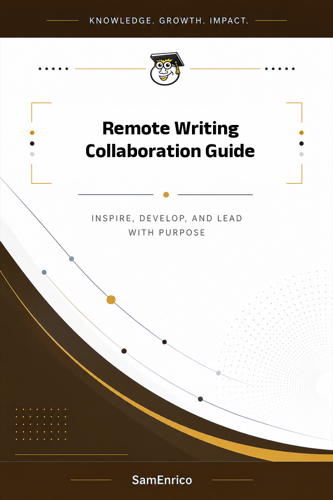
Remote Writing Collaboration Guide eBook
Teaches co-authors to edit and provide feedback on
by Story Reena
Teaches co-authors to edit and provide feedback on documents online.
Formats
Free sample
Chapter 1: The Architecture of Trust...–- Every remote writing collaboration fails for the same reason. It is not bad grammar, missed deadlines, or even creative differences that kill manuscripts. It is the slow, silent erosion of trust that happens when two people who have never shared a room try to share a voice. This chapter is not about tools or workflows. It is about the invisible architecture that holds remote co-authorship together—or allows it to collapse.
By the end of this chapter, you will understand exactly why most remote writing teams fail within the first six weeks, and more importantly, you will have the blueprint to build a collaboration that outlasts the project.The Three-Day Graveyard Let us begin with a story. It is the most common story in remote writing, and no one tells it because it is embarrassing.Sarah and Michael agreed to co-author a business book. They had worked together in person years ago, so they assumed remote would be easy. They shared a Google Doc. Michael wrote the first three chapters.
Sarah opened the document, felt a knot in her stomach, and left a comment: "This feels a bit off. Can you revisit the tone?"Michael read the comment. He had no idea what "off" meant. He waited two days, hoping Sarah would clarify. She did not.
Finally, he wrote back: "What specifically do you mean?"Sarah, now frustrated by the delay, replied: "I thought we agreed on a conversational voice. This reads like an academic paper."Michael felt defensive. He had spent twenty hours on those chapters. He wrote: "I don't think it's academic. Maybe you're reading it too fast."Three weeks later, the Google Doc had forty-seven comments, none of which resolved anything.
The book was never finished. They stopped talking to each other entirely.This is the three-day graveyard. It is the space between a piece of feedback and a response, between confusion and clarity, between two people who assume the worst because they cannot see each other's faces. In person, Sarah would have heard Michael's sigh, seen his exhaustion, and softened her tone. Michael would have watched Sarah's eyes scan the page and known which paragraphs troubled her most.
Remote, they had none of that. They had only text, and text is a terrible liar.Every remote writing collaboration that fails does so not because the writing is bad but because the trust infrastructure was never built. This chapter is that infrastructure.The Four Pillars of Remote Co-Authorship Before you write a single sentence together, you must agree on the invisible rules that will govern your collaboration. These are not legal terms or project management jargon. They are psychological contracts that determine whether your partnership produces joy or resentment.Pillar One: Trust Without Oversight Trust in a remote writing relationship is not about believing the other person is honest.
It is about believing they will act in the shared interest of the manuscript when you are not watching.Most writers confuse trust with surveillance. They check timestamps to see when the other person last edited. They count words. They ask, "Have you started your section yet?" in ways that are not questions but accusations. This is not trust.
This is anxiety dressed as management.True trust without oversight means you assume the other person is working, even when you see no evidence. It means you do not ask for status updates unless a deadline has passed. It means you accept that their process may look nothing like yours—they may write at 2 AM, they may dictate into their phone, they may outline for three weeks before drafting a single paragraph—and you do not interpret difference as dysfunction.The practical expression of this pillar is the No-Status Rule: status updates are given only when requested or when a deadline is missed. All other communication is about the writing itself. This rule sounds simple.
It is brutally hard for anyone who has been burned before. But without it, your collaboration becomes a series of passive-aggressive check-ins disguised as collaboration.Pillar Two: Radical Transparency If trust without oversight is about what you do not ask, radical transparency is about what you voluntarily share. Every remote writing team needs a visible, accessible, permanent record of decisions, changes, and reasoning.Here is what radical transparency looks like in practice. Every significant decision about the manuscript—changing a character's name, restructuring a chapter, cutting a section—is logged in a shared Decision Log. This is not a formal document.
It can be a shared note, a spreadsheet, or a dedicated channel in your communication tool. But it must contain three things for every decision: what changed, who proposed it, and why.Without this log, remote teams experience a peculiar form of amnesia. One person will propose a change in a comment thread. The other will agree. Two weeks later, no one remembers who suggested what, and the original intent is lost.
The log prevents this. It also serves a second function: it makes the invisible work of collaboration visible. When you can see the log growing, you can see that your partner is engaged, even when they are silent.The most successful remote teams also maintain a Question Log—a running list of open questions about the manuscript that no one has answered yet. This is different from a to-do list. Questions are uncertainties: "Does this character need a backstory?" "Is this argument too technical for our audience?" By making questions visible, you prevent them from circling endlessly in comment threads.
You also create a ritual: every Friday, you spend fifteen minutes reviewing the Question Log together.Pillar Three: Explicit Turnaround Time The single biggest source of resentment in remote writing is the gap between expected and actual response times. One person thinks "soon" means two hours. Another thinks "soon" means two days. Neither is wrong. Both are angry.Explicit turnaround time means you abandon vague words forever.
You replace "I'll get to it soon" with specific windows: four hours, twenty-four hours, three days. You agree on these windows before you start writing. And you write them down in your Team Alignment Charter (see Appendix A).But explicit turnaround time is not just about speed. It is about categorization. Different kinds of feedback require different windows.
A typo in a finished chapter can wait three days. A structural problem that breaks the entire argument cannot. The most effective remote teams use a simple three-tier system for all requests:Critical: Response required within four hours. Reserved for issues that block progress entirely. Use this rarely.
If you use it more than once a week, you are crying wolf.Standard: Response required within twenty-four hours. For most substantive feedback and questions.Low: Response required within three days. For typos, minor phrasing suggestions, and non-urgent questions.Notice that all of these windows are concrete. None of them say "as soon as possible," which is the most toxic phrase in remote collaboration because it means "as soon as possible for you" to the speaker and "as soon as I have nothing better to do" to the listener.Pillar Four: Tone Awareness In person, tone is carried by voice, face, and body. Remote, tone is…
This is the end of the free sample. Get the eBook to keep going. Buy now
About this book
Details
- Author
- Story Reena
- Publisher
- SamEnrico
- Language
- English
- Genre
- Non-Fiction, Self-Help, Writing
- Released
- 2026-06-07
- Pages (approx.)
- 135
- Available as
- eBook, Audiobook

Read better in the ZLOADR app
Your eBooks on your phone or tablet. Sign in with your SamEnrico account and start reading.
More by Story Reena
 Hawking Microsoft ResearchStory Reena$11.99
 The Betting Diary CourseStory Reena$11.99
 The Hospice Parent Death GuideStory Reena$11.99
 Growth Hormone for Organ RepairStory Reena$11.99
 The Great Bitcoin Heist: How a Flawed System Lost MillionsStory Reena$11.99
 Echoes of the Abyss: The Titanic’s Final WhispersStory Reena$11.99
 One Page Lead Magnet BlueprintStory Reena$12.99
 Godzilla Defense PlaybookStory Reena$12.99
 Ultimate Handbook Guide to Port-au-prince : (Haiti) Travel GuideStory Reena$11.99
 Equipment ManagerStory Reena$11.99
 Understanding BaerStory Reena$17.99
You may also like
 Hong Kong Handover 1997Dunn Johnnie$11.99
 Zumba For Postnatal Recovery CourseNeal Christian$11.99
 Zumba for BeginnersLadner Nikia$11.99
 YouTube Comment Mining GuideHumes Pandora$12.99
 Worry Box MeditationCarlin Rudy$11.99
 Workplace Stress MeditationNguyen Lynn$11.99
 Workplace Stress and Sleep RepairHawley Ivory$11.99
 Workplace Perfectionism CureDelaney Jeffry$11.99
 Workplace Injustice Anger GuideWallen Isabelle$11.99
 Work Addiction and Burnout LinkGreenwood Ester$11.99
 Women in Yoga and WellnessBeattie Galina$11.99
 Women in Stand Up ComedyChun Evangeline$11.99