
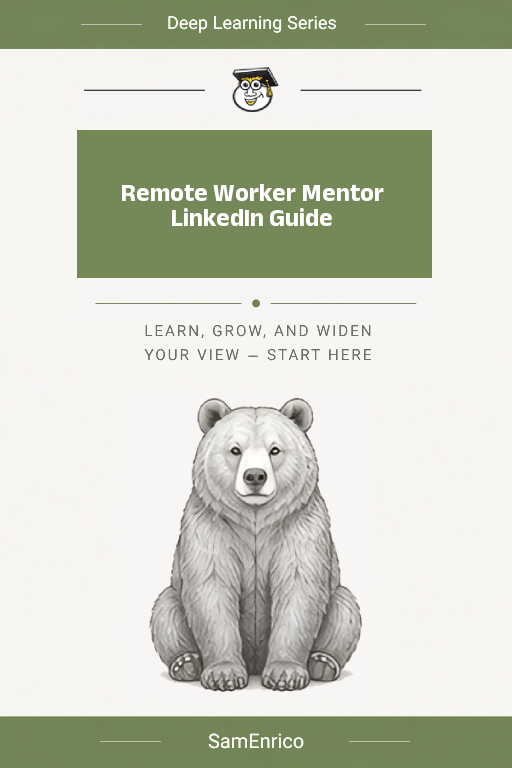
Non-FictionFirst 30 DaysRemote Work
Remote Worker Mentor LinkedIn Guide eBook
Find mentors for remote and distributed work chall
by Mark Iola
Find mentors for remote and distributed work challenges. Navigate virtual relationship building and asynchronous communication.
Formats
Free sample
Chapter 1: The Proximity Trap--–- Six months into her first fully remote role at a mid-sized tech company, Maya hit every target. She delivered the Q3 analytics dashboard two days early. She never missed a Slack message within 30 minutes. She volunteered for the late-Asia shift when the Singapore office needed coverage. And when promotion season came, she was passed over for a colleague who came into the empty office twice a week—someone with objectively lower output.Maya’s manager gave her the standard feedback: “You’re doing great work.
Just make sure leadership sees it.” But no one explained how to make leadership see it when leadership never came to her virtual standups and ignored her carefully drafted weekly status reports.Maya is not real. But her story happens every single day to thousands of remote workers. And the force that stole her promotion has a name: proximity bias.The Loneliest Productivity Machine Most remote work literature has sold you a lie. The lie is this: if you become productive enough—if you close enough tickets, reply to enough emails, attend enough meetings—you will be recognized, rewarded, and promoted. The top-selling books on remote work focus almost exclusively on output: how to structure your day, how to manage your energy, how to use the right tools, how to measure your results.They are not wrong.
Productivity matters. But productivity is the price of entry, not the path to influence.The actual foundation of sustainable remote performance is belonging—the quiet, invisible sense that you are seen, remembered, and advocated for when you are not in the room. Without belonging, productivity becomes a hamster wheel. You run faster and faster, generating more and more output, while staying exactly where you are. You become what I call a ghost worker: highly efficient, completely invisible.Consider the data.
A 2022 study by the National Bureau of Economic Research found that remote workers are 13% more productive than their in-office counterparts. Yet the same study found they are also significantly less likely to be promoted. The researchers concluded that “visibility” and “informal mentorship” accounted for the gap—not performance.Thirteen percent more work. Lower promotion rates. That is the math of the proximity trap.What This Book Is (And Is Not)Before we go any further, let me be explicit about what you are holding.This is not a book about productivity.
I will not teach you how to wake up at 5 AM, batch your deep work, or optimize your Notion dashboard. There are excellent books for that, and you should read them—but they will not solve the problem this book exists to solve.This is not a book about Linked In personal branding. I will not teach you how to grow your follower count, go viral with a “day in the life” post, or position yourself as an influencer. That is a different game with a different prize (attention, not guidance).This is a book about mentorship. Specifically, this is a book about how to find, attract, and sustain relationships with experienced leaders who will advocate for you when you are not in the room.
And because remote work has destroyed the informal channels where mentorship used to happen, this book teaches you to use Linked In not as a resume database, but as a proximity tool—a way to bridge the distance that proximity bias creates.The core thesis is simple: You cannot Google your way out of a human problem. You cannot watch a You Tube tutorial on how to interpret a passive-aggressive Slack message from a coworker in a different culture. You cannot read a blog post that teaches you how to make your manager remember your name during promotion cycles. You need a human who has navigated the same invisible landmines. You need a mentor.But remote work has killed the water cooler.
It has killed the hallway conversation. It has killed the coffee queue where senior leaders used to spot promising junior talent. Those were the informal mentorship channels. They are gone.This book rebuilds them—on Linked In.The Villain: Proximity Bias Let me name the enemy explicitly, because you cannot fight what you cannot name.Proximity bias is the cognitive shortcut that makes leaders unconsciously favor workers they see regularly, regardless of output. It is not malice.
It is not conscious discrimination. It is a feature of how human brains work. We remember faces better than spreadsheets. We trust people we have laughed with more than people we have only emailed. We advocate for those who feel familiar.In an office, proximity bias works like this: You walk past the senior director’s desk on your way to get coffee.
You say good morning. A month later, when a stretch assignment comes up, your name floats into her head because your face is associated with a pleasant, low-stakes interaction. You get the assignment. You perform well. You get promoted.In a remote environment, proximity bias does not disappear.
It mutates. Now the senior director walks past an empty kitchen. She makes her own coffee. No faces float into her head except the three people who happen to be on the Zoom call she just left. If you are not one of those three, you do not exist for her in that moment.The tragic irony is that remote workers often work harder to compensate for their invisibility.
They reply to Slack messages at 10 PM. They join meetings across time zones. They over-document and over-communicate. And none of it works, because they are fighting proximity bias with productivity. You cannot solve a visibility problem with efficiency.You solve it with relationships.
Specifically, you solve it with mentors who will carry your name into rooms you cannot enter.The Mentorship Gap in Distributed Teams Let us define the problem more precisely. A mentorship gap exists when:You face a challenge that requires situational judgment, not technical knowledge (e.g., “Should I escalate this conflict or absorb it?”).You lack access to someone who has faced that same challenge successfully.Your organization provides no structured way to find such a person.In an office, mentorship happens informally and organically. A junior designer sits near a senior designer. She overhears how he handles a difficult client. She asks a question at lunch.
Six months later, she has absorbed his mental models without either of them ever saying the word “mentor.”In a distributed team, that proximity does not exist. The junior designer and senior designer may work in different time zones. Their only interaction is a 30-minute weekly status meeting. The junior designer has never heard the senior designer handle a difficult client. She has never asked a question in an unguarded moment.
She has no mental model to absorb.This is the mentorship gap. And it is the single largest unaddressed problem in the remote work economy, which is now valued at over $500 billion annually.Most companies respond to this gap by throwing tools at it. They buy mentorship platforms. They launch “reverse mentoring” programs. They schedule “coffee chats” with random pairings.
These efforts fail because they confuse structure with relationship. You cannot schedule trust. You cannot automate belonging.What you can do…
This is the end of the free sample. Get the eBook to keep going. Buy now
About this book
Details
- Author
- Mark Iola
- Publisher
- SamEnrico
- Language
- English
- Genre
- Non-Fiction, First 30 Days, Remote Work
- Released
- 2026-06-01
- Pages (approx.)
- 138
- Available as
- eBook, Audiobook

Read better in the ZLOADR app
Your eBooks on your phone or tablet. Sign in with your SamEnrico account and start reading.
More by Mark Iola
 Financial Trauma TriggersMark Iola$11.99
 Peg System for Card GamesMark Iola$11.99
 Microexpression Recognition Training GuideMark Iola$11.99
 Remote Review for New HiresMark Iola$11.99
 The Last Stand of the White Company: Swiss Mercenaries at MarignanoMark Iola$11.99
 Understanding Paranoid Personality DisorderMark Iola$17.99
 Events ExecutiveMark Iola$11.99
 Utilities ESG Performance ComparisonMark Iola$12.99
 How to Start a Abrasive Bonded Disc, Wheel and Segment Business (Beginners Guide)Mark Iola$11.99
You may also like
 Hong Kong Handover 1997Dunn Johnnie$11.99
 Zumba For Postnatal Recovery CourseNeal Christian$11.99
 Zumba for BeginnersLadner Nikia$11.99
 YouTube Comment Mining GuideHumes Pandora$12.99
 Worry Box MeditationCarlin Rudy$11.99
 Workplace Stress MeditationNguyen Lynn$11.99
 Workplace Stress and Sleep RepairHawley Ivory$11.99
 Workplace Perfectionism CureDelaney Jeffry$11.99
 Workplace Injustice Anger GuideWallen Isabelle$11.99
 Work Addiction and Burnout LinkGreenwood Ester$11.99
 Women in Yoga and WellnessBeattie Galina$11.99
 Women in Stand Up ComedyChun Evangeline$11.99