
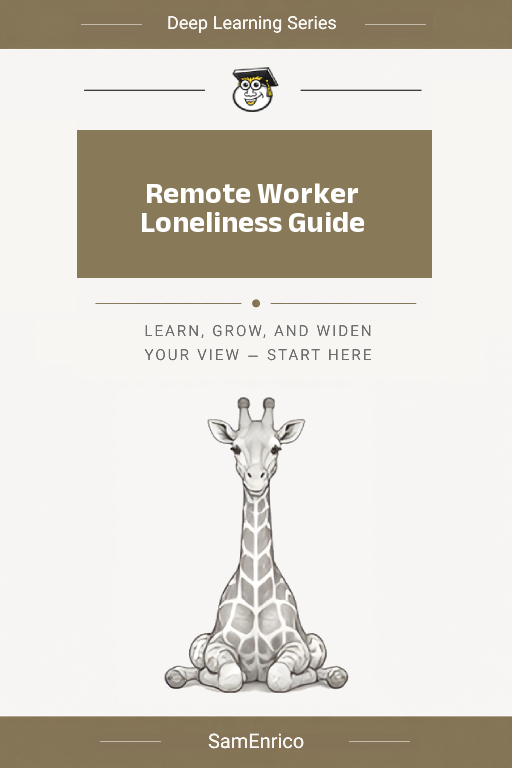
Non-FictionMental WealthSocial ConnectionMindset Blueprint
Remote Worker Loneliness Guide eBook
Combat isolation when your coworkers exist only on
by Malloy Ina
Combat isolation when your coworkers exist only on screens. Covers building virtual water coolers, coworking memberships, and transitioning from digital to in-person connections.
Formats
Free sample
Chapter 1: The Zoom Hangover–- You have just finished your fourth video call of the day. Your back hurts. Your eyes are dry. You have said the word “great” seventeen times in the last hour, each one less convincing than the last. You close your laptop, sit in the sudden silence of your home office, and feel something you cannot quite name.
It is not exactly sadness. It is not exactly exhaustion. It is something heavier than tiredness but emptier than grief. You have done your work. You have been “present.” And yet you feel utterly, profoundly alone.This is not a personal failing.
This is not evidence that you are “not cut out for remote work.” This is not a weakness that better productivity hacks or a more optimized morning routine will fix. This is a biological signal, as real and as urgent as hunger or thirst. And like hunger, if you ignore it long enough, it will distort everything else about your life.Welcome to the Zoom Hangover.The Paradox That Defines Our Era Let us begin with a paradox that is now familiar to tens of millions of people around the world. You can spend four hours on back-to-back video calls and feel utterly depleted, drained, almost hungover. Yet you could spend eight hours in a bustling physical office—with all its interruptions, its ambient noise, its awkward kitchen encounters—and walk out feeling energized, or at least human.
Why? The standard explanation blames “Zoom fatigue,” a term that entered our vocabulary sometime in early 2020 and has never left. But fatigue is only the symptom. The cause runs much deeper.Consider what happens in a physical office during a typical day. You walk past a colleague’s desk and glance at the family photo pinned to their cubicle wall.
You overhear someone laughing at a podcast in the break room. You share an elevator with a person from accounting who tells you about their terrible commute. None of these interactions are “productive” in the narrow sense of advancing your quarterly goals. None of them appear on any timesheet or KPI. And yet, collectively, they do something essential: they remind you that you are working among humans.This is what sociologists call “ambient belonging.” It is the unspoken, unearned sense of being part of a social ecosystem, simply by virtue of physical presence.
You do not have to talk to anyone to feel it. You just have to be there. Remote work, for all its many virtues, strips away ambient belonging entirely. What replaces it is a series of scheduled, framed, high-stakes interactions that demand your full attention and offer almost none of the unconscious social nourishment of physical proximity. The result is a kind of social malnutrition.
You are consuming enough calories to survive, but nothing close to what you need to thrive.The Missing Mirror To understand why video calls exhaust us while physical offices sustain us, we need to look at the brain. Specifically, we need to look at a class of neurons discovered in the 1990s by Italian neuroscientist Giacomo Rizzolatti. Mirror neurons, as they came to be called, fire both when you perform an action and when you observe someone else performing that same action. When you see a colleague smile, your brain activates the same regions involved in your own smiling. When you see someone wince, your brain simulates the sensation of pain.
This is the neural basis of empathy, of rapport, of the wordless understanding that makes human collaboration possible.Here is the problem: mirror neurons are exquisitely sensitive to physical presence. They evolved over hundreds of thousands of years to process three-dimensional, embodied humans in real space. On a video call, the signal is degraded. The frame rate is choppy. The eye contact is simulated—looking at the camera means not looking at the person, and looking at the person means not looking at the camera.
The posture cues are missing below the chest. The subtle shifts in breathing, the micro-expressions that last a fraction of a second, the unconscious synchronization of body language that tells two people “we are on the same page”—all of this disappears inside a rectangle of pixels.What remains is what one researcher has called “social weightlessness.” You are talking at a person, not with them. You are performing connection without feeling it. Your brain, starved of the cues it evolved to expect, works overtime trying to compensate. It reads tone of voice more carefully.
It strains to interpret facial expressions that are often frozen or lagging. It fills in missing information with anxious guesses. All of this happens beneath conscious awareness, but the cumulative cost is real. By the end of a day of back-to-back video calls, your brain has run a marathon on a treadmill. It has exerted enormous effort and gone exactly nowhere.Loneliness Is Not a Character Flaw Let us pause here to address something important.
If you have felt lonely as a remote worker, you have probably also felt ashamed of that loneliness. You have told yourself that you should be grateful for the flexibility, the lack of commute, the ability to see your children more often. You have compared yourself to colleagues who seem to thrive in solitude and concluded that something must be wrong with you. You have Googled “how to stop feeling lonely while working from home” and found articles suggesting you take more breaks or buy a better chair.This shame is misplaced, and it is dangerous.In her extraordinary book The Lonely City, Olivia Laing argues that loneliness is not a failure of character but a biological signal, like hunger or thirst. Hunger prompts you to seek food.
Thirst prompts you to seek water. Loneliness prompts you to seek social connection. The signal is not the problem. The signal is the solution’s first step. The problem arises only when the signal is ignored, suppressed, or pathologized.
When you blame yourself for feeling lonely, you are blaming yourself for being human.This reframing is not merely philosophical. It has practical implications. If loneliness is a signal, then the appropriate response is not self-criticism but investigation. Where is the signal coming from? What need is not being met?
What small adjustment might satisfy the signal before it grows into a siren? The chapters that follow will provide dozens of answers to those questions. But the first answer is always the same: stop telling yourself that you should not feel this way. You should. It means your social brain is working properly.The Hidden Costs of Unaddressed Loneliness If loneliness were merely uncomfortable, it would still deserve our attention.
But the research of the past two decades has shown that chronic loneliness is genuinely dangerous to both mental and physical health. A landmark meta-analysis by Julianne Holt-Lunstad and her colleagues, synthesizing data from over three million participants, found that loneliness and social isolation increase the risk of premature death by approximately twenty-six percent. That is comparable to the risk posed by obesity and exceeds the risk posed by physical inactivity. Loneliness is not a soft problem. It is a hard physiological stressor.How does loneliness get under…
This is the end of the free sample. Get the eBook to keep going. Buy now
About this book
Details
- Author
- Malloy Ina
- Publisher
- SamEnrico
- Language
- English
- Genre
- Non-Fiction, Mental Wealth, Social Connection, Mindset Blueprint
- Released
- 2026-05-29
- Pages (approx.)
- 108
- Available as
- eBook, Audiobook

Read better in the ZLOADR app
Your eBooks on your phone or tablet. Sign in with your SamEnrico account and start reading.
More by Malloy Ina
 Influencer Disclosure In Private GroupsMalloy Ina$11.99
 Mayor's Nightlife WarMalloy Ina$11.99
 Door In Face Technique GuideMalloy Ina$11.99
 The Property Tax Freeze After DownsizingMalloy Ina$11.99
 Mirror Work Affirmation GuideMalloy Ina$11.99
 The Phantom of the Vatican: The Pope’s Secret War Against the MafiaMalloy Ina$11.99
 B2B Subscription Pricing GuideMalloy Ina$12.99
 Understanding Ivemark SyndromeMalloy Ina$17.99
 GunsmithMalloy Ina$11.99
 How to Become a Laminated-plastic-tabletop-molding WrapperMalloy Ina$11.99
You may also like
 Hong Kong Handover 1997Dunn Johnnie$11.99
 Zumba For Postnatal Recovery CourseNeal Christian$11.99
 Zumba for BeginnersLadner Nikia$11.99
 YouTube Comment Mining GuideHumes Pandora$12.99
 Worry Box MeditationCarlin Rudy$11.99
 Workplace Stress MeditationNguyen Lynn$11.99
 Workplace Stress and Sleep RepairHawley Ivory$11.99
 Workplace Perfectionism CureDelaney Jeffry$11.99
 Workplace Injustice Anger GuideWallen Isabelle$11.99
 Work Addiction and Burnout LinkGreenwood Ester$11.99
 Women in Yoga and WellnessBeattie Galina$11.99
 Women in Stand Up ComedyChun Evangeline$11.99