
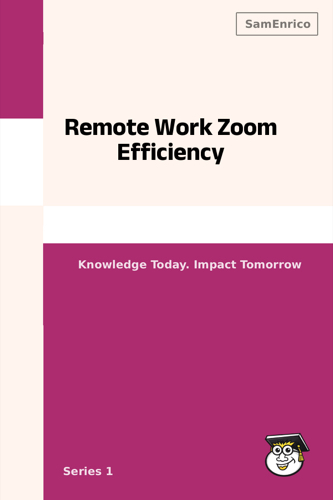
Free sample
Chapter 1: The Zoom Trap–- It begins with a single notification. A calendar invite labeled “Quick Sync – 15 minutes.” You click accept without thinking, because that is what professionals do. What you do not realize is that you have just volunteered yourself and ten of your colleagues to burn $125 of your company’s money and three hours of cumulative human attention—for a conversation that could have been an email, a Loom video, or nothing at all.This is the Zoom Trap. And you are already in it.The Great Illusion: More Calls, Better Teamwork When remote work exploded onto the global stage in 2020, organizations scrambled for a solution that would replicate the office experience. They found Zoom, Microsoft Teams, Google Meet, and a dozen other video conferencing platforms that promised to keep teams connected.
The assumption was simple and seductive: if we cannot be in the same room, we will create a digital room. And if one digital room is good, then more digital rooms must be better.That assumption has quietly bankrupted the productivity of millions of knowledge workers.The average professional now spends over forty percent of their workweek in meetings. For managers and executives, that number often exceeds seventy percent. But here is the paradox that defines modern remote work: despite this explosion in synchronous communication, most teams report feeling less connected and less productive than they did before the pandemic. They are having more conversations and accomplishing less.
They are spending more time on video and feeling more exhausted. They are paying the salary cost of ten people for a fifteen-minute update that could have been delivered in a one-paragraph Slack message.This is not a failure of effort. It is a failure of understanding. We have confused availability with productivity. We have mistaken presence for progress.
And we have built meeting cultures that prioritize real-time reaction over deep, thoughtful work.Digital Presenteeism: The Silent Productivity Killer Before remote work, presenteeism meant showing up to the office when you were too sick to work effectively—being physically present but mentally absent. Digital presenteeism is its evil twin: the pressure to appear constantly online, constantly responsive, and constantly available for video calls, even when your cognitive resources are depleted.Here is how digital presenteeism manifests in your daily work life:You join a video call with your camera on because you do not want to seem disengaged, even though you desperately…
This is the end of the free sample. Get the Audiobook to keep going. Buy now
About this book
Details
- Author
- Rodriquez Sabrina
- Publisher
- SamEnrico
- Language
- English
- Genre
- Non-Fiction, Self-Help / Video
- Released
- 2026-06-09
- Pages (approx.)
- 152
- Available as
- eBook, Audiobook

Listen in the VoxFlicks app
Audiobooks and audio dramas wherever you go. Sign in with your SamEnrico account and press play.
More by Rodriquez Sabrina
 Hoffa Case DNA Evidence Possibility GuideRodriquez Sabrina$11.99
 Handling Difficult Bosses WorkbookRodriquez Sabrina$11.99
 Liars Body Language SignsRodriquez Sabrina$11.99
 Etsy Shop Sales ComparisonRodriquez Sabrina$11.99
 Atomic Habits For Decision MakingRodriquez Sabrina$11.99
 Screen Time GuideRodriquez Sabrina$11.99
 Pressure Dressing ApplicationRodriquez Sabrina$11.99
 The Nobel Heist: Breaking the Code of GeniusRodriquez Sabrina$11.99
 The Green Visionary: Hasan Fathy and the Birth of Earth ArchitectureRodriquez Sabrina$11.99
 How to Produce Wireless Communication TerminalsRodriquez Sabrina$11.99
 Newspaper Article Citation GuideRodriquez Sabrina$12.99
 Nigeria VAT Deregistration GuideRodriquez Sabrina$12.99