
Non-FictionSelf-HelpDigital Nomad
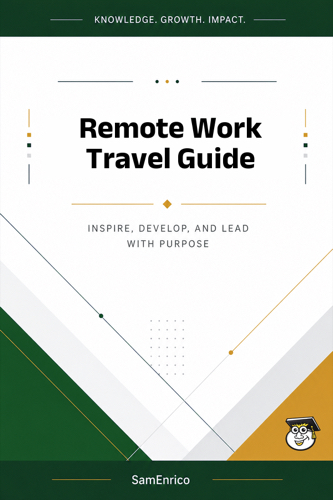
Remote Work Travel Guide eBook
Balances work and sightseeing.
Balances work and sightseeing.
Formats
Free sample
Chapter 1: The Week Three Crash--The dream died on a Tuesday, in a cramped Airbnb in Lisbon, at 2:47 in the afternoon.You had imagined this moment differently. In the fantasy, you were typing wise words into a laptop while a gentle sea breeze rustled your hair and a ceramic mug of locally-roasted coffee sat steaming beside you. In reality, you were hunched over a wobbly IKEA desk, the window behind you painted shut, the “sea breeze” replaced by the rhythmic thumping of construction workers renovating the apartment downstairs. Your coffee was cold. Your Wi-Fi had dropped twice during the Zoom call with your boss, who had asked, “Is that a jackhammer?” And you had just realized that the spreadsheet you’d been wrestling with for three hours had a formula error that set the project back by two days.Outside, through the grimy glass, you could see the Alfama district—yellow trams, cobblestone hills, tourists eating pasteis de nata.
You hadn’t seen any of it. You’d been in Lisbon for eighteen days and had visited exactly zero castles, ridden zero trams, and eaten your body weight in delivered pizza because the grocery store felt “too far.”This was not the Instagram reel. This was Week Three.And you were starting to think you had made a terrible mistake.You are not alone. This chapter is called “The Week Three Crash” because it is the single most predictable, most under-discussed, and most dangerous moment in the remote work travel journey. It is the point where the euphoria of Week One (“I can’t believe this is my life!”) and the productivity of Week Two (“Look at me, I’m crushing it from a cafe!”) collide with the mundane reality of Week Three (“I still have a job, and jobs are hard, and I’m lonely, and I haven’t seen anything, and why did I spend $800 on a flight to sit in an apartment that smells like stale sardines?”).Week Three is where most people quit.
Not loudly—they don’t post a dramatic “I’m going home” video. They just… stop. They book a flight. They tell themselves they’ll try again “when things calm down.” They close the laptop and never open it in another country again.This chapter exists to prevent that. Because Week Three is not a sign that you’ve failed.
It is a sign that you’ve arrived. The crash is not the end of the road—it is the beginning of the real road. And once you understand why it happens, you can not only survive it but design your entire remote work life to avoid it entirely.Let us begin with the anatomy of a crash.The Three-Week Arc: Euphoria, Productivity, and the Hangover The remote work travel experience follows a predictable psychological curve. Knowing it in advance is like having a map of a dark forest—you still have to walk through it, but you won’t panic when the trees close in.Week One: The Euphoria Phase Everything is new. The airport was an adventure.
The taxi driver told you a joke you almost understood. The apartment has charming quirks (a balcony! a stray cat! a key that requires a specific jiggle!). You post a photo of your laptop next to a pastry.
Your friends comment “living the dream” with envy emojis. You feel brilliant, brave, and slightly superior to everyone still in fluorescent-lit offices.You work diligently, but the work feels lighter. Your morning Zoom call happens against a backdrop of terracotta roofs. You take a “lunch break” that is actually an hour-long walk through a neighborhood you’ve never seen. You tell yourself: This is sustainable.
I was born for this.Biologically, you are riding a wave of novelty-induced dopamine. Your brain is delighted by every new stimulus—the different traffic sounds, the unfamiliar coffee brand, the challenge of figuring out which light switch does what. This is not sustainable, and you shouldn’t expect it to be.Week Two: The Productivity Peak By Week Two, the novelty has faded slightly but not vanished. You know where the grocery store is. You have a favorite cafe where the barista nods when you walk in.
You have figured out that the third light switch controls the bathroom fan. You settle into a routine—not a boring routine, but a functional one.This is your most productive week. You have enough familiarity to focus but enough novelty to feel energized. You crush your to-do list. You reply to emails promptly.
You even do that annoying administrative task you’ve been avoiding for months. You feel like you’ve cracked the code.This is also a trap. Because Week Two convinces you that you are invincible. And invincible people do not prepare for Week Three.Week Three: The Hangover Then comes the crash.The novelty has worn off completely. The charming balcony is just a balcony.
The stray cat is just a cat that might have fleas. The key still requires a jiggle, and now it’s annoying. You realize that you have not actually seen any of the famous sights because you’ve been working. You have not made any local friends because you don’t speak the language well enough to say more than “thank you” and “where is the bathroom.”You are lonely. You are tired.
Your work is still hard—because work is hard everywhere, and moving to Portugal did not magically make your spreadsheet formulas correct. You start doomscrolling. You compare your “real” experience to the highlight reels of other nomads on social media. You wonder if you’re doing it wrong.Here is what you need to understand: Week Three is not a bug. It is a feature.The crash happens because you have transitioned from “tourist who works a little” to “resident who works a lot.” The euphoria of Week One was never going to last—that’s not a failure of the lifestyle, it’s a failure of expectation.
Week Two’s productivity was real, but it was fueled by the last embers of novelty. Week Three is the first week of your actual life as a remote worker abroad. It is the baseline. And baselines always feel disappointing compared to peaks.The question is not whether you will experience Week Three. You will.
The question is what you do when you arrive.The Guilt Spiral: Why You Feel Like You’re Wasting Your Location Let me name something you are probably feeling right now but haven’t said out loud: guilt.You paid money for this flight. You told your friends you were going to “work from Europe.” You imagined yourself sending emails from a piazza, taking conference calls from a castle courtyard, closing your laptop at 3pm to watch the sunset over a river. And instead, you are sitting in an apartment that looks remarkably like your apartment at home, except the outlets are different and the shower has confusing controls.The guilt manifests in specific, predictable ways:The Sightseeing Debt. You feel like you “owe” it to your location to see everything. You have a mental list—the museum, the cathedral, the famous bridge, the market, the…
This is the end of the free sample. Get the eBook to keep going. Buy now
About this book
Details
- Author
- Gatlin Vannesa
- Publisher
- SamEnrico
- Language
- English
- Genre
- Non-Fiction, Self-Help, Digital Nomad
- Released
- 2026-06-06
- Pages (approx.)
- 119
- Available as
- eBook, Audiobook

Read better in the ZLOADR app
Your eBooks on your phone or tablet. Sign in with your SamEnrico account and start reading.
More by Gatlin Vannesa
 Pomodoro Technique Remote WorkGatlin Vannesa$11.99
 Tone of Voice GuideGatlin Vannesa$11.99
 Protect Deep Work BlocksGatlin Vannesa$11.99
 Climate Risk in Retirement HousingGatlin Vannesa$11.99
 The Resilience GymGatlin Vannesa$11.99
 Estate Settlement GriefGatlin Vannesa$11.99
 Personal Branding for VeterinariansGatlin Vannesa$11.99
 The Whispering Fingerprints: The First Forensic Breakthrough in the Victorian EraGatlin Vannesa$11.99
 The Celestial Architects: Designing the Future of HumanityGatlin Vannesa$11.99
 How to Start a Esters of Methacrylic Acid Business (Beginners Guide)Gatlin Vannesa$11.99
 How to Produce Water Filter HousingsGatlin Vannesa$11.99
 How to Produce Linens and BeddingGatlin Vannesa$11.99
You may also like
 Hong Kong Handover 1997Dunn Johnnie$11.99
 Zumba For Postnatal Recovery CourseNeal Christian$11.99
 Zumba for BeginnersLadner Nikia$11.99
 YouTube Comment Mining GuideHumes Pandora$12.99
 Worry Box MeditationCarlin Rudy$11.99
 Workplace Stress MeditationNguyen Lynn$11.99
 Workplace Stress and Sleep RepairHawley Ivory$11.99
 Workplace Perfectionism CureDelaney Jeffry$11.99
 Workplace Injustice Anger GuideWallen Isabelle$11.99
 Work Addiction and Burnout LinkGreenwood Ester$11.99
 Women in Yoga and WellnessBeattie Galina$11.99
 Women in Stand Up ComedyChun Evangeline$11.99