
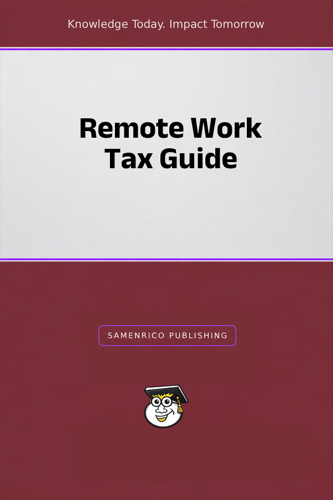
Remote Work Tax Guide eBook
Track home office deductions and state tax obligat
by Caswell Mica
Track home office deductions and state tax obligations.
Formats
Free sample
Chapter 1: The $12,000 Coffee Shop--The mug says "Work From Anywhere." The IRS says "No, you can't."This is the central lie of the remote work revolution. For the past five years, you have been told that geography is dead, that your laptop is your office, and that the old rules no longer apply. But the tax code did not get the memo. The IRS and state tax authorities still operate on a physical-location model written in 1913—the year the federal income tax was ratified, the same year Woodrow Wilson became president, and a full decade before the first commercial radio broadcast.The tax code does not care about your lifestyle. It does not care about your freedom.
It cares about one thing and one thing only: where your body is when you perform work. A laptop in a coffee shop is treated differently than a laptop in a dedicated home office. A spare bedroom with a door is treated differently than a kitchen table. And the difference, as you are about to learn, can cost you thousands of dollars per year.This chapter is not a gentle warm-up. It is a wake-up call.
By the time you finish reading these pages, you will understand why almost every remote worker is overpaying taxes, why your employer probably has no idea what they are doing, and why the three words "I work remotely" are the most dangerous phrase in modern taxation.The Myth of the Virtual Office Let us start with a story. It is a true story, though the names have been changed to protect the innocent and the audited.Sarah was a graphic designer. She lived in Austin, Texas, which has no state income tax. She worked remotely for a tech company based in San Francisco, California. She had a dedicated home office—a converted guest bedroom with a desk, two monitors, and a very expensive ergonomic chair.
She worked from that office 220 days per year. The other 145 days, she traveled. She worked from coffee shops in Portland, co-working spaces in Denver, and her parents' basement in Ohio during the holidays.Sarah thought she had figured out taxes. She was a 1099 independent contractor, so she deducted her home office expenses. She deducted her internet bill, her phone, her laptop, and a portion of her rent.
She used Turbo Tax. She felt smart.Then the letter came.It was not from the IRS. It was from the Franchise Tax Board of California. The letter stated that Sarah owed back taxes for three years, plus penalties and interest, totaling $12,400. California claimed that because she performed work for a California-based company, and because she had not proven that her remote work was for the "convenience of her employer" rather than her own convenience, her income was sourced to California.
She owed them money.Sarah hired a CPA. The CPA asked one question: "Did your employer require you to work from Texas, or did you choose to?"Sarah said, "I chose to. I wanted to live in Austin."The CPA sighed. "Then you lose."Sarah paid the $12,400. She also paid the CPA $800 to tell her that she had no case.
She stopped deducting her home office because the CPA advised her that claiming the deduction while fighting California's claim would create a contradiction. She lost the deduction and the tax fight.Sarah made two mistakes. First, she did not understand the difference between domicile and physical presence. Second, she did not understand the "Convenience of the Employer" rule. But her biggest mistake was believing that working remotely simplified her taxes.
It did the opposite. It turned a simple single-state return into a multi-state nightmare.This book exists to ensure that you do not become Sarah.The Physical-Location Trap The IRS operates on a simple principle: income is taxed where it is earned. For most of American history, that was straightforward. You worked at a factory. The factory was in Ohio.
You paid Ohio tax. You went home. End of story.Remote work breaks this model entirely. When you work from home, where is your income "earned"? Is it at your employer's headquarters?
Is it at your home office? Is it at the coffee shop where you answered emails for two hours? The answer, infuriatingly, is "it depends"—and it depends on rules written long before anyone had ever heard of Zoom.The IRS addresses this through the concept of the "tax home." Your tax home is defined as your regular place of business, regardless of where you maintain your family home. If you have no regular place of business, your tax home is where you live. For a traditional worker, this is simple.
For a remote worker, it is a labyrinth.Here is the critical distinction that most remote workers miss: the IRS does not recognize a "virtual office." A laptop is not a place. A co-working membership is not a place. A coffee shop is not a place. The IRS requires a physical, fixed, and dedicated space to recognize a home office as a bona fide place of business.This matters because the location of your "principal place of business" determines which state has the primary right to tax your income. It also determines whether you can claim the home office deduction at all.
And if you are a W-2 employee, it determines whether you can claim any deductions whatsoever—spoiler alert: currently, you cannot.The Three Tax Identities Before we go any further, you need to know who you are in the eyes of the tax code. Every remote worker falls into one of three categories. Your category determines every rule, every deduction, and every trap that applies to you.Identity One: The W-2 Employee You receive a Form W-2 at the end of the year. Your employer withholds federal income tax, Social Security, Medicare, and state income tax from your paycheck. You have no control over this withholding, and your employer has significant control over how, when, and where you work.Here is the brutal truth for W-2 employees under current law (2018–2025): you cannot deduct unreimbursed home office expenses.
Period. The Tax Cuts and Jobs Act (TCJA) of 2017 suspended the deduction for "miscellaneous itemized deductions subject to the 2% floor" through 2025. This includes home office expenses, unreimbursed employee business expenses, tax preparation fees, and investment expenses.If you are a W-2 employee reading this book hoping to deduct your internet bill, your new desk, or your ergonomic keyboard, you need to put the book down and turn to Chapter 9 immediately. That chapter explains the 2026 sunset (when these deductions may return), the Accountable Plan workaround (if your employer is cooperative), and the hard truth that most employers will say no.For now, understand this: as a W-2 remote employee, your tax strategy is not about deductions. It is about state sourcing.
It is about ensuring that your employer is withholding taxes for the correct state. It is about tracking your days so you do not accidentally trigger residency in a high-tax state. And it is about surviving the Convenience of the Employer rule, which we will cover in detail in Chapter 2.Identity Two: The Independent Contractor (1099)You receive a Form 1099-NEC at the end…
This is the end of the free sample. Get the eBook to keep going. Buy now
About this book
Details
- Author
- Caswell Mica
- Publisher
- SamEnrico
- Language
- English
- Genre
- Non-Fiction, Self-Help, Finance
- Released
- 2026-06-09
- Pages (approx.)
- 139
- Available as
- eBook, Audiobook

Read better in the ZLOADR app
Your eBooks on your phone or tablet. Sign in with your SamEnrico account and start reading.
More by Caswell Mica
 Nose Touching DeceptionCaswell Mica$11.99
 TRIZ Problem Solving GuideCaswell Mica$11.99
 Self Hypnosis for Tension HeadachesCaswell Mica$11.99
 Self Esteem for MinoritiesCaswell Mica$11.99
 Conversation Starters for ConcertsCaswell Mica$11.99
 Parental Anger After AdoptionCaswell Mica$11.99
 The Sultan's Stolen Steeds: The Crime That Sparked Ottoman ReformCaswell Mica$11.99
 Prototyping for StartupsCaswell Mica$11.99
 The Unseen Playbook: How Bill Belichick’s Obsession with Film Changed Football ForeverCaswell Mica$11.99
 WindsurfingCaswell Mica$11.99
 Launching A Youtube Channel For Your Brand FoundationsCaswell Mica$12.99
 Belgian ARES Scholarships GuideCaswell Mica$12.99
You may also like
 Hong Kong Handover 1997Dunn Johnnie$11.99
 Zumba For Postnatal Recovery CourseNeal Christian$11.99
 Zumba for BeginnersLadner Nikia$11.99
 YouTube Comment Mining GuideHumes Pandora$12.99
 Worry Box MeditationCarlin Rudy$11.99
 Workplace Stress MeditationNguyen Lynn$11.99
 Workplace Stress and Sleep RepairHawley Ivory$11.99
 Workplace Perfectionism CureDelaney Jeffry$11.99
 Workplace Injustice Anger GuideWallen Isabelle$11.99
 Work Addiction and Burnout LinkGreenwood Ester$11.99
 Women in Yoga and WellnessBeattie Galina$11.99
 Women in Stand Up ComedyChun Evangeline$11.99