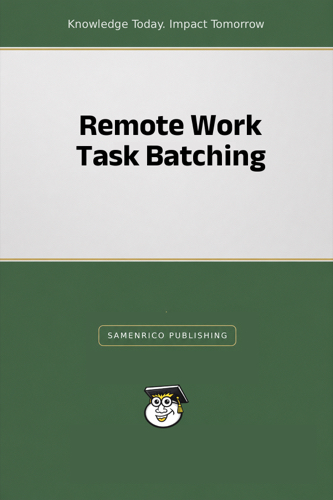
Remote Work Task Batching eBook
Group administrative work into one weekly block.
Group administrative work into one weekly block.
Formats
Free sample
Chapter 1: The Fragmentation Trap--–- The email arrived at 9:17 AM. Sarah, a freelance brand designer, was just settling into her morning coffee, ready to tackle a logo concept for a new client. The message was quick: "Hi Sarah, just confirming our call tomorrow at 2 PM? Also, attached is the revised brief." She replied immediately: "Confirmed! Will review the brief." Thirty seconds.
Done. Back to the logo.At 9:43 AM, Slack pinged. A former collaborator: "Hey! Can you send over that invoice from the March project? Accounting is asking." Sarah sighed, opened her invoicing tool, found the old invoice, and emailed it over.
Four minutes. Back to the logo.At 10:12 AM, her project management tool notified her: "Task 'File receipts for Q2' is overdue." She clicked over, uploaded three receipts, marked it complete. Two minutes.At 10:28 AM, a vendor form arrived. "Please update your W-9 information." She downloaded the PDF, filled it out, uploaded it. Seven minutes.At 11:05 AM, she realized she had spent nearly two hours on "small things" and had barely touched the logo.
She closed all her tabs, put her phone face down, and swore: "No more interruptions." She worked solidly for 45 minutes. Then lunch.The afternoon brought five more emails, two Slack threads, a calendar invite she needed to reschedule, and a "quick question" from a client about file formats. By 5 PM, Sarah had answered 23 emails, processed three invoices, filled out two forms, organized a cloud folder, updated her status in three tools, and scheduled four calls. She had also worked on the logo for a total of 90 minutes. She felt exhausted.
She felt busy. She felt like she had accomplished nothing.Sarah is not lazy. She is not disorganized. She is not bad at her job. Sarah is trapped in the Fragmentation Trap—the default operating system of the remote knowledge worker.
And unless you are reading this book as a complete anomaly, so are you.The Great Remote Work Paradox Remote work was supposed to be the liberation. No commute. No open office distractions. No "can you just quick hop on a call?" from a coworker standing at your desk. You would finally have the focused, uninterrupted hours you needed to do your best work.Instead, something unexpected happened.
The physical barriers disappeared, yes. But the digital barriers multiplied. And worse, the psychological barriers—the subtle cues that told you when you were "at work" and when you were "available"—evaporated entirely.In an office, your desk is your territory. Someone walking up to ask a "quick question" requires physical effort and social calculation. In remote work, a Slack message costs nothing.
An email is frictionless. A calendar invite is a click. The result is not freedom from interruption—it is interruption at scale, delivered through five different channels, each one demanding a micro-decision.The average remote worker, according to research from the University of California, Irvine, switches tasks every three minutes and five seconds. After each switch, it takes an average of twenty-three minutes to return to the original task with the same level of cognitive focus. Do the math: three minutes of work, twenty-three minutes of recovery, repeated across an eight-hour day.
That is not a workday. That is a fragmentation machine.And here is the cruelest irony: the tasks causing the fragmentation are not your real work. They are administrative. Low-cognitive. Repetitive.
Non-strategic. They are the chores of knowledge work—the digital equivalent of doing laundry while trying to write a novel.Defining the Invisible Tax Let us name what we are dealing with. For the purposes of this book, administrative tasks are defined by three characteristics, all of which must be present:First, they are low-cognitive. They require minimal judgment, creativity, or strategic thinking. Answering "Can you send me that file?" is low-cognitive.
Deciding which file format to recommend to a client is not.Second, they are repetitive. They occur more than once per week, often in identical or near-identical form. The invoice you send every Thursday. The status update you post every morning. The "checking in" email you fire off to pending clients.Third, they are non-strategic.
They do not directly advance your primary value creation. For a designer, designing is strategic. Filing receipts is not. For a software engineer, writing code is strategic. Updating Jira tickets is not.
For a salesperson, closing deals is strategic. Entering CRM data is not.Notice what this definition excludes. Client contract reviews? High-cognitive. Strategic.
Not administrative. Budget planning? High-cognitive. Strategic. Not administrative.
Team scheduling for a complex project? Requires judgment and coordination. Not administrative. These are your real work, and they deserve their own protected time. This book is not about batching your real work.
It is about isolating the low-value, high-interruption tasks that currently masquerade as "quick wins" while quietly destroying your capacity for depth.The typical remote worker spends between fifteen and twenty hours per week on tasks that meet all three criteria. Fifteen to twenty hours. That is nearly half a standard workweek. But here is the kicker: those fifteen to twenty hours are not experienced as a single block. They are experienced as 5-minute slices, 2-minute slices, 90-second slices, scattered across every single day like landmines.You answer an email.
You file a receipt. You update a status. You confirm a meeting. You send an invoice. You unsubscribe from a newsletter.
You move a file. Each one takes almost no time. Each one costs almost nothing. But the cumulative effect is devastating.The Sarah Problem, Generalized Sarah's week was not unusual. It was typical.
Let me show you the math of her fragmentation.Across five days, Sarah spent 14 hours on administrative tasks. But those 14 hours were not continuous. They were broken into 47 separate administrative "touches"—individual moments where she stopped her real work to do something low-cognitive, repetitive, and non-strategic.Monday: 11 touches (emails, one invoice, cloud organization)Tuesday: 9 touches (Slack responses, a vendor form, scheduling)Wednesday: 8 touches (email cleanup, receipt filing, status updates)Thursday: 12 touches (client emails, project management updates, calendar juggling)Friday: 7 touches (timesheet, final email sweep, folder cleanup)Forty-seven touches. Each touch cost her not only the 5-15 minutes of execution time but also the cognitive cost of switching. The cost of disengaging from her logo design, answering the email, and then re-engaging—finding her place, remembering what she was thinking, rebuilding momentum.Research from Microsoft found that after an interruption, it takes an average of fifteen minutes to return to a focused state.
Fifteen minutes. Multiply that by 47 touches, and you get 705 minutes—nearly 12 hours—of pure recovery time. Add the 14 hours of execution, and Sarah is spending 26 hours per week on the combination of administrative work and the recovery from administrative work.She has a 40-hour workweek. She is spending 26 of those hours on admin and recovery. That leaves 14 hours for her actual job: designing.Sarah is not a cautionary tale.
Sarah is the average knowledge worker. And if you are reading this book, Sarah is probably you.The Shallow Work Debt I want to introduce a concept that will recur throughout this book: Shallow Work Debt.We are familiar with financial debt. You spend money you do not have, and it accrues interest. The longer you…
This is the end of the free sample. Get the eBook to keep going. Buy now
About this book
Details
- Author
- Stepp Lorriane
- Publisher
- SamEnrico
- Language
- English
- Genre
- Non-Fiction, Self-Help, Admin
- Released
- 2026-06-10
- Pages (approx.)
- 132
- Available as
- eBook, Audiobook

Read better in the ZLOADR app
Your eBooks on your phone or tablet. Sign in with your SamEnrico account and start reading.
More by Stepp Lorriane
 Immigrant Child Sports TeamStepp Lorriane$11.99
 Dream Nudity JournalStepp Lorriane$11.99
 Mexico Benefits NegotiationStepp Lorriane$11.99
 Open Space Technology GuideStepp Lorriane$11.99
 Conversation Starters for Online DatingStepp Lorriane$11.99
 Anger at Childs Gender IdentityStepp Lorriane$11.99
 Design Thinking for TeachersStepp Lorriane$11.99
 Magellan's Odyssey: Charting the UnknownStepp Lorriane$11.99
 How to Produce Cocktail StrainersStepp Lorriane$11.99
 How to Start a Cold Formed Steel Sections Business (Beginners Guide)Stepp Lorriane$11.99
 How to Produce an Oilseed PressStepp Lorriane$11.99
 A Collector's Handbook to the Standard Sixteen (1930-33)Stepp Lorriane$11.99