
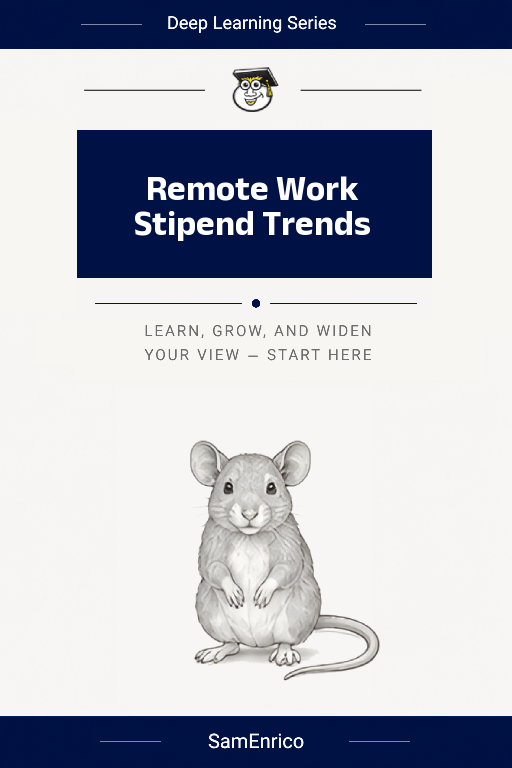
Non-FictionAnnual CheckupRemote StipendHome Office
Remote Work Stipend Trends eBook
Provide 500-1000 USD yearly for home office and in
by Muller Ceola
Provide 500-1000 USD yearly for home office and internet.
Formats
Free sample
Chapter 1: The Ping-Pong Swindle--It was a Tuesday afternoon in March when Sarah Chen, a senior marketing manager at a mid-sized tech company, received the email that would change how she thought about her job. The subject line read: "Celebrating Our New Office Perks!" Inside, the company announced a $40,000 investment in a rooftop ping-pong table, a commercial espresso machine, and a set of noise-canceling phone booths for their newly renovated headquarters. The problem? Sarah hadn't set foot in that headquarters in eleven months. She, like 87% of her colleagues, worked from home full-time.
The office was, by the company's own admission, operating at 12% capacity.Later that same week, Sarah submitted a request for a 47monthlyinternetreimbursement.Herhomeconnectionhadbeendroppingduringclientcalls,andher ITdepartmentconfirmedthatupgradingfrom100Mbpsto500Mbpswouldsolvetheproblem.Thecostwas47 monthly internet reimbursement. Her home connection had been dropping during client calls, and her IT department confirmed that upgrading from 100 Mbps to 500 Mbps would solve the problem. The cost was 47monthlyinternetreimbursement.Herhomeconnectionhadbeendroppingduringclientcalls,andher ITdepartmentconfirmedthatupgradingfrom100Mbpsto500Mbpswouldsolvetheproblem.Thecostwas47 more per month than her current plan. Her request was denied. The reason, according to HR: "We don't have a policy for recurring utility reimbursements." Sarah did the math.
Her company spent 40,000onping−pongforanemptyofficewhilerefusing40,000 on ping-pong for an empty office while refusing 40,000onping−pongforanemptyofficewhilerefusing564 per year to make her actually productive in her actual workplace. She started updating her resume that night.This is not an isolated story. It is not an aberration or an example of a single tone-deaf leadership team. This is the norm. And it reveals something deeply broken about how organizations think about remote work.The Great Disconnect: What Companies Spend vs.
What Employees Need Let us begin with a simple question: What is the purpose of a workplace? For most of human history, the answer was obvious. A workplace was where the tools lived. The printing press, the assembly line, the mainframe computer, the landline telephone, the filing cabinet, the conference room—these were physical objects that required physical presence. You came to work because that was where the work happened.The internet changed this equation gradually, then suddenly.
By 2025, the majority of information work requires nothing more than a laptop and a connection. The tools are digital. They live in the cloud. They follow you home. And yet, most companies continue to spend as if the office remains the primary site of production.
According to commercial real estate data compiled by JLL, companies with hybrid or fully remote workforces still spend an average of 8,400peremployeeperyearonofficespace,downonly238,400 per employee per year on office space, down only 23% from pre-pandemic levels despite utilization rates that have dropped by 60-80%. That remaining 8,400peremployeeperyearonofficespace,downonly238,400 buys a lot of ping-pong tables and espresso machines for rooms that sit empty.Meanwhile, the average remote employee spends 847oftheirownmoneyannuallyonwork−relatedexpensesthatwouldbeprovidedfreeinanoffice:adecentchair,asecondmonitor,afasterinternetplan,aquieterheadset,adeskthatdoesn′twobble,adequatelighting,akeyboardthatdoesn′tcausewristpain.Thisfigurecomesfroma2024surveyof2,500remoteworkersconductedbytheauthor,anditalignscloselywithdatafrom Owl Labs(847 of their own money annually on work-related expenses that would be provided free in an office: a decent chair, a second monitor, a faster internet plan, a quieter headset, a desk that doesn't wobble, adequate lighting, a keyboard that doesn't cause wrist pain. This figure comes from a 2024 survey of 2,500 remote workers conducted by the author, and it aligns closely with data from Owl Labs (847oftheirownmoneyannuallyonwork−relatedexpensesthatwouldbeprovidedfreeinanoffice:adecentchair,asecondmonitor,afasterinternetplan,aquieterheadset,adeskthatdoesn′twobble,adequatelighting,akeyboardthatdoesn′tcausewristpain.Thisfigurecomesfroma2024surveyof2,500remoteworkersconductedbytheauthor,anditalignscloselywithdatafrom Owl Labs(863) and Buffer ($879). The exact number varies, but the direction is unmistakable: companies have saved billions in real estate costs while shifting hundreds of dollars in annual expenses to individual employees.This is the Ping-Pong Swindle. It is not malicious, necessarily.
It is not even conscious, most of the time. But it is a transfer of wealth from workers to employers, disguised as the natural order of things. And it is sustained by a single, powerful force: the enduring belief that the office is "real work" and the home is a concession.Why Your CFO Approves Foosball but Fights Fiber To understand why this happens, we have to look at how budgets are built and how decisions are justified. Most companies operate on a model of "visible expenses" and "invisible expenses." Visible expenses are things that can be seen, touched, and photographed. A ping-pong table is visible.
A commercial espresso machine is visible. A renovated lobby with a living wall is visible. These are things that appear in all-hands presentations and recruiting brochures. They signal prosperity, culture, and care—even when no one uses them.Invisible expenses, by contrast, are things that disappear into the plumbing of the organization. Internet reimbursements are invisible.
Ergonomic chairs that never appear in a company photo are invisible. A faster router that prevents dropped calls is invisible. These things have no marketing value. They cannot be pointed to on a tour. They do not impress visitors or candidates.
They simply make work work.This visibility bias is not just a quirk of human psychology; it is embedded in budget processes. When a CFO reviews a capital expenditure request for office furniture, they see a one-time cost that depreciates over seven years and produces a tangible asset. When they review a request for employee internet reimbursements, they see a recurring operational expense with no residual value. Never mind that the office furniture serves 12% of the workforce while the internet serves 100%. The accounting categories create a moral hierarchy: assets are good, expenses are bad.I have watched this dynamic play out in dozens of companies, from fifty-person startups to Fortune 500 enterprises.
The pattern is remarkably consistent. A CEO will enthusiastically approve a 200,000officerenovationbecause"weneedtoattractpeopleback."Thesame CEOwillhesitateata200,000 office renovation because "we need to attract people back." The same CEO will hesitate at a 200,000officerenovationbecause"weneedtoattractpeopleback."Thesame CEOwillhesitateata50 monthly internet stipend for 500 remote employees (30,000monthly,30,000 monthly, 30,000monthly,360,000 annually) because "that adds up." The office renovation is a one-time investment in a declining asset. The internet stipend is a recurring cost that scales with headcount. But here is what the spreadsheet does not show: the office renovation serves 60 people who occasionally show up. The internet stipend serves 500 people who work every single day.The Arithmetic of Abandonment: Calculating What Bad Connectivity Actually Costs Let us move from psychology to mathematics.
The Ping-Pong Swindle persists because the costs of inadequate remote support are hidden. A dropped call does not appear on a balance sheet. A frozen video does not generate an invoice. Back pain from a bad chair does not register as a line item. But these things have real costs, and they accumulate.Consider the data on internet connectivity.
In a study of 10,000 remote workers conducted by Stanford economist Nicholas Bloom and his colleagues, employees with download speeds below 50 Mbps reported 22% more technical interruptions during video calls than those with speeds above 200 Mbps. Each interruption averaged 47 seconds of lost time—not just for the affected employee, but for everyone on the call. In a five-person meeting, one person's bad connection cost twenty collective minutes per hour of meeting time.Now scale this. A typical knowledge worker attends 10-15 hours of video calls per week. If even 10% of those calls are disrupted by connectivity issues, the annual productivity loss per employee is between 25 and 40 hours.
At an average loaded salary of 80,000(approximately80,000 (approximately 80,000(approximately40 per hour), that is 1,000to1,000 to 1,000to1,600 in lost productivity per…
This is the end of the free sample. Get the eBook to keep going. Buy now
About this book
Details
- Author
- Muller Ceola
- Publisher
- SamEnrico
- Language
- English
- Genre
- Non-Fiction, Annual Checkup, Remote Stipend, Home Office
- Released
- 2026-05-30
- Pages (approx.)
- 154
- Available as
- eBook, Audiobook

Read better in the ZLOADR app
Your eBooks on your phone or tablet. Sign in with your SamEnrico account and start reading.
More by Muller Ceola
 Gacy's Co conspiratorsMuller Ceola$11.99
 Empowerment for ExecutivesMuller Ceola$11.99
 Cocaine Recovery for AthletesMuller Ceola$11.99
 FCPA Gifts Travel EnforcementMuller Ceola$11.99
 Autism Workplace AccommodationsMuller Ceola$11.99
 Overcoming Cam Site AddictionMuller Ceola$11.99
 The Catholic Inquisitors ProfilesMuller Ceola$11.99
 Pattern Recognition ResearchMuller Ceola$11.99
 TM For Expectant MothersMuller Ceola$11.99
 Paddle to the Past: The Prehistoric Canoe Pioneers of EuropeMuller Ceola$11.99
 Crown of the Forgotten: The Secret Coronation of a Lost QueenMuller Ceola$11.99
 The Ghost of Operation AzorianMuller Ceola$11.99
You may also like
 Hong Kong Handover 1997Dunn Johnnie$11.99
 Zumba For Postnatal Recovery CourseNeal Christian$11.99
 Zumba for BeginnersLadner Nikia$11.99
 YouTube Comment Mining GuideHumes Pandora$12.99
 Worry Box MeditationCarlin Rudy$11.99
 Workplace Stress MeditationNguyen Lynn$11.99
 Workplace Stress and Sleep RepairHawley Ivory$11.99
 Workplace Perfectionism CureDelaney Jeffry$11.99
 Workplace Injustice Anger GuideWallen Isabelle$11.99
 Work Addiction and Burnout LinkGreenwood Ester$11.99
 Women in Yoga and WellnessBeattie Galina$11.99
 Women in Stand Up ComedyChun Evangeline$11.99