
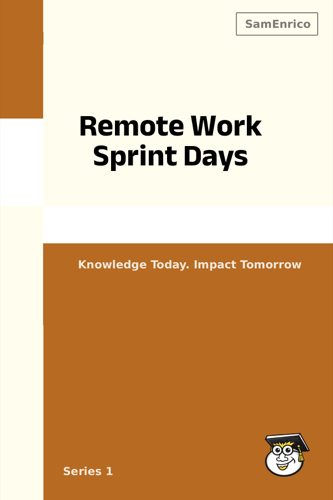
Remote Work Sprint Days eBook
Design ultra focused days with minimal meetings fo
by Currier Lura
Design ultra focused days with minimal meetings for deep output.
Formats
Free sample
Chapter 1: The Exhaustion Paradox–- You close your laptop on Friday at 5:47 PM. The screen goes dark. You lean back in your chair, and for a moment, there is silence. Then the quiet hum of your home office returns—the refrigerator, the distant traffic, the dog shifting on the couch. You answered forty-seven Slack messages this week.
You attended eight hours of video calls. You cleared your email inbox to zero not once but three times. You feel exhausted. You feel like you worked hard. And yet, when your partner asks, “What did you actually accomplish this week?” you draw a complete blank.This is the Exhaustion Paradox of remote work: high activity, low output.
You have been busy. You have not been productive.You are not alone. Across the knowledge economy, millions of remote workers are trapped in the same exhausting cycle. They wake up, check Slack before brushing their teeth, join their first meeting at 9 AM, bounce between calls and emails until noon, grab a hurried lunch, spend the afternoon “putting out fires,” log off at 6 PM feeling drained, and cannot name a single thing they created, solved, or advanced. The calendar is full.
The to-do list is longer than when they started. And the week has vanished into a fog of reactivity.Something is deeply wrong with how we work remotely. And the problem is not what you think.The Great Disappearance Let me tell you a story. In 2020, the world went remote almost overnight. Companies that had resisted working from home for decades suddenly had no choice.
Zoom downloads exploded. Slack usage tripled. Microsoft Teams became the most installed software on the planet. And for a few months, everyone celebrated. No commutes.
More time with family. Working in comfortable clothes. It felt like liberation.Then something shifted.By 2021, the cracks began to show. Studies emerged showing that remote workers were working longer hours than ever before—an average of 48.5 hours per week, compared to 40.2 in the office. Another study found that the number of meetings per person had increased by nearly 150% since the pandemic began.
And yet, despite working more hours and attending more meetings, output per hour had declined.How is this possible? How can we work more and produce less?The answer lies in a fundamental confusion between two very different kinds of work. One produces value. The other produces the illusion of value. And remote work has accidentally become a machine for producing the illusion while strangling the reality.Deep Work Versus Shallow Work: The Distinction That Changes Everything In his landmark book Deep Work, computer science professor Cal Newport introduced a distinction that should be tattooed on the forearm of every knowledge worker.
It is the single most important idea in this entire book, and everything else builds from it.Deep Work is cognitively demanding activity performed in a state of distraction-free concentration. It pushes your capabilities to their limit. It creates new value. It improves your skills. And it is hard to replicate.Examples of deep work:Writing a strategy document that will guide your team for the next quarter Solving a complex analytical problem that requires sustained reasoning Designing a product feature from first principles Writing code for a new system architecture Analyzing a data set to find a pattern no one has seen before Learning a new skill that requires focused practice Deep work is what you were hired to do.
It is the reason your salary exists. It is the work that moves the needle.Shallow Work is logistical, low-cognitive tasks often performed while distracted. These tasks do not create new value. They simply move existing value around. They are easy to replicate.
And they are the default state of most remote workers.Examples of shallow work:Answering emails and Slack messages Attending status update meetings Scheduling calls and coordinating calendars Filling out forms and updating status fields Forwarding information from one person to another“Cleaning up” documents without adding substance Shallow work feels like work. It can fill an entire day. It can make you feel busy, important, and responsive. But at the end of the week, shallow work has not advanced anything. It has just kept the wheels spinning.Here is the brutal truth that most remote workers refuse to accept: Shallow work does not produce value.
It produces the appearance of value.The Remote Paradox: More Shallow, Less Deep In an office, there are natural constraints on shallow work. When you finish a meeting, you walk back to your desk. When you send an email, the person might not respond for an hour. When you need to focus, you can close your door or put on headphones. The physical environment creates friction.
That friction is actually protective.Remote work removed that friction.Now, you wake up and Slack is already open. Notifications are already pinging. Your manager is already asking for a “quick sync.” Your teammates are already posting updates. The expectation is not that you will respond “soon” but that you will respond immediately. Because you’re at home.
Because you’re not commuting. Because you don’t have a door to close.This is the remote paradox: The friction that protected your focus has disappeared, and the expectations of availability have exploded.Consider this data, which we will reference throughout this book. A study conducted by researchers at the University of California, Irvine found that after a single notification pull—one Slack message, one email ding, one calendar reminder—it takes an average of twenty-three minutes and fifteen seconds to return to the original task at full cognitive capacity. Not two minutes. Not five.
Twenty-three minutes.Now do the math. If you check Slack ten times per day—a conservative estimate for most remote workers—you are losing nearly four hours of cognitive capacity every single day. Not time. Cognitive capacity. You are still at your desk.
You are still “working.” But your brain is a broken machine, switching contexts so many times that it never reaches the depth required for real output.A separate study found that context switching between digital tasks can reduce effective IQ by up to ten points. That is the equivalent of missing an entire night of sleep. Imagine showing up to work every day having not slept. That is what your notification habit is doing to you.The Deep Work Ratio: Your Diagnostic Tool Before we go any further, you need to know where you stand. This book is not theoretical.
It is not inspirational fluff. It is a diagnostic and a prescription. And the first step of any diagnosis is measurement.Complete the following self-assessment. Be honest. No one is watching.The Deep Work Ratio Quiz For each question, rate yourself on a scale of 1 (almost never) to 5 (almost always).I have blocks of at least ninety consecutive minutes with no notifications, no Slack, and no email.I can identify a specific output I created yesterday that required intense concentration.I decline or skip meetings that do not require my direct participation.I go more than two hours without checking Slack or email.I finish my workday knowing exactly what I accomplished, not just what I reacted to.My calendar has fewer…
This is the end of the free sample. Get the eBook to keep going. Buy now
About this book
Details
- Author
- Currier Lura
- Publisher
- SamEnrico
- Language
- English
- Genre
- Non-Fiction, Self-Help, Sprints
- Released
- 2026-06-11
- Pages (approx.)
- 140
- Available as
- eBook, Audiobook

Read better in the ZLOADR app
Your eBooks on your phone or tablet. Sign in with your SamEnrico account and start reading.
More by Currier Lura
 Welfare to Wealth StoryCurrier Lura$11.99
 Dream Gender JournalCurrier Lura$11.99
 French Critique ExpectationCurrier Lura$11.99
 Design Thinking Team GuideCurrier Lura$11.99
 Small Talk for WeddingsCurrier Lura$11.99
 Parental Anger at Mess and ClutterCurrier Lura$11.99
 Ideation Techniques for DesignCurrier Lura$11.99
 Horizon Chasers: The Legend of John CabotCurrier Lura$11.99
 The Phantom Ledger: How a Forgotten Accountant Exposed the World’s Largest Corporate Cover-UpCurrier Lura$11.99
 A Collector's Handbook to the Standard Flying SixteenCurrier Lura$11.99
 How to Produce Oil Lamp FuelCurrier Lura$11.99
 Partial Shipment Payment MatchingCurrier Lura$12.99
You may also like
 Hong Kong Handover 1997Dunn Johnnie$11.99
 Zumba For Postnatal Recovery CourseNeal Christian$11.99
 Zumba for BeginnersLadner Nikia$11.99
 YouTube Comment Mining GuideHumes Pandora$12.99
 Worry Box MeditationCarlin Rudy$11.99
 Workplace Stress MeditationNguyen Lynn$11.99
 Workplace Stress and Sleep RepairHawley Ivory$11.99
 Workplace Perfectionism CureDelaney Jeffry$11.99
 Workplace Injustice Anger GuideWallen Isabelle$11.99
 Work Addiction and Burnout LinkGreenwood Ester$11.99
 Women in Yoga and WellnessBeattie Galina$11.99
 Women in Stand Up ComedyChun Evangeline$11.99