
Non-FictionSelf-HelpRemote Culture
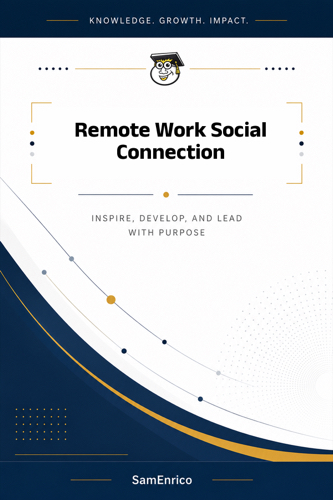
Remote Work Social Connection eBook
Schedules virtual coffee breaks.
by Hanks Deana
Schedules virtual coffee breaks.
Formats
Free sample
Chapter 1: The Lonely Screen--–- I quit my dream remote job on a Tuesday morning in March, not because the work was hard or the pay was bad, but because no one had asked me a single non-work question in eleven days.The realization hit me somewhere between my third cup of coffee and a Slack notification that read, “Great work on the Q2 forecast.” Great work. That was it. No “How are you holding up?” No “Did you see that crazy thing on the news?” Just a perfunctory acknowledgment of output, delivered with the emotional warmth of a spreadsheet formula. I stared at my screen for a long moment, then closed my laptop, walked to my kitchen, and sat on the floor with my back against the refrigerator. The hum of the compressor was the only human-like voice I had heard in hours.I had been sold a dream.
The dream was freedom: no commute, no open-plan office chaos, no performative face-time with colleagues I barely liked. I could work from anywhere, wear sweatpants, and reclaim eight hours a week previously lost to traffic. And for the first six months, the dream worked. I was more productive than ever. My calendar was a masterpiece of optimization.
I answered emails at 7 AM, crushed deep work blocks until noon, and logged off at 4 PM feeling smugly efficient.But somewhere around month seven, something shifted. The silence that had felt liberating began to feel heavy. The lack of interruption that had felt focused began to feel lonely. I started noticing that my Slack conversations had become purely transactional: “Approved.” “LGTM.” “Thoughts?” The exclamation points that once punctuated our messages had disappeared, replaced by periods. Cold, terminal, final periods.I was surrounded by digital tools designed to connect me—Slack, Zoom, Asana, Miro, Notion—and yet I had never felt more alone in my life.
I had optimized every minute of my workday for productivity and accidentally eliminated every minute designed for joy.The Great Paradox of Remote Work This is the central contradiction of our moment. Remote work has delivered on its productivity promises. Study after study confirms what knowledge workers have long suspected: people get more done when they are not interrupted by commute chaos, fluorescent lighting, and the colleague who “just has a quick question” every forty-five minutes. A 2023 study from Stanford economist Nicholas Bloom found that fully remote workers completed 13% more calls per minute than their office-based counterparts. Another study from the National Bureau of Economic Research found that remote work increased individual output by 8% to 10%, depending on the task.And yet.And yet the same workers who are producing more than ever are also reporting record levels of loneliness, disconnection, and burnout.
The Buffer State of Remote Work report, now in its eighth year, consistently finds that loneliness is the second-biggest struggle for remote employees, trailing only collaboration and communication. In the 2023 edition, 67% of remote workers reported difficulty maintaining workplace friendships. More startling: 76% said remote work negatively affects their mental health, with social isolation cited as the primary driver.Let me repeat those numbers because they are easy to skim and hard to sit with. Seventy-six percent. Three out of every four people reading this book have, at some point in their remote work journey, felt their mental health decline specifically because of the social conditions of working from home.
That is not a fringe issue. That is not a “soft skill” problem. That is a crisis hiding in plain sight.The Tools That Were Supposed to Save Us How did we get here? The answer is painfully ironic. We built an unprecedented infrastructure for remote connection, and that infrastructure turned out to be terrible at fostering connection.Consider the tools of the modern remote workplace.
Slack launched in 2013 with the promise of making work “simpler, more pleasant, and more productive.” Zoom became a verb during the pandemic, its smiling orange logo a beacon of continued collaboration. Asana, Trello, Monday.com, Miro, Notion—each promised to bring us closer together, to make distributed work feel like co-located work, to preserve the magic of the office without the commute.And they succeeded, in a technical sense. We can now collaborate with anyone, anywhere, at any time. Documents are shared instantly. Decisions are recorded permanently.
Handoffs happen seamlessly. From a purely operational perspective, the technology of remote work is a miracle.But here is the lie hidden inside that miracle: operational efficiency is not the same as human connection. We optimized for information transfer and accidentally eliminated emotional transmission. We built highways for data and neglected the footpaths where friendship grows.Think about the physical office. Not the romanticized version from movies—the watercooler as plot device—but the actual, mundane, sometimes annoying reality of shared physical space.
You walk to the kitchen to refill your mug, and someone else is there. You say “morning.” They say “morning.” You notice they look tired. You ask if they’re okay. They mention their kid didn’t sleep. You share a commiserating sigh.
You return to your desk having exchanged nothing of operational value and everything of relational value.That interaction lasted forty-five seconds. It produced no deliverable, no action item, no ROI. And it was absolutely essential to your sense of belonging.Now consider the remote equivalent. You are working from home. You need more coffee.
You walk to your kitchen—alone. You refill your mug—alone. You return to your desk—alone. The entire sequence produces no interaction, no recognition, no moment of shared humanity. Multiply that by a hundred small moments per day, and you begin to understand how remote work erodes connection not through any single catastrophic failure but through the death of a thousand paper cuts.The Myth of Structured Serendipity Some well-intentioned managers read the paragraph above and think, “Aha!
We need to create the remote equivalent of that kitchen encounter. We will schedule informal time. We will create virtual watercoolers. We will mandate fun.”This is where most remote connection initiatives go to die.I have been in those scheduled “virtual coffee breaks.” The invite appears on your calendar with a cheerful title like “☕ Team Coffee Chat ☕” and a description that says “no agenda, just connection!” And then the meeting starts, and everyone sits in awkward silence waiting for someone else to go first. Someone finally says, “So… how’s everyone doing?” and everyone says “good” and then there is another silence, and someone mentions the weather, and someone else makes a joke about their cat, and the meeting ends twenty minutes later with everyone feeling exhausted and slightly resentful.The problem is not the intention.
The problem is the assumption that serendipity can be scheduled without redesigning the conditions that make serendipity possible.In a physical office, the kitchen encounter worked because it was unplanned, low-stakes, and short by default. You did not prepare for it. You did not get a calendar invite. You did not spend the five minutes before it mentally rehearsing conversation topics. It simply happened, and it happened in a context where the default expectation was brevity.
You were getting coffee, not “doing connection.”Scheduled virtual coffee breaks invert every one of those conditions. They are planned, which…
This is the end of the free sample. Get the eBook to keep going. Buy now
About this book
Details
- Author
- Hanks Deana
- Publisher
- SamEnrico
- Language
- English
- Genre
- Non-Fiction, Self-Help, Remote Culture
- Released
- 2026-06-10
- Pages (approx.)
- 142
- Available as
- eBook, Audiobook

Read better in the ZLOADR app
Your eBooks on your phone or tablet. Sign in with your SamEnrico account and start reading.
More by Hanks Deana
 The Retirement Housing Insurance AuditHanks Deana$11.99
 Dreadnought Revolution GuideHanks Deana$11.99
 Teacher Stress Management GuideHanks Deana$11.99
 The Prevention Mindset GuideHanks Deana$11.99
 Parent Suicide GriefHanks Deana$11.99
 Personal Branding for ChefsHanks Deana$11.99
 Amusement Park ConversationHanks Deana$11.99
 The Mozart Gambit: A Maestro's Shadow WarHanks Deana$11.99
 The Bootlegger's Shadow: Canada's First Forensic DetectiveHanks Deana$11.99
 How to Produce Water ChestnutsHanks Deana$11.99
 FMLA Layoff Protections GuideHanks Deana$12.99
 US LLC for UK Residents GuideHanks Deana$12.99
You may also like
 Hong Kong Handover 1997Dunn Johnnie$11.99
 Zumba For Postnatal Recovery CourseNeal Christian$11.99
 Zumba for BeginnersLadner Nikia$11.99
 YouTube Comment Mining GuideHumes Pandora$12.99
 Worry Box MeditationCarlin Rudy$11.99
 Workplace Stress MeditationNguyen Lynn$11.99
 Workplace Stress and Sleep RepairHawley Ivory$11.99
 Workplace Perfectionism CureDelaney Jeffry$11.99
 Workplace Injustice Anger GuideWallen Isabelle$11.99
 Work Addiction and Burnout LinkGreenwood Ester$11.99
 Women in Yoga and WellnessBeattie Galina$11.99
 Women in Stand Up ComedyChun Evangeline$11.99