
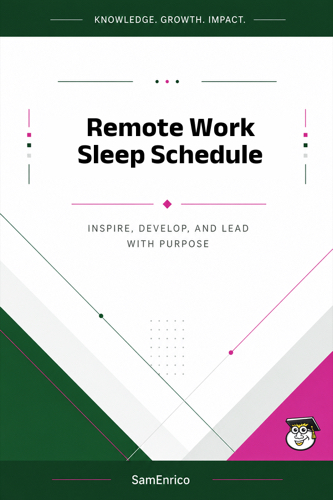
Remote Work Sleep Schedule eBook
Maintain consistent wake times to regulate energy.
by Levy Candie
Maintain consistent wake times to regulate energy.
Formats
Free sample
Chapter 1: The Flexibility Trap--–- The email arrived at 11:47 PM on a Tuesday. Sarah, a 34-year-old marketing manager who had been remote for eighteen months, had written: "I have complete control over my schedule. So why am I exhausted all the time?" She described waking at 6:30 AM on Mondays, 9:00 AM on Saturdays, 7:45 AM on Wednesdays, and 10:30 AM on Sundays. She was sleeping eight hours per night on average—sometimes nine, sometimes seven. She drank three cups of coffee before noon.
And yet, by 2:00 PM every single day, she felt like she had been hit by a truck. "I thought flexibility was supposed to make me healthier," she wrote. "Instead, I feel more tired than I ever did in an office."Sarah's problem was not unique. It was not a failure of willpower, discipline, or motivation. It was not insomnia, depression, or a medical disorder.
Sarah had fallen into what sleep scientists call the Flexibility Trap—the false belief that varying your wake time according to your daily preferences leads to better rest. In reality, the opposite is true. The freedom to "sleep in" on weekends, wake early on busy days, and shift your schedule based on meetings and social obligations creates a hidden biological debt that manifests as chronic fatigue, brain fog, and emotional volatility. And Sarah, like millions of remote workers who celebrated the death of the 9:00-to-5:00, had no idea it was happening.This chapter dismantles the most dangerous myth of remote work: that flexible hours mean better sleep. Drawing on circadian biology, sleep research, and the lived experience of thousands of remote workers, we will expose the truth about social jetlag, introduce the concept of the Wake Time Anchor, and explain why the loss of your morning commute may have been the single most destructive change to your sleep health.
By the end of this chapter, you will understand why your current sleep schedule is failing and—more importantly—why willpower alone will never fix it.The Promise That Broke Us When the world shifted to remote work in the early 2020s, the narrative was overwhelmingly positive. No more commutes. No more rigid schedules. No more rushing to catch a train or fighting traffic before sunrise. Articles with headlines like "Finally, You Can Sleep Like a Human" and "The End of the Morning Madness" celebrated the new flexibility.
Sleep experts were cautiously optimistic. For the first time in modern history, millions of workers could align their schedules with their biological preferences. Night owls could start at 10:00 AM. Early risers could start at 6:00 AM and finish their day before lunch. It seemed, for a brief moment, that the ancient conflict between capitalism and circadian biology had been resolved.But the data told a different story.
Within eighteen months of the mass remote work transition, sleep researchers began publishing alarming findings. A 2021 survey of 1,200 remote workers published in the Journal of Occupational Health Psychology found that 41% of respondents reported worse sleep quality than when they worked in an office. Not the same. Worse. Remote workers took longer to fall asleep, woke up more frequently during the night, and reported lower energy levels upon waking.
The very flexibility that was supposed to save their sleep was destroying it.Why? The answer lies in a fundamental misunderstanding of how the human body regulates rest. Most people believe that sleep is about quantity—that if you get seven to nine hours, you are fine. But sleep is also about timing. Your body does not treat all hours equally.
A hour of sleep from 10:00 PM to 11:00 PM is biologically different from an hour of sleep from 2:00 AM to 3:00 AM, even if both are uninterrupted. Your master clock, a tiny cluster of neurons called the suprachiasmatic nucleus (SCN) located just above the roof of your mouth, expects certain events to happen at certain times. Light in the morning. Darkness at night. Wakefulness during the day.
Sleep during the night. When you vary your wake time by two hours on a Saturday, you are not "catching up." You are confusing your SCN as thoroughly as if you had flown from New York to London and back in a single weekend.Social Jetlag: The Hidden Epidemic The scientific term for this confusion is social jetlag. Coined by chronobiologist Till Roenneberg in the early 2000s, social jetlag refers to the mismatch between your body's natural circadian rhythm and the sleep schedule imposed by social obligations. In the office era, social jetlag was caused by early work start times that forced night owls to wake before their biology was ready. But in the remote era, a new form of social jetlag has emerged: self-inflicted schedule variability.
You are not being forced to wake at 6:00 AM by a boss or a train schedule. You are choosing to wake at different times based on how you feel, what meetings you have, and when you went to bed the night before. And those choices are creating the same biological chaos as international travel.Here is what happens inside your body when you vary your wake time by just two hours. Let us say you wake at 6:30 AM on Monday, Tuesday, and Wednesday to accommodate early meetings. By Thursday, your SCN has adjusted to expect light at 6:30 AM.
It has begun releasing cortisol at 6:15 AM, raising your core body temperature, and suppressing melatonin production. You are biologically primed for 6:30 AM. Then comes Friday. You have no early meetings. You decide to "sleep in" until 8:30 AM.
Your SCN, still operating on the 6:30 AM schedule, releases cortisol at 6:15 AM anyway. You do not notice because you are asleep, but your body is now producing wake-up hormones while you are still in bed. When you finally wake at 8:30 AM, your cortisol levels are already declining. You wake up groggy, not because you slept poorly, but because you woke up two hours after your body started its wake-up sequence.Saturday arrives. You stay up late watching a movie and wake at 10:00 AM.
By now, your SCN is thoroughly confused. It received light at 6:30 AM for three days, no light until 8:30 AM on Friday, and no light until 10:00 AM on Saturday. It has lost its reference point. Sunday, you wake at 9:00 AM. Monday morning, your alarm goes off at 6:30 AM again.
You feel jetlagged—not because you traveled, but because your internal clock is now misaligned with the external clock by approximately three hours. You drink extra coffee. You feel terrible. You blame the weekend. And you repeat the cycle next week.This is social jetlag.
It is not a metaphor. It is a measurable biological phenomenon. Researchers can detect social jetlag by comparing a person's wake time on workdays versus free days. A difference of one hour causes measurable cognitive impairment. A difference of two hours causes the equivalent of a mild concussion.
A difference of three hours or more is classified as chronic circadian disruption and has been linked to obesity, diabetes, cardiovascular disease, depression, and reduced life expectancy.The cruel irony of remote work is that it gave you the freedom to vary your schedule, and that very freedom has made your social jetlag worse than it ever was in an office. In the office…
This is the end of the free sample. Get the eBook to keep going. Buy now
About this book
Details
- Author
- Levy Candie
- Publisher
- SamEnrico
- Language
- English
- Genre
- Non-Fiction, Self-Help, Sleep
- Released
- 2026-06-09
- Pages (approx.)
- 136
- Available as
- eBook, Audiobook

Read better in the ZLOADR app
Your eBooks on your phone or tablet. Sign in with your SamEnrico account and start reading.
More by Levy Candie
 Workplace Confidence WorkbookLevy Candie$11.99
 School Diversity Day HypocrisyLevy Candie$11.99
 Team Charter Creation GuideLevy Candie$11.99
 Fidgeting Anxiety CueLevy Candie$11.99
 Anger at Childs Criminal BehaviorLevy Candie$11.99
 Design Thinking for HealthcareLevy Candie$11.99
 Conversation Starters for Kid BirthdaysLevy Candie$11.99
 Whispers Beyond the Veil: The Last Days of the Viking Funeral ShipLevy Candie$11.99
 The Alchemy of Genius: Florence's Creative RevolutionLevy Candie$11.99
 A Collector's Handbook to the Standard Ten CompanionLevy Candie$11.99
 How to Produce Coffee and Tea CupsLevy Candie$11.99
 How to Produce On ChoyLevy Candie$11.99
You may also like
 Sleep Meditation For PainOakes Earnestine$11.99
 The MBSR for Insomnia WorkbookCoker Bret$11.99
 Spending Addiction and InsomniaBrooks Marco$11.99
 Sleep Log ReviewMontoya Latesha$11.99
 Sleep Anxiety Affirmations GuideBergman Norene$11.99
 Senior Sleep ConfidenceFinch Keshia$11.99
 Parental Insomnia SolutionsMorrow Taryn$11.99
 Breath Awareness for InsomniaHefner Sheilah$11.99
 Bedtime Letting Go Breath GuideDwyer Beula$11.99
 TM for Insomnia ReliefShipley Nanci$11.99
 The Parent Anger Sleep GuideDietz Tosha$11.99
 The Sleep and Memory GuideGalvez Jamar$11.99