
Non-FictionSelf-HelpRemote Work
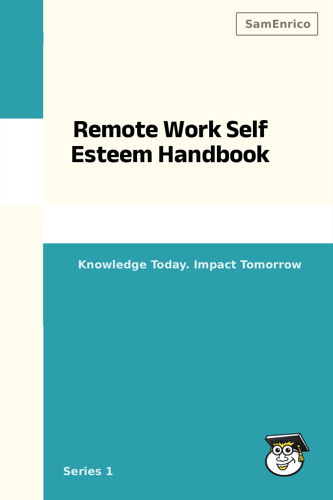
Remote Work Self Esteem Handbook eBook
Maintain confidence without in-person feedback and
Maintain confidence without in-person feedback and visible team presence.
Formats
Free sample
Chapter 1: The Silence That Speaks--–- The first time you notice it, you assume it is about you. You send a thoughtful message to a teammate—a suggestion, a question, a completed piece of work—and the response never comes. Not immediately, not after an hour, not after a day. Your cursor hovers over the thread. You check if they have read it.
You wonder if you said something wrong, if your idea was stupid, if you have somehow become invisible. The silence sits in your chest like a stone.You are not weak for feeling this way. You are not unusually insecure. You are, in fact, experiencing one of the most well-documented psychological responses to a specific modern condition: the remote feedback vacuum. This chapter is not about fixing you.
It is about understanding what the silence actually is, where it comes from, and why your brain reacts to it as if it were a threat when it is almost always just a neutral feature of the medium you now work within.The office environment was, for all its flaws, a continuous feedback machine. You did not notice it because it was ambient, like the hum of a refrigerator. When you walked past a coworker’s desk and they looked up and nodded, that was feedback. When your manager glanced at you during a meeting and tilted their head slightly while you spoke, that was feedback. When you stayed late and someone saw your light on, that was social proof that you were committed.
None of it was verbal. Most of it was not even conscious. But your brain collected all of those micro-signals and assembled them into a quiet, persistent sense of belonging, competence, and visibility.Remote work strips all of that away in a single stroke. You now send messages into a void. You speak on video calls where you cannot see most faces.
You produce work that lands in a shared drive with no accompanying facial expression, no nod, no ambient signal that anyone even noticed it exists. What remains is pure, unfiltered content—and the absence of response. And the absence, your brain quickly learns, is louder than any praise ever was.The Anatomy of the Feedback Vacuum Let us define the problem precisely. The feedback vacuum is not the same as receiving negative feedback. Negative feedback, however painful, is at least a signal.
It tells you something: adjust, clarify, improve. The vacuum is the absence of any signal at all. It is the void where a reaction should be. And because the human brain evolved to treat uncertainty as a threat, the vacuum generates its own content. Your mind does not leave the space empty.
It fills it with worst-case scenarios, because from an evolutionary standpoint, assuming danger and being wrong is safer than assuming safety and being wrong.In the office, the vacuum rarely formed because feedback was embedded in the environment. Even if no one praised you, you could see people working around you, hear conversations, observe your manager’s mood. Those ambient cues told your brain that you were still part of the tribe. Remotely, those cues vanish. The only signal you receive is the one explicitly sent.
And when nothing is sent, your brain concludes that you have been exiled.This is not a metaphor. Neuroscientific research on social rejection shows that the same brain regions activated by physical pain—the dorsal anterior cingulate cortex and the anterior insula—are also activated by social exclusion. The silence you experience after sending a message that goes unanswered for twenty-four hours triggers a low-grade pain response. You are not being dramatic. You are being human.Perceived Invisibility Versus Actual Low Performance One of the most damaging assumptions remote workers make is conflating the feeling of invisibility with the fact of low performance.
These are not the same thing. They are not even correlated in predictable ways. You can be the highest performer on your team and still feel invisible because no one saw you solve that problem at 9 PM. You can be the lowest performer and still feel visible because you post frequently in Slack. The feeling of invisibility is a structural consequence of the remote environment, not a reliable indicator of your actual contribution.This distinction matters because when you cannot distinguish between the two, you start trying to solve the wrong problem.
You work longer hours, not because the work requires it, but because you are trying to generate evidence of effort in the absence of evidence of impact. You send more messages, not because they add value, but because each message is a tiny bid for a response that will prove you exist. You check notification badges obsessively, not because you are eager to work, but because each new badge is a small pulse of social proof that you have not been forgotten.All of this activity drains your energy without increasing your actual performance. Worse, it trains your brain to depend on external signals for emotional regulation. You become addicted to the ping, the reply, the reaction emoji.
And when they do not come, you spiral.The Structural Silence of Remote Work Here is the truth that most books on remote work avoid: the silence is not about you, but it is also not random. Remote work has structural features that produce silence regardless of how well you are performing.First, asynchronous communication introduces natural delays. In an office, if you ask a question, the person is often physically present. Even if they are not, you can see whether they are at their desk. Remotely, your message enters a queue.
That queue is affected by time zones, meeting schedules, personal work rhythms, and the simple fact that typing a thoughtful response takes longer than nodding. A twelve-hour delay is not rejection. It is the normal physics of distributed work.Second, the cost of responding is higher remotely. In person, a nod costs nothing. A brief “good job” in the hallway costs a few seconds and minimal cognitive load.
Remotely, every response requires opening a channel, reading context, formulating words, and sending. Even a short “looks good” feels heavier because it is deliberate. People respond less often not because they care less, but because the medium makes every response feel like a commitment.Third, visibility is asymmetrical. In an office, you can see your manager working on something else and know why they have not responded to you yet. Remotely, you cannot see their workload.
You only see the absence of a reply. The asymmetry creates an illusion: you assume they are ignoring you, when in fact they are likely overwhelmed, distracted, or simply working on something that has nothing to do with you.None of this is your fault. None of it reflects your value. But unless you understand these structural forces, you will continue to interpret silence as personal judgment.The Neutrality Protocol: A Cognitive Reframing Tool Knowing that silence is structural is not enough. You need a protocol—a repeatable mental habit—that intercepts the automatic negative interpretation before it takes root.
The Neutrality Protocol is that tool. It has three steps, each designed to interrupt the Certainty-Seeking Loop described in Chapter…
This is the end of the free sample. Get the eBook to keep going. Buy now
About this book
Details
- Author
- Tucker Lillie
- Publisher
- SamEnrico
- Language
- English
- Genre
- Non-Fiction, Self-Help, Remote Work
- Released
- 2026-06-11
- Pages (approx.)
- 128
- Available as
- eBook, Audiobook

Read better in the ZLOADR app
Your eBooks on your phone or tablet. Sign in with your SamEnrico account and start reading.
More by Tucker Lillie
 Umayyad Caliphate ArchitectureTucker Lillie$11.99
 Virtual Negotiation GuideTucker Lillie$11.99
 Alcohol Cue Exposure TrainingTucker Lillie$11.99
 Comparison Journal WorkbookTucker Lillie$11.99
 The Exercise Cognition GuideTucker Lillie$11.99
 Divorce and Car OwnershipTucker Lillie$11.99
 Midlife Purpose RebootTucker Lillie$11.99
 The Goryeo Green Dragon Fleet: Smugglers, Spies, and the Opium Wars of the EastTucker Lillie$11.99
 The Angel of the Danube: Halldora’s Crusade Against the Magyar HordeTucker Lillie$11.99
 How to Produce Motorcycle GlovesTucker Lillie$11.99
 A Collector's Handbook to the Riley Elf ITucker Lillie$11.99
 How to Produce Machinery Processing ServicesTucker Lillie$11.99
You may also like
 Hong Kong Handover 1997Dunn Johnnie$11.99
 Zumba For Postnatal Recovery CourseNeal Christian$11.99
 Zumba for BeginnersLadner Nikia$11.99
 YouTube Comment Mining GuideHumes Pandora$12.99
 Worry Box MeditationCarlin Rudy$11.99
 Workplace Stress MeditationNguyen Lynn$11.99
 Workplace Stress and Sleep RepairHawley Ivory$11.99
 Workplace Perfectionism CureDelaney Jeffry$11.99
 Workplace Injustice Anger GuideWallen Isabelle$11.99
 Work Addiction and Burnout LinkGreenwood Ester$11.99
 Women in Yoga and WellnessBeattie Galina$11.99
 Women in Stand Up ComedyChun Evangeline$11.99