
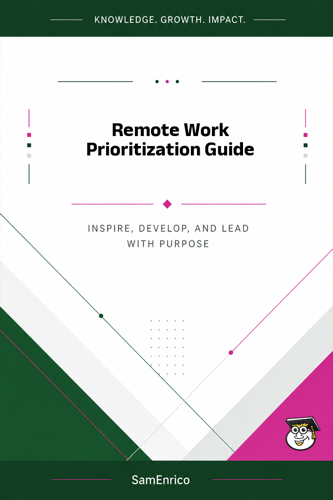
Remote Work Prioritization Guide eBook
Focus on what matters most when no manager is look
Focus on what matters most when no manager is looking over your shoulder.
Formats
Free sample
Chapter 1: The Visibility Trap--The remote worker’s most dangerous enemy is not laziness. It is not Netflix, nor the pile of laundry staring at you from the corner of the room, nor the siren song of the refrigerator. The most dangerous enemy is something far more subtle and far more seductive: the desperate, gnawing need to be seen.In a physical office, you are visible by default. Your manager sees you at your desk. They notice when you arrive early and when you stay late.
They hear you on the phone with a client. The simple act of walking to the break room with a coffee cup in hand signals engagement. You do not have to try to be seen. Presence equals productivity in the unconscious calculus of most workplace cultures. This is not a conspiracy; it is a cognitive shortcut.
Managers are busy. They cannot measure every output in real time. So they substitute what is measurable—presence, activity, responsiveness—for what is truly valuable.Then you go remote.Overnight, that visual feedback loop disappears. You are now a name on a screen, a status dot that turns green and yellow, a series of Slack messages that may or may not be read. And something strange happens.
Most people, when asked to predict how they would behave without a manager looking over their shoulder, imagine they would slack off. They imagine longer lunches, afternoon naps, and the slow erosion of discipline. The data tells a very different story. Remote workers do not slack off. They overwork.The statistics are startling.
According to a 2022 study by the National Bureau of Economic Research, remote workers added an average of 8.2 hours to their workweek during the first year of widespread remote adoption—not subtracted. Email volume increased by 64%. Meeting attendance rose by 45%. And yet, despite working more hours, productivity gains were modest at best and negative for many knowledge workers. Something was broken.
People were working longer and achieving less.This is the Visibility Trap.The Psychology of Invisible Anxiety The Visibility Trap operates on a simple psychological mechanism: anxiety without a target seeks a target. In the office, anxiety about your performance attaches itself to visible cues. You see your manager frowning at their screen and wonder if it is about you. You overhear a conversation about budget cuts and update your resume. The anxiety has somewhere to go.
It attaches to real stimuli, however misinterpreted.At home, that anxiety floats. There is no manager to read, no colleague to benchmark against, no ambient feedback loop telling you whether you are doing well or about to be fired. The brain, which evolved to prioritize threat detection above all else, does not tolerate this vacuum. It fills the void with the only thing available: activity.The logic is unconscious but relentless. If I am not visible, I must make myself visible.
If no one can see me working, I must work harder, faster, and longer so that the results alone will prove my value. But results take time. They are delayed, uncertain, and not always attributable to a single individual. So the anxious brain takes a shortcut. It substitutes output for activity and then substitutes activity for visible activity.
Before long, you are sending emails at 10 PM, joining meetings you do not need to attend, and responding to Slack messages within thirty seconds—not because the work requires it, but because the silence requires noise.Gorick Ng, in his essential book The Unspoken Rules, calls this the "anxiety of invisibility." Ng spent years studying how early-career professionals navigate workplace cultures where the rules are never written down. His research revealed a consistent pattern: remote employees who lack "micro-affirmations"—a nod from a manager, a quick "good job" in passing, the simple experience of being seen—often double their visible output to compensate. They do not produce more valuable work. They produce more visible work. And because visible work is rarely the most valuable work, they burn out without advancing.David Rock, the neuroscientist behind Your Brain at Work, offers a deeper explanation.
The brain's reward system, Rock explains, is wired for immediate feedback. Dopamine—the neurotransmitter associated with motivation and pleasure—is released when you complete a task and receive a signal of success. Checking a box on a to-do list releases dopamine. Clearing your email inbox releases dopamine. Updating a Slack status releases dopamine.
These are small, frequent, and predictable rewards.Strategic work—planning, deep analysis, creative problem-solving, relationship building, learning—produces no such immediate reward. The payoff is delayed by days, weeks, or months. The process is uncertain, messy, and often lonely. When unobserved and unmanaged, the anxious brain will consistently choose the smaller, sooner reward (clearing email) over the larger, later reward (completing a quarterly strategy). This is not a character flaw.
It is neuroscience.The Visibility Trap, then, has two reinforcing loops. First, anxiety about invisibility drives you to perform visible activity. Second, the brain's reward system favors that visible activity over strategic work. The result is a perfect storm of low-value overwork. You are busy, exhausted, and falling behind on the things that actually matter.The Difference Between Activity and Outcomes To escape the Visibility Trap, you must first understand a distinction that will appear throughout this book: the difference between activity visibility and outcome visibility.Activity visibility is what your manager sees you doing.
It includes responding to emails, attending meetings, updating project management software, commenting on Slack threads, and producing drafts that no one asked for. Activity visibility is easy to measure. It is also almost completely uncorrelated with value creation.Outcome visibility is what your manager sees as a result of your work. It includes completed projects, improved metrics, problems solved, decisions made, money saved, revenue generated, and time freed for others. Outcome visibility is harder to measure and often delayed.
But it is the only thing that actually matters for your career.Here is the crucial insight that most remote workers miss: Managers rarely notice the absence of activity visibility. They do notice the absence of outcome visibility.Consider two remote workers. Worker A responds to every Slack message within two minutes, attends every meeting, produces weekly status reports, and is constantly "present." But their projects are consistently late, their work contains errors, and they never seem to finish anything of substance. Worker B takes four hours to respond to non-urgent messages, declines most meetings, and is often "away" on Slack. But when Worker B delivers, the work is flawless, on time, and moves the business forward.
Which worker gets promoted? The data is unambiguous. Worker B is perceived as a high performer. Worker A is perceived as chaotic or, worse, invisible despite their constant activity.The trap is that Worker A feels more secure. They have the dopamine hits.
They have the illusion of control. They are busy. Worker B feels anxious during the silence. They wonder if anyone notices their absence. But over time, the outcomes speak.The goal of this book—and the specific purpose of this chapter—is to help you shift from optimizing for activity visibility to optimizing for outcome visibility.
The tools that follow will help you identify which of your current tasks are truly valuable and which are merely…
This is the end of the free sample. Get the eBook to keep going. Buy now
About this book
Details
- Author
- Dobbins Versie
- Publisher
- SamEnrico
- Language
- English
- Genre
- Non-Fiction, Self-Help, Prioritization
- Released
- 2026-06-06
- Pages (approx.)
- 141
- Available as
- eBook, Audiobook

Read better in the ZLOADR app
Your eBooks on your phone or tablet. Sign in with your SamEnrico account and start reading.
More by Dobbins Versie
 Flame Retardant Furniture AvoidanceDobbins Versie$11.99
 Assertive Customer ServiceDobbins Versie$11.99
 Retirement Housing Relocation ReimbursementDobbins Versie$11.99
 The Courtroom ChildDobbins Versie$11.99
 Grief and Guilt ParentsDobbins Versie$11.99
 Remote Work Kids ActivitiesDobbins Versie$11.99
 Entrepreneurial Success Without BurnoutDobbins Versie$11.99
 The Great Dartmoor Escape: Britain’s Boldest Prison Break of the Prohibition EraDobbins Versie$11.99
 The Maestro and the Moonlight: A Love Letter to MozartDobbins Versie$11.99
 How to Produce Water OvensDobbins Versie$11.99
 A Collector's Handbook to the Mercury MarquisDobbins Versie$11.99
 Force Majeure ClauseDobbins Versie$12.99
You may also like
 The Remote Task Prioritization GuideGaddis Micaela$11.99
 The Eisenhower Block MatrixLedford Tanja$11.99
 Goal Prioritization MatrixSheets Cordell$11.99
 The Trigger Hierarchy MethodOsgood Cole$11.99
 The Remote Work Power ListCabral Bernita$11.99
 The Anger Budget WorkbookRollins Sherell$11.99
 Remote Worker Task PrioritizationTrinidad Cristobal$11.99
 The Remote Work Daily ThreeHoneycutt Bobbie$11.99
 Remote Worker Priority MatrixReece Fran$11.99
 Remote Work Eisenhower MatrixKrauss Carey$11.99
 Remote Dot Voting GuidePerrin Terese$11.99
 Priority Task First RuleNunn Rocky$11.99