
Non-FictionSelf-HelpFocus Techniques
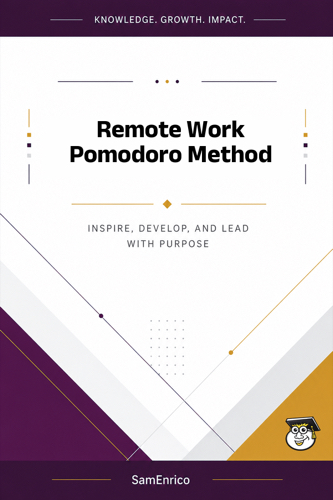
Remote Work Pomodoro Method eBook
Applies 25 minute sprints to homework.
by Denton Thi
Applies 25 minute sprints to homework.
Formats
Free sample
Chapter 1: The Proximity Tax--You are not lazy. You are not undisciplined. And you are certainly not the only remote worker who has spent forty-five minutes "working" while actually opening your email, checking Slack, loading the dishwasher, scrolling Instagram, answering one text, staring at a blinking cursor, and then wondering where the morning went.This is not a moral failure. It is a design flaw.The Pomodoro Technique—twenty-five minutes of focused work followed by a five-minute break—was invented in the late 1980s by Francesco Cirillo, a university student who used a tomato-shaped kitchen timer to force himself to study for short, intense bursts. The technique worked brilliantly in a dorm room, a library, or a cubicle.
It spread across the globe because it solved a universal problem: the human brain is not built for hours of continuous focus. We need intervals. We need rest. We need the structure of a ticking clock to anchor our wandering attention.But here is the dirty secret that no productivity book has told you: the original Pomodoro Technique assumes a neutral environment. It assumes that when you close your laptop, work ends.
It assumes that distractions are mostly external and mostly predictable. It assumes that you are not ten feet from your laundry, fifteen feet from your refrigerator, and twenty feet from an unmade bed that has been silently judging you since 7:30 AM.You work from home. That changes everything.The Great Unspoken Crisis of Remote Work Let me paint a scene that will feel familiar. It is 10:17 AM on a Tuesday. You have been "at work" for nearly two hours.
In that time, you have replied to four non-urgent emails, answered two Slack messages that could have been a single sentence, moved a load of laundry from the washer to the dryer, folded three towels, made a cup of coffee, scrolled Linked In long enough to feel inadequate about your career, and written exactly one paragraph of the report that was due yesterday.You feel exhausted. You feel guilty. You feel like you are failing at work and failing at home simultaneously.This is not a time management problem. This is a proximity problem.The average remote worker's desk is located somewhere between their kitchen and their bedroom, often in a corner of the living room or a repurposed closet. Within a thirty-second walk, they have access to every domestic comfort and every domestic obligation.
The fridge offers a snack. The laundry basket offers a quick win. The unmade bed offers a nagging reminder that you are not keeping your life together.In an office, these micro-temptations do not exist. Your laundry is at home. Your dishes are at home.
Your bed is at home. When you are at work, home is a concept, not a physical presence. When you work from home, home is everywhere. It surrounds you. It whispers to you.
It asks you, constantly and quietly, why you are staring at a spreadsheet when the bathroom needs cleaning.This is the crisis that every remote work book has ignored. They teach you how to use Zoom, how to manage your calendar, how to communicate asynchronously. But no one has taught you how to ignore the dishes.Until now.The Proximity Tax: Your Hidden Cognitive Burden Let me introduce a concept that will appear throughout this book: the Proximity Tax. This is the cognitive and emotional drain caused by the physical closeness of domestic life during your work hours. It has three distinct flavors, and understanding them is the first step toward freedom.Flavor One: Physical Proximity Your fridge is twenty feet away.
Your TV is fifteen feet away. Your phone is in your pocket. These are not distractions you have to seek out—they are already there, waiting for you to glance in their direction. The fridge does not require you to get up and walk to the break room. It requires you to turn your head.
The barrier to entry for a snack, a show, or a scroll is measured in inches, not minutes.This matters because your brain is a lazy organ. It will always choose the path of least resistance. When a work task feels hard (writing that report) and a domestic task feels easy (making toast), your brain will nudge you toward the toast. Not because you are weak. Because the toast is right there.Flavor Two: Emotional Guilt This is the more insidious flavor.
You are sitting at your desk, trying to focus on a spreadsheet, and your eyes land on the pile of laundry you meant to fold yesterday. You do not get up to fold it. You ignore it. But the ignoring itself costs you energy. Your brain spends a small but real amount of processing power suppressing the thought of the laundry.
You are not doing the laundry. You are also not fully focused on the spreadsheet. You are in a cognitive limbo, half-committed to both and fully present for neither.This is emotional guilt, and it is the single biggest productivity killer in remote work. You do not have to do the chore to be distracted by it. You just have to see it.Flavor Three: Cognitive Noise The third flavor is the accumulation of the first two.
After three hours of ignoring the laundry, the dishes, the unmade bed, and the pile of mail on the counter, your brain is carrying a heavy backpack of suppressed tasks. You are not consciously thinking about any of them. But they are there, taking up mental bandwidth that should be reserved for your work.Cognitive noise is the reason you feel exhausted at 2:00 PM even though you have only done two hours of actual work. Your brain has been multitasking in the background all day, managing the constant tension between "I should work" and "I should clean." That tension is exhausting. And it is entirely invisible to anyone watching you from the outside.Why Your Timer Is Not the Problem If you have tried the Pomodoro Technique at home and found it lacking, you are not alone.
Thousands of remote workers have downloaded a timer app, set it for twenty-five minutes, and then discovered that the timer did nothing to stop their toddler from waking up, their partner from asking about dinner, or their own brain from wandering to the dirty dishes.The timer is not the problem. The problem is what you are using the timer for.In the original Pomodoro Technique, the timer is a tool to force focus. You set it, and then you battle against distractions until it rings. The timer is a whip. It is a weapon.
It is something you fight against.This book is going to flip that completely.Here is the core inversion of the Remote Pomodoro Method: the timer is not a tool to force yourself to work. It is a permission slip to ignore the house.When you set that timer for twenty-five minutes, you are not saying, "I must work harder." You are saying, "For the next twenty-five minutes, I am legally—within my own mind—allowed to let the laundry sit. The dishes can wait. The bed can stay unmade. My only job is to…
This is the end of the free sample. Get the eBook to keep going. Buy now
About this book
Details
- Author
- Denton Thi
- Publisher
- SamEnrico
- Language
- English
- Genre
- Non-Fiction, Self-Help, Focus Techniques
- Released
- 2026-06-09
- Pages (approx.)
- 128
- Available as
- eBook, Audiobook

Read better in the ZLOADR app
Your eBooks on your phone or tablet. Sign in with your SamEnrico account and start reading.
More by Denton Thi
 The Influencer Car EffectDenton Thi$11.99
 Active Listening in the WorkplaceDenton Thi$11.99
 Crisis Breath ShorteningDenton Thi$11.99
 SAD And Suicide RiskDenton Thi$11.99
 Vegan Weight Loss GuideDenton Thi$11.99
 Networking for WritersDenton Thi$11.99
 Anger De escalation for CoachesDenton Thi$11.99
 Pharaoh's Champions: The Rise of Ancient Egypt's First Olympic WarriorsDenton Thi$11.99
 The Radiant Minds of Africa: Nobel Laureates Who Lit the Path of ScienceDenton Thi$11.99
 A Collector's Handbook to the Mercedes-benz 460Denton Thi$11.99
 Service Providers Guide to Graphic ArtistsDenton Thi$11.99
 How to Produce LED Light BulbsDenton Thi$11.99
You may also like
 Hong Kong Handover 1997Dunn Johnnie$11.99
 Zumba For Postnatal Recovery CourseNeal Christian$11.99
 Zumba for BeginnersLadner Nikia$11.99
 YouTube Comment Mining GuideHumes Pandora$12.99
 Worry Box MeditationCarlin Rudy$11.99
 Workplace Stress MeditationNguyen Lynn$11.99
 Workplace Stress and Sleep RepairHawley Ivory$11.99
 Workplace Perfectionism CureDelaney Jeffry$11.99
 Workplace Injustice Anger GuideWallen Isabelle$11.99
 Work Addiction and Burnout LinkGreenwood Ester$11.99
 Women in Yoga and WellnessBeattie Galina$11.99
 Women in Stand Up ComedyChun Evangeline$11.99