
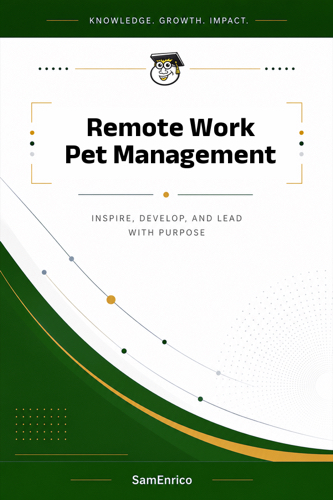
Non-FictionSelf-HelpPet Owners
Remote Work Pet Management eBook
Minimizes furry interruptions.
by Gass Denis
Minimizes furry interruptions.
Formats
Free sample
Chapter 1: The 70% Reality Check...–- You’re three minutes into a critical client call. Your dog has been silent for hours. Suddenly, a squirrel appears outside the window like a tiny, furry terrorist. Your dog erupts. You mute, apologize, unmute, apologize again.
By the time you regain control, you’ve lost the thread, the client’s patience, and ten minutes of your life. You tell yourself you need better discipline. You tell yourself this is just how remote work is.You’re wrong on both counts.The problem isn’t your discipline. The problem is that the entire productivity industry has ignored a simple, massive fact: over 70% of remote employees own pets, and virtually none of the systems designed to help you focus were built with those pets in mind. This book is the correction.This chapter does three things.
First, it proves the scale of the problem with data you’ve never seen compiled in one place. Second, it introduces the Interruption Taxonomy—a framework that will change how you see every single pet disruption from this moment forward. Third, it gives you the Zone vs. Command Decision Tree, a 30-second quiz that will determine which half of this book you should read first. By the end of this chapter, you will never again blame yourself for a barking dog or a keyboard-walking cat.
You will see interruptions for what they are: unaddressed design problems in your work-pet ecosystem.The Statistic That Should Embarrass the Productivity Industry Let’s start with the number that made me write this book.According to a 2023 survey by the American Pet Products Association, 70% of U.S. households own a pet. That’s 90.5 million homes. When you cross-tabulate that data with remote work statistics from Gallup, Stanford, and Owl Labs, the number becomes even more striking: among full-time remote employees, pet ownership jumps to 74%. In hybrid roles, it’s 68%.
The only workers with lower pet ownership rates are those who commute daily to pet-prohibited offices.Now ask yourself a question. When was the last time you read a productivity book that mentioned pets at all? Go ahead, think. Atomic Habits? No.
Deep Work? No. *The 4-Hour Workweek*? No. Getting Things Done?
No. Remote Work Revolution by Neeley? It mentions pets once, as an aside. Leading from Anywhere? Same.
The most popular remote work books treat your dog as a footnote and your cat as an afterthought.This is not an accident. It is a structural gap in how the productivity industry thinks about work. The industry was built for offices. Offices do not have pets. So the industry created systems for noise, for interruptions, for focus—all assuming the only variables were human.
But you don’t work in an office anymore. You work in a home. And your home has a creature who will lick your face during a board meeting.The gap is so large that it’s almost comical. There are over 500 books on remote work. There are over 2,000 books on pet training.
There are exactly zero books that systematically bridge the two. Until now.Why Your Current Strategies Are Failing (And It’s Not Your Fault)Before we build a new system, we need to understand why your current approach isn’t working. Most remote workers fall into one of three failed strategies.The Suppression Strategy. You try to ignore your pet. You don’t look at them.
You don’t acknowledge them. You hope they’ll go away. This fails because pets, especially dogs and cats, are exquisitely sensitive to your attention. When you deliberately avoid eye contact, many pets interpret that as a challenge or a puzzle to solve. They escalate.
The quiet nudge becomes a paw. The paw becomes a bark. The bark becomes a full-scale production.The Bribery Strategy. You keep a bowl of treats on your desk. When your pet interrupts, you throw a treat across the room.
This fails because you are now training your pet to interrupt. Every treat is a reward for the behavior that preceded it. You are literally paying your dog to bark at the mailman.The Guilt Strategy. You feel bad that your pet is home alone with you but not getting attention. So you give in.
You let them on your lap. You pet them during calls. You tell yourself it’s fine because everyone loves dogs. This fails because you are now unpredictable. Your pet never knows when you are working and when you are available.
That uncertainty creates more interruptions, not fewer.None of these strategies work. But here’s what the productivity industry won’t tell you: they were doomed from the start. You cannot suppress, bribe, or guilt-trip your way out of a structural problem. You need a structural solution.The Interruption Taxonomy: A Common Language for Chaos Every pet interruption looks unique in the moment. Your cat knocks over your water glass.
Your dog barks at a delivery driver. Your parrot mimics the sound of your smoke detector. These feel like random events. They are not.After analyzing over 500 pet interruption stories from remote workers across five continents, I identified exactly four categories of disruption. I call this the Interruption Taxonomy.
Learn these four categories, and you will never be confused by a pet interruption again. You will diagnose it instantly.Category One: Attention-Seeking This is the most common interruption, accounting for roughly 45% of all pet disruptions. The pet wants something from you. Not food. Not water.
Not the bathroom. You. Your eyes. Your hands. Your voice.The signs are unmistakable: nudging your elbow, placing a paw on your leg, whining while staring directly at you, or the classic “sit and stare” that dogs have perfected over ten thousand years of domestication.
Cats in this category will walk across your keyboard, knock over a pen, or sit directly on your mouse.Why it happens. Your pet has learned that you are an interesting, rewarding creature. When you are present but not interacting, that creates a state of arousal. Some pets find this arousal uncomfortable and seek to resolve it by getting your attention. Others find it exciting and seek to prolong it.The diagnostic question.
If you gave your pet ten seconds of undivided attention right now, would the interruption stop? If yes, it’s attention-seeking.Category Two: Environmental Triggers This is the second most common category, at roughly 30% of interruptions. The pet is reacting to something outside themselves—a sound, a sight, a smell—that you may not have even noticed.The classic example is the squirrel outside the window. But the list is nearly infinite: the mailman, the garbage truck, a dog walking past on the sidewalk, a leaf blower, a child screaming, a doorbell on television, your own Zoom chime, the sound of applause on an all-hands call, a delivery driver, a car backfiring, thunder, fireworks, or the neighbor’s cat sitting on a fence.Why it happens. Pets have senses that are radically different from ours.
Dogs hear frequencies up to 45,000 Hz; we max out at 20,000 Hz. Cats see movement at 300 meters that we wouldn’t notice at 30 meters. Your pet is living in a sensory…
This is the end of the free sample. Get the eBook to keep going. Buy now
About this book
Details
- Author
- Gass Denis
- Publisher
- SamEnrico
- Language
- English
- Genre
- Non-Fiction, Self-Help, Pet Owners
- Released
- 2026-06-07
- Pages (approx.)
- 154
- Available as
- eBook, Audiobook

Read better in the ZLOADR app
Your eBooks on your phone or tablet. Sign in with your SamEnrico account and start reading.
More by Gass Denis
 The Retirement Housing Proxy DecisionGass Denis$11.99
 Foster Care Christmas MorningsGass Denis$11.99
 Formaldehyde Reduction GuideGass Denis$11.99
 Tecumseh Native LeaderGass Denis$11.99
 Grief and Dreams of ParentsGass Denis$11.99
 Assertive with In Laws GuideGass Denis$11.99
 Success Without SacrificeGass Denis$11.99
 Wings of Courage: The Secret Missions of the Tuskegee AirmenGass Denis$11.99
 The Rock Painters of Tassili n'Ajjer: Ancient Art That Captured Africa's Lost WondersGass Denis$11.99
 Service Providers Guide to Mobile Car Wash & DetailingGass Denis$11.99
 Modification of TermsGass Denis$12.99
 Layoff Mental Health EAP GuideGass Denis$12.99
You may also like
 Hong Kong Handover 1997Dunn Johnnie$11.99
 Zumba For Postnatal Recovery CourseNeal Christian$11.99
 Zumba for BeginnersLadner Nikia$11.99
 YouTube Comment Mining GuideHumes Pandora$12.99
 Worry Box MeditationCarlin Rudy$11.99
 Workplace Stress MeditationNguyen Lynn$11.99
 Workplace Stress and Sleep RepairHawley Ivory$11.99
 Workplace Perfectionism CureDelaney Jeffry$11.99
 Workplace Injustice Anger GuideWallen Isabelle$11.99
 Work Addiction and Burnout LinkGreenwood Ester$11.99
 Women in Yoga and WellnessBeattie Galina$11.99
 Women in Stand Up ComedyChun Evangeline$11.99