
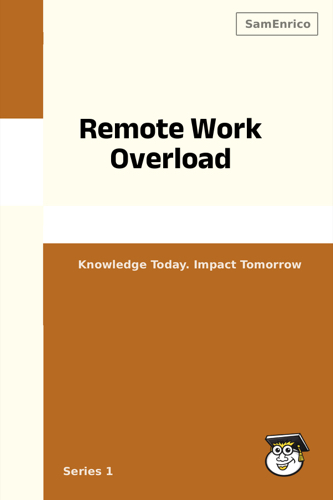
Remote Work Overload eBook
Say no to excessive tasks when working from home.
Say no to excessive tasks when working from home.
Formats
Free sample
Chapter 1: The Three-Headed Monster--–- The email arrived at 11:47 PM on a Tuesday. You were already in bed, teeth brushed, lights off. Your phone buzzed on the nightstand. You knew you shouldn't look. You looked.
"Quick question—can you review these slides by 8 AM? Nothing major. Thanks!"You told yourself it would only take five minutes. Forty-five minutes later, you finally closed your laptop, your heart racing, your mind spinning with everything else you now remembered you hadn't done. You fell asleep at 1 AM.
You woke up at 6:30 AM to seven Slack messages, three calendar invites, and a sense of dread that had become as familiar as your own heartbeat.This is not a story about laziness. This is not a story about poor time management. This is a story about a trap—one so cleverly designed that you have probably blamed yourself for falling into it.The trap has a name. Call it the Invisible Tether. It is the psychological cord that connects you to your job even when you are in pajamas, even when you are eating dinner, even when you are supposed to be present with the people you love.
Remote work promised to cut the commute, to give you back hours of your life. Instead, for millions of knowledge workers, it has done something stranger and more insidious: it has made work follow you everywhere, because home is now the office, and the office is now everywhere.But here is what most books get wrong. They tell you that the solution is better habits, or a more disciplined morning routine, or a fancy productivity app. They treat the symptom—your exhaustion—while ignoring the disease. The disease is not one thing.
It is three things, working together like a monster with three heads. Cut off one head, and the other two keep biting.This book is about cutting off all three.The Paradox at the Heart of Remote Work Let us begin with a simple fact: you were probably happier when you first started working from home. No commute. No uncomfortable office clothes. No fluorescent lights humming overhead.
You could throw in a load of laundry between meetings. You could eat lunch with your family. You could finally breathe.That was the honeymoon. And like all honeymoons, it ended.What replaced it was something strange. You started working earlier.
Then later. Then through lunch. Then on weekends. Not because anyone explicitly demanded it—though some did—but because something inside you shifted. You began to feel that if you weren't visibly working, you weren't really working.
The green dot on Slack became a surveillance camera. The sound of a notification became a summons. Your living room, once a sanctuary, became a pressure cooker.This is the paradox of remote work: the very freedom that was supposed to liberate you has become the mechanism of your captivity.The numbers bear this out. A 2022 study of 10,000 remote workers found that average workday length increased by 48 minutes after transitioning to remote work. Another study found that the number of meetings increased by 13 percent.
But the most damning statistic is this: remote workers report feeling less in control of their time than office workers, even though they have objectively more flexibility.How can this be? Because control is not just about having time. Control is about the ability to say no. And remote work has made saying no feel impossible.Meet the Monster: The Three Heads of Overload After interviewing dozens of burned-out remote workers and analyzing the research, I have concluded that overload is not caused by a single factor. It is caused by three forces that feed on each other.
I call them the Three-Headed Monster.Each head represents a different source of pressure. Each head requires a different strategy to defeat. And if you try to fight only one, the other two will overwhelm you.Here are the three heads:Head One: The Invisible Tether (Environment) — The physical and digital architecture of remote work that erases boundaries between work and life. This head convinces you that you are always at work because your workspace is now your living space. It exploits the absence of a commute, the collapse of context, and the tyranny of the green dot.Head Two: The Dopamine Loop (Brain Chemistry) — The neurological reward system that makes small, quick tasks feel more satisfying than large, meaningful ones.
This head hijacks your brain's reward pathways, turning you into a notification-junkie who craves the tiny hit of clearing a Slack message while avoiding the deep work that actually matters.Head Three: The Imposter's Whisper (Fear) — The voice inside your head that says, "If you say no, they'll discover you're not as competent as they think." This head preys on your insecurities, convincing you that every request is a test you cannot afford to fail. It is the most insidious head because it lives entirely inside you—and yet it was put there by a culture that rewards availability over output.These three heads are not separate problems. They are a system. The Invisible Tether creates the conditions for the Dopamine Loop to thrive—when there are no boundaries, every notification feels urgent. The Dopamine Loop trains your brain to prefer busyness over effectiveness, which makes you more susceptible to the Imposter's Whisper—because if all you do is small tasks, you never prove to yourself that you are capable of big ones.
And the Imposter's Whisper makes you say yes to everything, which tightens the Invisible Tether.Round and round it goes. This is why you are exhausted. This is why you feel like you are drowning in tasks that don't matter. This is why you have lost the ability to say no.But here is the good news: because the monster has three heads, you have three ways to fight it. You do not need to be perfect at all of them.
You just need to be better at each than you are today.Before we go any further, let me ask you a question. When you think about your own overload, which head feels strongest? Do you feel like your environment is the problem—the constant pings, the lack of separation, the expectation of availability? Or do you feel like your brain chemistry is the problem—the addictive pull of small tasks, the inability to focus on what matters? Or do you feel like fear is the problem—the dread of saying no, the certainty that someone will discover you are not good enough?If you are like most people, all three feel true.
That is because they are. The rest of this chapter will help you see each head clearly. The rest of this book will teach you how to cut them off.Head One: The Invisible Tether — Why Your Home Became a Prison Let us start with the environment, because it is the head that most people can see. The Invisible Tether is the name for all the ways that remote work has erased the boundaries that used to protect you.In an office, you had a commute. That commute was not wasted time.
It was a ritual—a transition between "work self" and "home self." You got in your car or on the train…
This is the end of the free sample. Get the eBook to keep going. Buy now
About this book
Details
- Author
- Blanchette Elicia
- Publisher
- SamEnrico
- Language
- English
- Genre
- Non-Fiction, Self-Help, Workload, Boundaries
- Released
- 2026-06-09
- Pages (approx.)
- 129
- Available as
- eBook, Audiobook

Read better in the ZLOADR app
Your eBooks on your phone or tablet. Sign in with your SamEnrico account and start reading.
More by Blanchette Elicia
 MIND Diet For Dementia PreventionBlanchette Elicia$11.99
 Lonely With Social SuccessBlanchette Elicia$11.99
 Assertiveness for Recovering DoormatsBlanchette Elicia$11.99
 The Daily Reading for CreativityBlanchette Elicia$11.99
 The Fearless Voyagers: Cartier and the Birth of New FranceBlanchette Elicia$11.99
 Assistive Technology ConsultingBlanchette Elicia$11.99
 How to Start a Phenol Business (Beginners Guide)Blanchette Elicia$11.99
 Product Hunt Pre LaunchBlanchette Elicia$12.99
 PGWP to Express Entry PathBlanchette Elicia$12.99
 Learn to Play the Baritone HornBlanchette Elicia$11.99