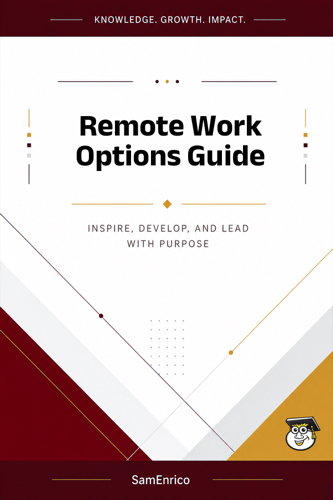
Remote Work Options Guide eBook
Flexibility for working from home by sector.
Flexibility for working from home by sector.
Formats
Free sample
Chapter 1: The Flexibility Trap--–- It was 10:47 on a Tuesday morning when Maria, a senior accountant at a midsize manufacturing firm, realized she had been staring at her kitchen wall for fourteen minutes. Not thinking. Not working. Just staring. Her laptop sat open to a spreadsheet she had closed three times already.
Slack pinged every thirty seconds. Her manager had sent a smiling emoji asking if she was “feeling present today.” The coffee had gone cold. The house was silent except for the hum of the refrigerator and the distant, rhythmic thump of a neighbor’s washing machine.Maria had fought for two years to work from home. She had written a twenty-page proposal, documented her productivity, and agreed to weekly check-ins. She had bought a standing desk, noise-canceling headphones, and a ring light for video calls.
She had done everything the articles said to do. And now, sitting in her carefully curated home office, she felt less free than she had in the fluorescent-lit cubicle she used to despise.She was not alone.Across the country, in a one-bedroom apartment in Austin, David was on his third Zoom call of the morning. He was a software developer at a tech startup that had gone “remote-first” in 2022. On paper, his life was the dream. No commute.
No dress code. No manager looking over his shoulder. But the meetings started at 8:00 AM and ended at 6:00 PM, sometimes later. His “asynchronous” team had somehow scheduled back-to-back sync sessions every single day. He had not written a line of code before 2:00 PM in three months.
His pull requests gathered dust while he sat in meetings about meetings.In a hospital break room outside Chicago, Teresa, a registered nurse, scrolled through Instagram and watched influencers talk about their “remote work morning routines.” Candle lighting. Journaling. A leisurely walk before logging on. She laughed bitterly and stuffed her phone back into her scrubs. She had just finished a twelve-hour shift.
Her feet hurt. She had missed her daughter’s school play. The idea of “flexibility” felt like a joke designed by people who had never cleaned bedpans or held a dying patient’s hand.Three different people. Three different sectors. Three different relationships with the same word: flexibility.And yet, every single one of them was trapped.This book is about why that happened and, more importantly, how to fix it.
But before we get to the fixes, we have to dismantle the lie that has been sold to millions of workers over the past five years. The lie that “remote work” is one thing. The lie that flexibility looks the same for everyone. The lie that if you just try harder, buy the right equipment, or find the right manager, you too can have the dream.That lie has a name. I call it the Flexibility Trap.The Great Misunderstanding: Why "Remote Work" Means Nothing Anymore The word “remote” has become useless.
It is a bucket so large and so vague that it holds everything from a developer in Bali writing code at midnight to a call center agent in Omaha required to answer calls between exactly 9:00 AM and 5:00 PM to a nurse documenting patient charts from her dining room after a twelve-hour shift. These are not the same thing. They share almost no meaningful characteristics. And yet, we have been using the same word to describe all of them.This is not merely a semantic problem. It is a strategic disaster.When executives say “return to office,” they are often reacting to a failed version of remote work that was never designed properly in the first place.
When employees say “I want to work remotely,” they often have no idea which version they are asking for. When managers install surveillance software, they are responding to a model of work that was never measured correctly. Everyone is speaking the same language—English—but using entirely different dictionaries.Drawing from Prithwiraj Choudhury’s groundbreaking research at Harvard Business School, summarized in his book The World Is Your Office, we have to start by distinguishing between two fundamentally different models. The first is what Choudhury calls Remote Work—working from home but still tethered to office hours, office expectations, and office culture. This is not flexibility.
This is the same cage, just moved to your living room. The second is Work from Anywhere (WFA) —a strategic talent model where employees can work from any location, often with asynchronous schedules, and where the organization’s processes, culture, and metrics have been redesigned around distributed work.Most companies claiming to offer remote work are actually offering the first model. Most workers demanding flexibility are actually asking for the second model. The gap between these two things is the source of almost every complaint, every burnout story, and every “back to office” mandate you have read about in the news.But even this distinction—Remote Work versus Work from Anywhere—is not enough. Because it still assumes that the only thing that matters is where you work.
In reality, three different kinds of flexibility matter, and most jobs require different combinations of them.The Three Kinds of Flexibility (And Why You Need All Three)After analyzing hundreds of jobs across dozens of sectors and synthesizing the best-selling literature on the future of work, I have identified three distinct types of flexibility. Every job has a unique fingerprint across these three dimensions. Understanding your fingerprint is the first step toward escaping the Flexibility Trap.Type 1: Place Flexibility This is the one everyone talks about. Place flexibility means the ability to choose where you work. Home.
Coffee shop. Coworking space. A beach in Thailand. Your mother’s kitchen table. A cabin in the woods with spotty Wi-Fi.Some jobs have high place flexibility.
Software development. Writing. Graphic design. Data analysis. If the only thing you need to do your job is a laptop and an internet connection, you have high place flexibility.Other jobs have zero place flexibility.
Surgery. Hairdressing. Manufacturing. Laboratory work that requires physical samples. If your job requires you to touch something, move something, or be physically present with another person, you have low or no place flexibility.Here is where most conversations go wrong.
Advocates for remote work often assume that place flexibility is the only flexibility that matters. They argue that if everyone just had the freedom to work from anywhere, all problems would be solved. But this ignores the reality of nurses, construction project managers, and retail workers who cannot take their work to Bali no matter how many times they read a Linked In post about “digital nomads.”Type 2: Time Flexibility This is the second dimension, and it is often more important than place flexibility—especially for workers in roles that cannot be fully remote. Time flexibility means the ability to choose when you work.Some jobs have high time flexibility. Software development again.
Research. Writing. Creative work that ebbs and flows with inspiration. If you can do your work at 2:00 AM or 2:00 PM without anyone caring, you have high time flexibility.Other jobs have zero time flexibility. Customer support.
Emergency dispatch. Air traffic control. Live sales. Any role where a customer or client is waiting for an immediate response.…
This is the end of the free sample. Get the eBook to keep going. Buy now
About this book
Details
- Author
- Maher Marybelle
- Publisher
- SamEnrico
- Language
- English
- Genre
- Non-Fiction, Non-Obvious Career, Remote Work
- Released
- 2026-06-07
- Pages (approx.)
- 144
- Available as
- eBook, Audiobook

Read better in the ZLOADR app
Your eBooks on your phone or tablet. Sign in with your SamEnrico account and start reading.
More by Maher Marybelle
 Research Proposal Budget Planning GuideMaher Marybelle$11.99
 Meditation For Menopause AnxietyMaher Marybelle$11.99
 Father Reunited With Child MemoirMaher Marybelle$11.99
 The Backpacker CaptiveMaher Marybelle$11.99
 Underwater Welder Stress GuideMaher Marybelle$11.99
 Marc Benioff 1 1 1Maher Marybelle$11.99
 Emma Chamberlain CoffeeMaher Marybelle$11.99
 Benedict Arnold's Betrayal: The General Who Turned His Back on LibertyMaher Marybelle$11.99
 Creative Asset Sales on Online PlatformsMaher Marybelle$11.99
 The Mineral Guide to BismiteMaher Marybelle$11.99
 Growing Deschampsia (Hair Grass)Maher Marybelle$11.99
 Leadership Certificate GuideMaher Marybelle$12.99